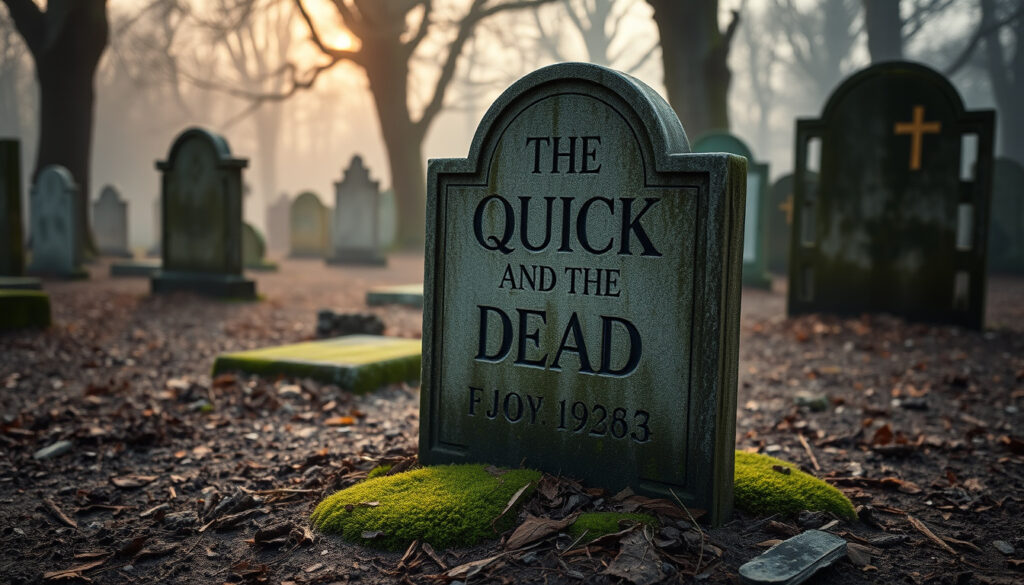
The Quick and the Dead – Meaning, Origin and History
What Does “The Quick and the Dead” Mean?
The phrase “the quick and the dead” is an English idiom that contrasts two groups: those who are living and those who have died. The word “quick” in this context does not mean fast or speedy, as it commonly does in modern English. Instead, it carries an older meaning derived from Old English, where “quick” referred to anything that is alive or living.
This contrast between the living and the departed forms the core meaning of the expression. The phrase appears most prominently in religious texts and statements of faith, where it often relates to themes of divine judgment and resurrection. Understanding the original meaning of “quick” is essential to grasping why this phrase has persisted for centuries in English language and literature.
In contemporary usage, the phrase retains its archaic flavor and appears most often in connection with its historical and religious roots, though it has also been adopted as a title for various works of fiction and film.
“Quick” = living/alive; the phrase contrasts those who are alive with those who are dead
Biblical references (Nahum 1:15) and the Apostles’ Creed
Film titles (1995 Western by Sam Raimi), literature, and religious contexts
“Quick” derives from Old English “cwic,” meaning alive or living
Key Insights on the Phrase
- The word “quick” originally meant “alive” in Old English and Middle English, preserving the sense of living flesh or a living creature
- The phrase appears in the Apostles’ Creed, where it refers to God’s role in judging both the living and the dead
- Biblical appearances in the Book of Nahum and the Book of Acts establish the religious foundation of the expression
- Modern confusion often arises because “quick” now predominantly means fast rather than alive
- The phrase has been adopted for popular media, most notably the 1995 Western film directed by Sam Raimi
- Related expressions include “cut to the quick,” which refers to reaching the living tissue beneath the nail
- The Apostles’ Creed dates to approximately the second century A.D. in its earliest forms
Snapshot of Key Terms
| Term | Old Meaning | Modern Meaning | Source |
|---|---|---|---|
| Quick | Alive/living | Fast | Bible/Old English |
| Dead | Corpse/departed | Same | Universal |
| Phrase Context | Judgment/living vs dead | Various | Creed/Films |
Many modern readers assume “quick” refers to speed when encountering this phrase. This confusion stems from the natural evolution of the English language, where the original meaning of “quick” as “alive” has largely been replaced by the sense of rapid movement. In the phrase “the quick and the dead,” the original meaning is preserved precisely because the expression has remained tied to its religious and archaic contexts.
Where Does the Phrase “The Quick and the Dead” Come From?
Biblical Origins
The phrase “the quick and the dead” traces its origins to biblical texts. The most frequently cited appearance comes from the Book of Nahum, chapter 1, verse 15, which in the King James Version reads: “Behold, upon the mountains, the feet of him that bringeth good tidings, that publisheth peace! O Judah, keep thy solemn feasts, perform thy vows: for the wicked shall no more pass through thee; he is utterly cut off.”
While the specific wording “the quick and the dead” does not appear verbatim in this passage, the concept of God’s judgment extending to both living and deceased individuals runs throughout Scripture. The Book of Acts 10:42 provides a clearer biblical foundation, where it states that Jesus is the one appointed by God to judge “the quick and the dead.”
According to etymological sources, the word “quick” derives from the Old English term “cwic,” which meant alive or living. This same root appears in related words like “quicken,” which historically meant to give life or to come to life.
The Apostles’ Creed Connection
The phrase appears most prominently in the Apostles’ Creed, one of the oldest and most widely used statements of Christian faith. The creed includes the line: “He ascended into heaven, and sitteth at the right hand of God the Father Almighty; from thence he shall come to judge the quick and the dead.”
The Apostles’ Creed developed from early interrogations of catechumens—persons receiving instruction for baptism—by bishops during the second century A.D. The Old Roman Creed, an early version, was in use as early as the second century. Some researchers suggest origins in the baptismal confession of Hippolytus of Rome (170-235).
In its present form, the Apostles’ Creed dates to approximately the eighth century. It reached its final form in southwestern France in the late sixth or early seventh century and was officially recognized by Charlemagne throughout the Frankish Empire in the early ninth century. By the time of Pope Innocent III (1198–1216), it was acknowledged as the official statement of faith of the entire Catholic Church in the West.
Old English Etymology
The word “quick” in Old English—written as “cwic”—meant literally alive. This meaning persisted through Middle English and into Early Modern English. The term appeared in various compounds and expressions, including “quick with child,” meaning pregnant with a living child, and “the quick,” referring to living flesh.
Over time, the meaning of “quick” shifted in everyday usage. The sense of being alive became archaic, replaced almost entirely by the meaning of rapid or fast. However, the phrase “the quick and the dead” preserved the original meaning because of its repeated use in religious contexts and the persistence of the Apostles’ Creed in church services worldwide.
The word “quick” shares a linguistic root with the Latin “vivus” (living) and the Greek “zoe” (life). This connection explains why “quick” originally carried the meaning of alive or living, linking it to concepts of vitality and life force in older Indo-European languages.
The Quick and the Dead in Popular Culture
The 1995 Western Film
The phrase gained renewed popular attention through the 1995 Western film directed by Sam Raimi. Starring Sharon Stone, Gene Hackman, and Russell Crowe, the film is set in the American frontier and centers on a mysterious gunslinger known only as “The Stranger” who arrives in the town of Processing.
The film’s title references the biblical and creedal phrase, though its plot focuses on themes of revenge, justice, and survival in the violent world of the Wild West. Unlike the religious original, the film uses the title metaphorically to suggest the confrontation between the living and those marked for death.
The movie was released by Columbia Pictures and received mixed reviews upon its initial release but has since developed a cult following. Its cast includes several actors who would later achieve major stardom, including Russell Crowe, who won an Academy Award for Gladiator just five years later.
Other Cultural References
Beyond the 1995 film, the phrase has appeared as a title in various contexts. A television film adaptation was produced in 1987, predating the more famous theatrical release. The title has also appeared in various works of fiction, video games, and other media, typically chosen for its dramatic weight and archaic quality.
The enduring appeal of the phrase in popular culture likely stems from its dramatic contrast and its association with ultimate judgment or reckoning. Whether used in Westerns, horror stories, or works of fiction dealing with mortality, the expression carries connotations of finality and the boundary between life and death.
The use of “the quick and the dead” as a film title creates an interesting tension between its serious religious origins and genre entertainment. Viewers unfamiliar with the biblical meaning may not immediately connect the Western film to its source, while those aware of the phrase’s history may appreciate the ironic contrast of applying sacred language to violent genre storytelling.
Timeline of Key Events
The history of the phrase “the quick and the dead” spans more than a millennium, from the earliest uses of Old English through its appearance in canonical religious texts to its adoption in modern popular media.
- Before 1000 A.D. — Old English “cwic” enters common usage, meaning alive or living. The root appears in various compounds and expressions throughout Anglo-Saxon texts.
- Circa 390 A.D. — The Apostles’ Creed in its early form includes the phrase “judge the quick and the dead” as part of its statement about Christ’s return and divine judgment.
- 1611 — The King James Version of the Bible is published, including passages that reference judgment of the quick and the dead, particularly in Acts 10:42.
- 1987 — A television film titled “The Quick and the Dead” is produced, predating the more widely known theatrical release.
- 1995 — Sam Raimi directs the theatrical Western film “The Quick and the Dead,” starring Sharon Stone, Gene Hackman, and Russell Crowe, bringing the phrase to a new generation of viewers.
What Is Established and What Remains Unclear
Established Information
- The word “quick” originally meant alive in Old English
- The phrase appears in the Apostles’ Creed
- Biblical references to judgment of quick and dead exist in Acts 10:42
- The Apostles’ Creed dates to approximately the second century A.D.
- Various media have used the phrase as a title
Areas of Uncertainty
- The exact first use of the phrase outside of religious texts
- When the phrase began appearing in secular contexts
- The precise path of linguistic evolution from “cwic” to modern usage
- Whether specific colloquial uses predate the Creed’s widespread adoption
The Phrase in Context: Why It Persists
The survival of “the quick and the dead” as a recognizable expression reflects several factors. First, the persistence of the Apostles’ Creed in regular liturgical use means that congregations worldwide continue to encounter the phrase in its original religious context. The creed is recited in Roman Catholic, Anglican, and many Protestant churches, maintaining awareness of the expression among believers.
Second, the dramatic quality of the phrase—the stark contrast between life and death—makes it appealing for literary and artistic use. The expression carries inherent weight and finality, making it suitable for titles, dramatic works, and works dealing with mortality.
Third, the semantic tension created by the modern meaning of “quick” (fast) versus its historical meaning (alive) adds an element of linguistic intrigue that keeps the phrase interesting to those who encounter it. The potential for misunderstanding encourages learning about etymology and the evolution of language.
Sources and Quotes
“He ascended into heaven, and sitteth at the right hand of God the Father Almighty; from thence he shall come to judge the quick and the dead.”
— Apostles’ Creed
“And he commanded us to preach unto the people, and to testify that it is he which was ordained of God to be the Judge of quick and the dead.”
— Acts 10:42, King James Version
“Quick, adj. Old English cwic ‘alive,’ from Proto-Germanic *kwikwaz, from PIE *gweikw- ‘to live.'” (Etymonline)
Summary
The phrase “the quick and the dead” preserves an archaic meaning of the word “quick” that has largely disappeared from everyday English. In this context, “quick” means living or alive, contrasting those who are alive with those who have died. The expression finds its primary foundation in biblical texts and the Apostles’ Creed, where it describes divine judgment that encompasses both the living and the dead.
The survival of this archaic usage demonstrates how set phrases can preserve linguistic features long after they have fallen out of general circulation. While modern speakers typically use “quick” to mean fast or rapid, the expression continues to carry its historical meaning because of its repeated use in religious contexts.
The phrase has also found renewed life in popular culture, most notably through the 1995 Western film directed by Sam Raimi. This adoption demonstrates how traditional language can be adapted for new contexts while retaining its dramatic and evocative qualities. For those interested in exploring related cultural phenomena, the concept of angel numbers offers another fascinating intersection of spiritual symbolism and modern interpretation. 666 Angel Number Meaning
Frequently Asked Questions
What is the etymology of the phrase “the quick and the dead”?
The phrase combines the archaic meaning of “quick” (from Old English “cwic,” meaning alive) with “the dead” to describe the contrast between living and departed individuals. The expression appears in the Apostles’ Creed and biblical texts.
What does “quick” mean in “the quick and the dead”?
In this phrase, “quick” means alive or living. This was the original meaning of the word in Old English and Middle English. The modern meaning of “quick” as fast or rapid developed later and largely replaced the original sense.
Is “the quick and the dead” from the Bible?
Yes, the phrase appears in biblical contexts. Acts 10:42 states that Jesus was ordained to judge “the quick and the dead.” The concept also appears in the Apostles’ Creed, which draws from biblical teachings.
What movies are titled “The Quick and the Dead”?
The most famous film with this title is the 1995 Western directed by Sam Raimi, starring Sharon Stone, Gene Hackman, and Russell Crowe. A television film with the same title was also produced in 1987.
Where does the word “quick” come from?
“Quick” derives from the Old English word “cwic,” meaning alive or living. This in turn comes from Proto-Germanic *kwikwaz, which is related to the PIE root *gweikw- meaning to live.
How is “the quick and the dead” used in the Apostles’ Creed?
The Apostles’ Creed states that Christ “shall come to judge the quick and the dead,” referring to God’s judgment that will encompass both living people and those who have already died.
What is the difference between “quick” in modern English and in this phrase?
In modern English, “quick” typically means fast or rapid. In “the quick and the dead,” it retains the archaic meaning of alive or living. This difference often causes confusion for modern readers encountering the phrase for the first time.
Are there any related phrases that use “quick” in the old sense?
Yes, the expression “cut to the quick” refers to cutting to the living tissue beneath a fingernail or toenail. The phrase preserves the original meaning of “quick” as living flesh. Historical phrases like “quick with child” (meaning pregnant) also used this archaic sense.
More related posts
 666 Angel Number Meaning – Balance, Love and Spiritual Harmony
 50 Pounds to NZD: Convert GBP to NZD Today [Current Rate]
 Galaxy M53 5G Review: Worth Buying in 2025
 Phone Case with Card Holder: Pros, Cons, and Safety Tips
 Nelson Police News Today – Key Incidents and Road Updates
 What’s Open on Good Friday 2026? Shops, Pubs & More
 Sweet and Sour Chicken Recipe: Easy, Crispy, and Authentic
 Happy Birthday in German: Phrases, Cards & the Birthday Song
