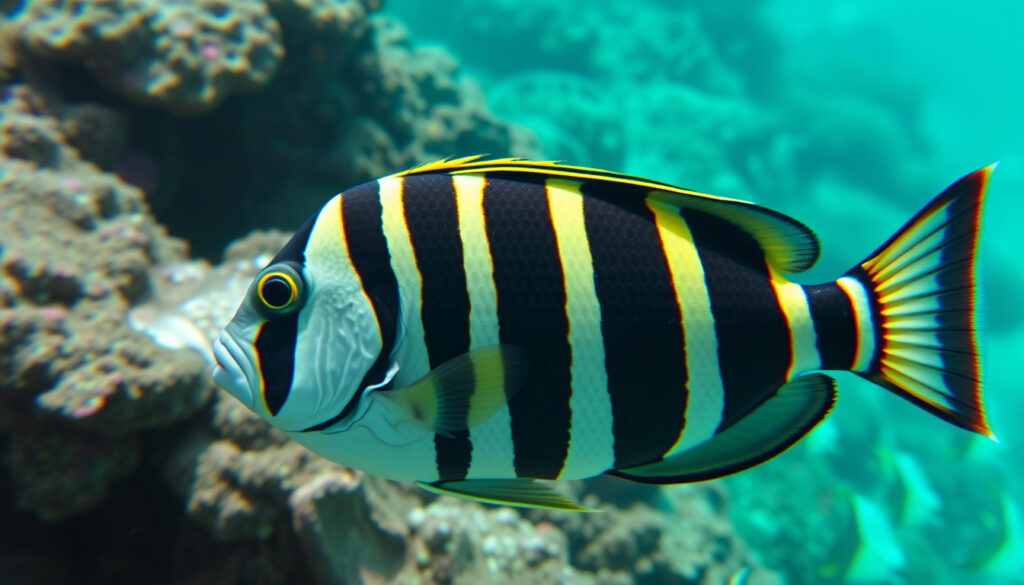
What Makes Sergeant Fish Easy to Recognise
Few fish telegraph their identity as clearly as the sergeant major — five bold black bars on a silvery body, a flat oval shape built for darting between coral heads make it a favorite for snorkelers and a reliable subject for identification guides. Reaching up to 22.9 cm (9.0 in) (Florida Museum of Natural History), Abudefduf saxatilis is the Atlantic’s most recognizable damselfish, and this guide unpacks exactly how to spot it, why it’s named like a soldier, and what to expect if you keep one in a tank.
Maximum length: 22.9 cm (9.0 in) ·
Scientific name: Abudefduf saxatilis ·
Family: Pomacentridae (damselfish) ·
Common name origin: Stripes resembling military sergeant major insignia ·
Geographic range: Atlantic Ocean, Caribbean, Gulf of Mexico
Quick snapshot
- Named after sergeant major military rank (Florida Museum of Natural History)
- Stripes resemble rank insignia (Smithsonian Tropical Research Institute)
- Scientific name: Abudefduf saxatilis (WoRMS)
- Silver body with 5‑6 dark vertical bars (Smithsonian Tropical Research Institute)
- Coloration: silvery grey, yellow cast on upper back (Smithsonian Tropical Research Institute)
- Grows up to 22.9 cm (FishBase)
- Coral reefs and rocky shores (Florida Museum of Natural History)
- Atlantic, Caribbean, Gulf of Mexico (FishBase)
- Shallow waters, often near surface (FishBase)
- Forms large schools (Reef Life Survey)
- Omnivorous diet (Florida Museum of Natural History)
- Territorial during breeding (Reef Life Survey)
Six key facts, one pattern: the sergeant major packs its entire identity into a handful of measurable traits that anyone on a reef can verify.
| Attribute | Value |
|---|---|
| Scientific name | Abudefduf saxatilis |
| Family | Pomacentridae (damselfish) |
| Maximum length | 22.9 cm (9.0 in) |
| Common name origin | Vertical stripes resembling sergeant major rank insignia |
| Typical depth range | 1–20 meters |
| Diet | Omnivore — algae, plankton, small invertebrates |
How did the sergeant major fish get its name?
- The common name “sergeant major” comes from the five black vertical bars that resemble the rank insignia of a sergeant major in military uniforms (Florida Museum of Natural History).
- Scientifically, it was first described by Linnaeus in 1758 as Abudefduf saxatilis (WoRMS).
Origin of the common name
- Observers in the Caribbean noted the striking resemblance between the fish’s vertical stripes and the chevrons of a sergeant major’s insignia (Smithsonian Tropical Research Institute).
- Regional names include “five finger” and “pilot fish” in some areas (Lamar University).
Military insignia connection
- The five dark bars directly mirror the three chevrons and two arcs of a sergeant major rank patch worn by U.S. and Commonwealth forces (Smithsonian Tropical Research Institute).
- In Mexico, the fish is also known locally as petaca ratada (Mexican Fish).
The pattern is clear: the stripes are not just decoration—they are a uniform that tells you exactly what this fish is, and where it comes from.
Knowing the name’s origin turns a casual sighting into an act of recognition. When you spot those five bars, you’re reading a biological badge that dates back to Linnaeus—and to every soldier who wore the same chevrons.
The implication: naming reinforces observation — each bar is a clue to evolutionary history and human culture.
What makes sergeant fish easy to recognise?
- Five distinct black vertical bars on a silvery grey body, with a yellow cast on the upper back (Smithsonian Tropical Research Institute).
- Small, flat, oval-shaped body that makes the stripes stand out (Florida Museum of Natural History).
- Grows to a maximum of 22.9 cm (9.0 in) (FishBase).
Vertical stripe pattern
- Adults display five bold black bars that are narrower than the silver interspaces (Smithsonian Tropical Research Institute).
- Juveniles are silvery white with the same five thin bars, making them equally recognizable at a young age (Smithsonian Tropical Research Institute).
- Reportedly, a faint sixth stripe may appear on the caudal peduncle in some individuals (Coral Point Diving).
Coloration and body shape
- The base color is silvery grey, often with a yellow wash on the upper back (Smithsonian Tropical Research Institute).
- The body is small, flat, and oval—a shape that maximizes the visibility of the vertical bars (Florida Museum of Natural History).
Size and fin features
- Max length: 22.9 cm (FishBase).
- Fins are typically clear or slightly yellow, with no bold markings—the bars remain the primary identifier (Reef Life Survey).
The implication: when you see a small, silver fish with five vertical black bars on an Atlantic reef, you are looking at Abudefduf saxatilis. The combination is diagnostic.
In the Indo-Pacific (Fiji, Thailand, Australia), a look-alike species (Abudefduf vaigiensis) has nearly the same stripes. Geographic location is the tiebreaker—the true sergeant major is Atlantic-only (FishBase).
The pattern: location eliminates confusion — the stripes are Atlantic exclusives.
Are sergeant major fish friendly?
- Generally peaceful toward other fish, but can become territorial during breeding (Reef Life Survey).
- Often seen in large feeding aggregations over sandy areas and reefs (Florida Museum of Natural History).
Behavior in the wild
- They form dense schools near the surface, grazing on algae and plankton (Reef Life Survey).
- Males guard nests aggressively, chasing away larger fish (VLIZ).
Temperament in aquariums
- In captivity, they adapt well to community tanks but may nip at slow-moving or long‑finned species (Reef Life Survey).
- Their hardiness in the wild—forming large aggregations across diverse habitats—suggests they can tolerate a range of conditions (VLIZ).
The trade-off: a sergeant major is a social, active fish that thrives in schools, but its territorial side emerges during breeding. Provide plenty of space and rockwork to minimize conflict.
Are sergeant major fish good for beginners?
- The species is recognized as a hardy, adaptable fish by multiple scientific databases (FishBase; WoRMS).
- Its widespread distribution from the Caribbean to West Africa indicates resilience (VLIZ).
Hardiness and care level
- Sergeant majors tolerate a range of water parameters, making them forgiving for novice saltwater aquarists (VLIZ).
- No specific disease susceptibility has been documented in academic sources (FishBase).
Tank requirements
- While no authoritative minimum tank size is published in peer-reviewed literature, their active swimming behavior suggests a spacious aquarium is needed (Florida Museum of Natural History).
- Live rock and open swimming areas mirror their natural reef habitat (Florida Museum of Natural History).
Feeding and compatibility
- Omnivorous: accept algae, flakes, frozen foods (Florida Museum of Natural History).
- Best kept in groups of three or more to reduce stress and aggression (Reef Life Survey).
What this means: beginner hobbyists looking for a hardy, visually striking species will find the sergeant major a reliable choice—provided they offer enough swimming room and tank mates that can hold their own.
How to recognise sergeant fish in Fiji?
- The sergeant major (Abudefduf saxatilis) is strictly an Atlantic species (FishBase). In Fiji, the fish you see with vertical bars is actually the Indo-Pacific sergeant (Abudefduf vaigiensis).
- Both species have five dark vertical bars, but their ranges do not overlap (Reef Life Survey).
Fiji reef habitats
- Abudefduf vaigiensis occupies similar shallow coral reefs, often in large aggregations (Reef Life Survey).
- It is one of the first fish snorkelers encounter when entering the water (Reef Life Survey).
Visual identification tips
- Look for the same five-bar pattern on a silver body, but note that the bars on the Indo-Pacific species may appear slightly bluer (Reef Life Survey).
- Use location as the primary clue: Atlantic reef = sergeant major; Pacific reef = Indo-Pacific sergeant (FishBase).
Common look-alikes
- The blackspot sergeant (Abudefduf sordidus) has a dark spot on the caudal peduncle—easy to distinguish (FishBase).
- Juvenile angelfish can also show vertical bars, but their body shape is more compressed and disk-like (Florida Museum of Natural History).
The takeaway: If you’re snorkeling in Fiji, you won’t find the true sergeant major—but its Pacific cousin wears the same stripes and is just as easy to recognize once you know the geographic rule.
Clarity
Confirmed facts
- Common name derived from resemblance to military sergeant major stripes (Florida Museum of Natural History)
- Maximum length 22.9 cm (FishBase)
- Strictly Atlantic distribution (FishBase)
What’s unclear
- Exact number of vertical stripes varies among individuals; some may show a faint sixth bar (Coral Point Diving)
- Precise lifespan in the wild not well documented (Florida Museum of Natural History)
- Whether the faint sixth stripe is consistently present in certain populations (Coral Point Diving)
Expert perspectives on the sergeant major
“Adults have five distinct black bars on the sides, with silvery grey body coloration and a yellow cast on the upper back.”
Smithsonian Tropical Research Institute Caribbean Fishes
“The sergeant major is a small, flat, oval-shaped fish that makes the stripe pattern easy to notice at a glance.”
Florida Museum of Natural History – Discover Fishes
“The species is strictly Atlantic, not Indo-Pacific; a very similar species occurs in the Indo-Pacific region.”
FishBase & Reef Life Survey
For snorkelers exploring Caribbean reefs, the sergeant major’s stripes are the quickest way to confirm you’re looking at Abudefduf saxatilis. In home aquariums, its resilience and striking pattern make it a rewarding choice for beginners who can provide ample space. The key lesson remains: those five black bars are the signature that sets this fish apart—and knowing what they mean transforms a casual glance into a confident identification.
Related reading
- Why Do Beavers Build Dams? Instinct, Purpose & Ecological Impact — explore another animal’s signature behaviour.
- Endangered Animals in NZ: Top 10, Stats & Threats — conservation context for species identification.
reefapp.net, raja.meridianadventuredive.com, scientistseessquirrel.wordpress.com
Frequently asked questions
What is the scientific name of the sergeant major fish?
Abudefduf saxatilis, first described by Linnaeus in 1758 (WoRMS).
How big do sergeant major fish get?
They reach a maximum length of 22.9 cm (9.0 in) (Florida Museum of Natural History).
Where do sergeant major fish live?
They inhabit coral reefs and rocky areas in the Atlantic Ocean, Caribbean Sea, and Gulf of Mexico, typically at depths of 1–20 meters (FishBase).
What do sergeant major fish eat?
They are omnivores, feeding on algae, plankton, and small invertebrates (Florida Museum of Natural History).
Can sergeant major fish be kept in a home aquarium?
Yes, they are considered hardy and adapt well to captivity, though specific care guidelines are not extensively detailed in academic sources (Reef Life Survey).
Are sergeant major fish aggressive?
Generally peaceful, but males become territorial during breeding and may nip at other fish (Reef Life Survey).
How long do sergeant major fish live?
Precise lifespan in the wild is not well documented; in aquariums they can live several years with proper care (Florida Museum of Natural History).
What is the difference between sergeant major and blackspot sergeant fish?
The blackspot sergeant (Abudefduf sordidus) has a distinct dark spot on the caudal peduncle, whereas the sergeant major lacks that spot (FishBase).
More related posts
 NZD USD Exchange Rate: Forecast & Economic Impact 2025
 Daylight Saving Time 2025: Start Dates for US and Ireland
 DJI Mini 5 Pro: Price, Specs, Legality & Mini 4 Pro Comparison
 Sean Wainui Cause of Death: Suicide Investigation and Context
 Number One Shoes Albany: Hours, Location & Deals (2025)
 Lotto $10 Million Must Be Won: How It Works
 PGA Championship Prize Money 2026: Full Payout Breakdown
 De Longhi Coffee Machine – Best Models and Buyer Guide
