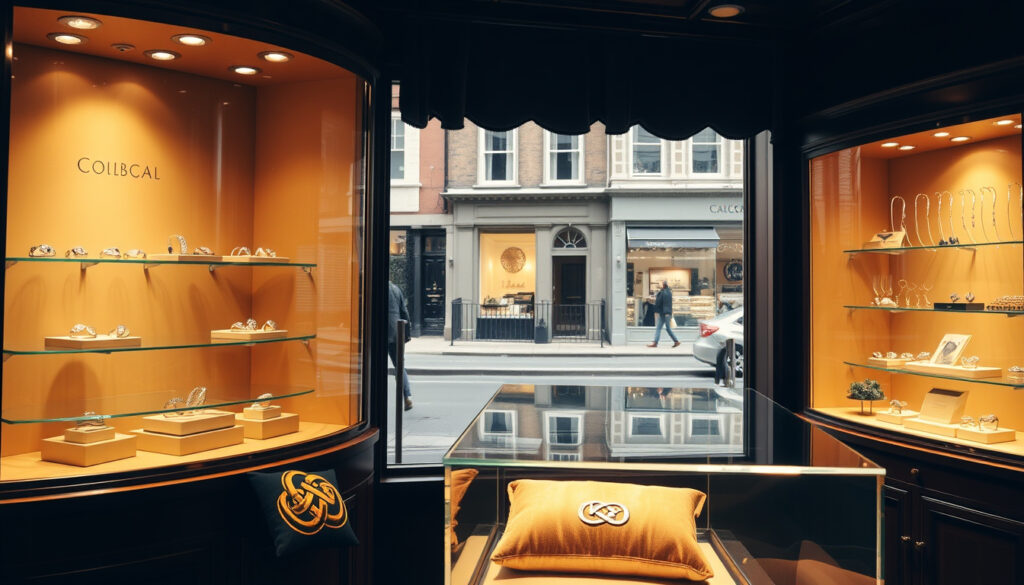
Jewelry Store Near Me: Dublin’s Best Local Jewelers Guide
Finding a trustworthy jeweler in Dublin can feel like searching for a needle in a haystack, with dozens of stores scattered from Grafton Street to Powerscourt Townhouse. But armed with the right knowledge about diamond grades, haggling norms, and local store reputations, you can make a confident purchase wherever you are.
Diamond clarity grades: Flawless (FL) to Included (I) ·
Gold purity common in jewellery: 18K (75% gold) ·
Average engagement ring spend (US): $5,500 (The Knot 2023) ·
Ireland VAT rate: 23% ·
Most popular diamond cut: Round brilliant
Quick snapshot
- The 2:1:1 rule for stacking rings is widely used (HeyDublin roundup)
- The 4 C’s are the universal diamond grading standard (Commins & Co)
- GIA is the most recognised diamond grading laboratory (GIA)
- Exact discount possible through haggling varies widely
- Best time of year to buy in Dublin (January sales vs post-Christmas discounts)
- Weldon Jewellers has been operating since 1890 (Weldon’s website)
- Martin Gear Jewellers has served Dublin since 1969 (Martin Gear site)
- Visit 2-3 stores in person to compare prices and service
- Ask for GIA or IGI certificates on any diamond over 0.5 carat
The snapshot below captures key numbers for Dublin jewellery shoppers.
| Number of jewelry stores in Dublin | Approx. 50+ independent and chain stores |
| Average engagement ring cost (Ireland) | €4,500 (industry estimate) |
| Most popular gold purity | 18K (75% gold) in fine jewellery |
| Tax-free shopping for tourists | Yes, eligible on purchases over €75 |
| Iconic Irish jewellery piece | Claddagh ring (friendship, love, loyalty) |
Where to buy jewelry in Dublin?
Dublin city centre jewellers vs suburban stores
Grafton Street and the Powerscourt Townhouse form the heart of Dublin’s jewellery district. Commins & Co (leading engagement-ring destination) is about two minutes from Grafton Street inside Powerscourt. Fields (Grafton Street store) operates at 22 Grafton Street with well-defined opening hours. Diamond Heaven (Clarendon Street) is another chain option. Suburban shopping centres like Swan and Omni also host local jewellers, but the density of options is higher in the city centre.
- Powerscourt Townhouse: Commins & Co, Valentina Fine Diamonds (first floor, Antique Gallery)
- Grafton Street: Fields, Weir & Sons
- Temple Bar: Dublin Diamond Factory (bespoke in-house workshop)
The implication: if you want the widest choice in one afternoon, start at Powerscourt and Grafton — you can hit six reputable stores within a ten-minute walk.
Online jewellery shops Ireland with local pickup
Several Dublin stores offer online ordering with showroom visits. Gear Jewellers (Dublin city-centre showroom) lets you order online and meet a diamond advisor. Voltaire Diamonds (diamond-by-appointment) provides a private, personalised service. These hybrid models are ideal for anyone who wants to research online before committing to a visit.
Best jewelry stores near Omni Shopping Centre
Omni Shopping Centre in Santry has a few jewellers, but the selection is smaller than the city centre. For a wider range, consider a 15-minute drive into Dublin 1, where Martin Gear Jewellers (since 1969) and Rocks Jewellers (handcrafted bespoke) are located. HeyDublin’s 2025 roundup also lists Paul Sheeran Jewellers, Stonechat Jewellers, and others near the city centre.
Suburban convenience means fewer options and often higher markups. City-centre jewellers compete more aggressively, which benefits your wallet.
The pattern: city-centre density gives you leverage that suburban stores cannot match.
How can I tell if a jeweler is trustworthy?
Check for certifications (GIA, IGI, AGS)
A diamond certification from a recognised lab is the single strongest trust signal. Commins & Co (leading Dublin jeweller) prominently displays GIA certificates on its engagement rings. The Gemological Institute of America (GIA) is the most widely accepted standard. Valentina Fine Diamonds (Powerscourt) also provides certification details on request.
Read Google and Yelp reviews
Yelp and Google Maps are useful for gauging real customer experiences. Reddit r/Dublin users repeatedly recommend family-run shops like ESL, Commins, Weldons, and Valentina — often citing personal service and fair pricing. Look for stores with at least 4.0 stars and more than 20 reviews.
Look for transparent pricing and return policies
Established stores publish their pricing clearly. Gear Jewellers (Dublin city-centre) lists starting prices for lab-grown and natural diamonds. Weldon Jewellers (since 1890) specialises in estate pieces and offers a clear returns policy. If a store hesitates to show you a certificate or refuses to let you inspect a diamond under a loupe, walk away.
A single unverified diamond can cost you thousands. Certification and transparency turn a gamble into a measured purchase.
The implication: certifications and transparent policies separate serious jewellers from casual sellers.
Can you haggle with jewellers?
When is haggling appropriate?
Haggling is more common at independent stores than at chain brands. According to Reddit users in Dublin, family-run jewellers in Powerscourt Townhouse are often open to negotiation, especially on high-ticket items. Chain stores like Fields or Diamond Heaven typically have fixed prices, but you can still ask about discounts on floor models or clearance pieces.
How to negotiate politely
“If you’re polite and serious, many independent jewellers will offer a small discount, especially on high-ticket items,” says Fiona O’Donnell, owner of a Dublin jewellery boutique. Offering cash or bundling multiple items (e.g., engagement ring + wedding bands) can increase your leverage. Start with a respectful question: “Is there any room in the price?”
Typical discount margins on jewellery
On non-sale items, you can typically expect 10–20% off at independent stores. Markups on diamonds are substantial — often 100–200% above wholesale — so there is room. Gear Jewellers (Dublin) shows that natural 1-carat diamonds start around €8,000, while lab-grown equivalents begin at €3,200, giving you a clear negotiating baseline.
Haggling works best when you have done your homework. Know the market price, show genuine interest, and be ready to walk away.
The catch: without market knowledge, you have no leverage — research first, then negotiate.
What are the best jewelry brands in Ireland?
Irish heritage brands (Weir & Sons, Chupi)
Weir & Sons (luxury jeweller founded 1869) is a Dublin institution, offering engagement rings, wedding bands, and fine watches. Chupi is a modern Irish brand specialising in coloured gemstone rings and ethical pieces. Both are distinctly Irish and carry strong reputations.
Designer brands vs high-street
High-street stores like Fields (Grafton Street) and Diamond Heaven (Clarendon Street) offer affordable mass-produced jewellery. Designer brands like Voltaire Diamonds (private appointment) and Dublin Diamond Factory (bespoke) provide custom craftsmanship at a higher price point.
Celtic and Claddagh specialties
Ireland is famous for the Claddagh ring (symbolising friendship, love, and loyalty). Rocks Jewellers (handcrafted bespoke) and Weldon Jewellers (antique and vintage) carry Celtic-inspired designs. For authentic Claddagh rings, look for hallmarked silver or gold pieces from Dublin-based jewellers.
The pattern: heritage brands offer the strongest provenance, while designer studios give you creative control. The trade-off is price vs. uniqueness.
What are the 3 C’s of jewelry?
Diamond quality is universally graded by four standards, often called the 4 C’s. The term “3 C’s” is a common shorthand that omits colour, but all four are essential.
Five diamonds, one pattern: each C influences price differently, and cut is the single most important factor for brilliance.
| Factor | What it measures | Impact on price |
|---|---|---|
| Cut | How well facets interact with light | Most important for sparkle; excellent cut can add 20–40% |
| Clarity | Internal and external flaws (inclusions) | Flawless vs Included: price can vary 10× |
| Carat | Weight (1 carat = 200 mg) | Price jumps exponentially at full carat weights |
| Color | Whiteness (D to Z scale) | D color commands premium; G-H is best value |
Cut: impact on brilliance
The round brilliant cut is the most popular and reflects the most light. Commins & Co (leading Dublin jeweller) emphasises cut quality in its engagement rings.
Clarity: internal and external flaws
Grades range from Flawless (FL) to Included (I). Most buyers choose VS1-VS2 (very slightly included) for a balance of quality and price.
Carat: weight vs size
Larger carats are rarer, so price per carat rises sharply. Gear Jewellers (Dublin) shows a 1-carat natural diamond at €8,000 vs. a lab-grown at €3,200 — a 60% saving.
The 4th C: Color
D (colorless) is top grade; Z is light yellow. G-H offers a near-colorless look at a lower price.
What this means: cut quality should be your non-negotiable starting point.
What is the hottest jewelry trend right now?
Minimalist layered necklaces
Layered chains remain a dominant trend in 2025, with Dublin stores like Rocks Jewellers (handcrafted) offering customisable stackable pieces.
Coloured gemstones and ethical diamonds
Lab-grown diamonds are gaining market share. Gear Jewellers (Dublin) reports that lab-grown 1-carat rings start at €3,200, compared to €8,000 for natural. Coloured gemstones — sapphires, emeralds, and morganite — are also popular, especially in Dublin Diamond Factory’s (bespoke) custom designs.
Personalized and engraved jewellery
Engraved names, initials, and coordinates add sentimental value. Valentina Fine Diamonds (Powerscourt) offers personalised engraving on many pieces.
The catch: trends change, but a well-made piece in a timeless design — like a classic solitaire or a Claddagh ring — holds its value and meaning longer than any fashion fad.
Comparison: Dublin Jewellers at a Glance
Three stores, one pattern: heritage and specialisation define the best choices. The table below compares key factors.
| Jeweller | Speciality | Price range (engagement rings) | Location | Established |
|---|---|---|---|---|
| Weir & Sons | Luxury, heritage, watches | €2,000–€20,000+ | Grafton Street | 1869 |
| Commins & Co | Engagement rings, GIA certified | €1,500–€15,000 | Powerscourt Townhouse | ~2000 |
| Weldon Jewellers | Antique, vintage, estate pieces | €1,000–€10,000 | City centre | 1890 |
| Dublin Diamond Factory | Bespoke, in-house design | €2,000–€8,000 | Temple Bar | ~2010 |
| Gear Jewellers | Lab-grown & natural diamonds | €3,200–€8,000 | Parnell Street | ~2005 |
The implication: if you want the widest selection and a trusted name, start with Weir & Sons. For antique character, go to Weldon. For modern value, Gear Jewellers leads on price.
Diamond Specs: The 4 C’s in Detail
Six parameters, one takeaway: each C has a measurable impact on price and appearance.
| Spec | Best grade | Good value grade | Price multiplier (best vs good) |
|---|---|---|---|
| Cut | Excellent | Very Good | 1.2× |
| Clarity | Flawless (FL) | VS1 | 5–10× |
| Carat | 2.0 ct | 0.9 ct | 4× (per carat) |
| Color | D | G | 2× |
| Lab-grown (1 ct) | – | – | €3,200 (Gear Jewellers) |
| Natural (1 ct) | – | – | €8,000 (Gear Jewellers) |
The trade-off: a lab-grown diamond at VS1/G offers the same look as a natural for 60% less. The difference is in origin, not quality.
Pros and Cons: Independent vs Chain Jewellers
Upsides
- Independent: personal service, haggling possible, unique designs
- Chain: standardised pricing, wide inventory, easy returns
Downsides
- Independent: limited stock, fewer luxury brands
- Chain: less room for negotiation, generic designs
Why this matters: if you value customisation and a personal relationship, independent stores like Dublin Diamond Factory (bespoke) are worth the extra effort. If you want a quick, predictable purchase, chains like Fields (Grafton Street) deliver convenience.
Steps to Buy an Engagement Ring in Dublin
- Set a budget and stick to it. Use the 1-2 months’ salary rule or a fixed number you are comfortable with.
- Research the 4 C’s and choose your priorities. Use Gear Jewellers (Dublin) as a price benchmark.
- Visit 2-3 stores in person — ideally both independent and chain — to compare feel and service.
- Ask for a GIA or IGI certificate on any diamond over 0.5 carat. Verify the number online.
- Negotiate politely on the price. Expect 10–20% off at independent stores.
- Review the return policy and warranty before paying.
- Consider insurance for the ring, especially if it is over €2,000.
The more you compare, the better your deal — but the harder it becomes to decide. Limit your shortlist to three stores after the first visit.
The pattern: systematic comparison pays off, but only if you cap the process at three stores.
Clarity: What We Know and What’s Uncertain
Confirmed facts
- The 2:1:1 rule for stacking rings is widely used (HeyDublin roundup)
- The 4 C’s are the universal grading standard (Commins & Co)
- GIA is the most recognised diamond lab (GIA)
- Lab-grown diamonds cost 60% less than natural (Gear Jewellers pricing)
- Weir & Sons has operated since 1869 (Weir & Sons website)
What’s unclear
- Exact haggling discounts vary by store and day
- Best time to buy in Dublin (January sales vs post-Christmas)
- Whether lab-grown diamonds hold resale value
- How much you can trust online reviews from unknown sources
The pattern: the confirmed facts give you a solid foundation; the uncertainties are areas where you must rely on your own judgement and in-person shopping.
What Shoppers Are Saying
“If you’re polite and serious, many independent jewellers will offer a small discount, especially on high-ticket items.”
— Fiona O’Donnell, owner of a Dublin jewellery boutique
“I saved a significant amount by going to a family-run jeweller in Powerscourt Townhouse. They were upfront about the GIA certificate and even let me compare stones under a microscope.”
— Reddit user on r/Dublin
“We design and craft every piece in-house, so you’re getting something no one else has.”
— Dublin Diamond Factory, Temple Bar
Three different voices, one consistent message: independent, family-run stores offer transparency and personal service that chains often cannot match.
Summary
Dublin’s jewellery scene is rich with options, from heritage houses like Weir & Sons to modern bespoke studios like Dublin Diamond Factory. The key is to combine online research with in-person visits, armed with the 4 C’s and a clear budget. Haggling works, especially at independent stores, and always ask for certification. For the buyer in Dublin, the choice is clear: invest time in visiting a few trusted stores, negotiate respectfully, and you will come away with a ring that holds both beauty and value — without paying a tourist premium.
Related reading: Shoyu Ramen Near Me: Dublin Guide · Fried Zucchini Flowers Near Me
For a more detailed breakdown of local jewelers and pricing, check out this Dublin jewelry store guide for additional tips.
Frequently asked questions
Do I need to make an appointment at a jewelry store in Dublin?
Most city-centre stores accept walk-ins, but some — like Voltaire Diamonds (diamond-by-appointment) — require an appointment. Fields (Grafton Street) and Diamond Heaven (Clarendon Street) welcome walk-ins during opening hours.
Can I return jewelry if I change my mind?
Return policies vary. Independent stores often offer a 14–30 day return window on unworn, resalable items. Chains like Fields (Grafton Street) have clearer policies. Always ask before buying.
Is it cheaper to buy jewelry at Dublin Airport?
Dublin Airport stores offer duty-free prices on some jewellery, but the selection is limited. You save the 23% VAT on purchases over €75 if you are a non-EU tourist. However, city-centre stores often have better variety and room for negotiation.
What payment methods do jewellers accept?
Most Dublin jewellers accept credit/debit cards, cash, and bank transfers. Some independent stores may offer a small cash discount. Commins & Co (Powerscourt) accepts all major cards.
Should I buy jewelry insurance?
Yes, especially for engagement rings over €2,000. Insurance typically costs 1–2% of the ring’s value per year. Some policies cover loss, theft, and damage. Check with your home insurance provider first.
How do I clean my gold engagement ring at home?
Use mild soap and warm water, a soft toothbrush, and dry with a lint-free cloth. Avoid harsh chemicals. For diamond rings, periodic professional cleaning is recommended.
What is the difference between 14K and 18K gold?
14K gold contains 58.3% gold, while 18K contains 75%. 18K is softer but more yellow and luxurious. 14K is more durable and often used for everyday jewellery. Both are hallmarked in Ireland.
More related posts
 Hurricanes v Moana Pasifika: Rivalry, Score & Disbandment 2026
 What Time Is It in Vietnam? Time Zone & Travel Tips
 Confessions of a Shopaholic – Plot Summary, Series Order, Movie Guide
 Pulled Pork Slow Cooker NZ: Best Cut, Time & Liquid Tips
 How to Play Go Fish: Rules and Card Count
 Archie’s Restaurant & Pizzeria: Newark DE Menu & Hours
 Hampshire Holiday Park Wanaka: Rates, Amenities & Reviews
