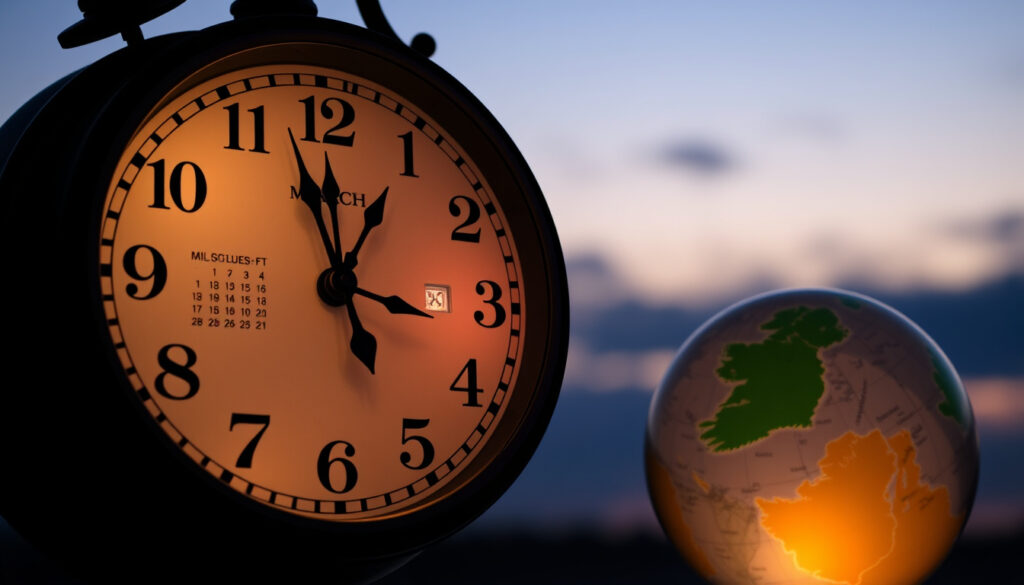
Daylight Saving Time 2025: Start Dates for US and Ireland
For many of us, the Sunday morning clock change brings a mix of confusion and grogginess — losing an hour of sleep can throw off your entire week. In 2025, daylight saving time begins on March 9 in the United States and March 30 in Ireland, three weeks apart. Whether you’re planning travel or just don’t want to be late for Monday’s meeting, knowing the exact dates and times helps you stay ahead of the change.
DST start in US (2025): March 9, 2025 · DST end in US (2025): November 2, 2025 · DST start in Ireland (2025): March 30, 2025 ·
DST end in Ireland (2025): October 26, 2025 · Countries without DST: Japan, China, India, Russia (most), and others ·
Sleep lost at spring forward: 1 hour
Quick snapshot
- US DST starts March 9 at 2:00 a.m. (Time and Date — official timekeeping reference)
- Ireland DST starts March 30 at 1:00 a.m. (RTÉ News — Irish state broadcaster)
- US DST ends November 2, 2025 (Time and Date — US time change data)
- Ireland DST ends October 26, 2025 (time.is — world clock data)
- Whether the US will permanently adopt DST — Sunshine Protection Act not enacted (Time and Date)
- Exact health impacts of the hour shift vary by individual (CDC — US public health agency)
- DST rules for US territories like Puerto Rico and Guam (Time and Date)
- US DST lasts 8 months — prepare for later sunsets (Time and Date)
- EU may end seasonal clock changes — watch for 2026 updates (Science Insights — time-policy analysis)
Five key dates, one pattern: the US springs forward three weeks earlier than Ireland, while both fall back in late autumn. Here’s a quick reference table that summarises the data.
| Fact | Value |
|---|---|
| US DST Start 2025 | March 9, 2:00 a.m. |
| US DST End 2025 | November 2, 2:00 a.m. |
| Ireland DST Start 2025 | March 30, 1:00 a.m. |
| Ireland DST End 2025 | October 26, 2:00 a.m. |
| Countries without DST | Japan, China, India, Russia, and others |
When does daylight savings start in the US in 2025?
Daylight saving time in the United States begins on Sunday, March 9, 2025. At 2:00 a.m. local standard time, clocks spring forward to 3:00 a.m., shifting an hour of daylight from morning to evening (Time and Date — official timekeeping reference).
What time exactly do clocks spring forward?
- The change happens at 2:00 a.m. local standard time — not 12:00 a.m. or at sunrise.
- For most of the US, that means 2:00 a.m. becomes 3:00 a.m. instantly.
This rule applies to all US states that observe DST, with the exception of Hawaii and most of Arizona (Time and Date).
When does DST end in the US in 2025?
The official end of daylight saving time in the United States is Sunday, November 2, 2025, at 2:00 a.m. local time. Clocks fall back one hour to 1:00 a.m., restoring standard time (Time and Date — US time change data).
The pattern: DST runs from the second Sunday in March to the first Sunday in November, covering about eight months of the year.
For US residents, the March 9 change means darker mornings and lighter evenings for seven months. Commuters and parents of school-age children feel the shift most — sunrise moves past 7:30 a.m. across much of the country.
When does daylight savings start in Ireland in 2025?
Ireland springs forward on Sunday, March 30, 2025. At 1:00 a.m. local time, clocks move ahead to 2:00 a.m., marking the start of Irish “summer time” (RTÉ News — Irish state broadcaster).
Do clocks go forward in Ireland tonight?
Yes — on the night of Saturday, March 29, going into Sunday, March 30, clocks advance by one hour before 1:00 a.m. arrives. By Sunday morning, the sun will rise an hour later.
When do the clocks change in Ireland for 2025?
- Spring forward: March 30, 2025 (1:00 a.m. → 2:00 a.m.)
- Fall back: October 26, 2025 (2:00 a.m. → 1:00 a.m.)
Ireland follows the EU directive that clocks change on the last Sunday of March and the last Sunday of October (Science Insights — time-policy analysis). Unlike the US, Ireland’s spring change occurs three weeks later, so March evenings in Dublin stay darker until the change.
Because Ireland shifts at 1:00 a.m. (not 2:00 a.m.), early-morning workers — think shift staff and overnight drivers — lose a full hour before midnight ends. The disruption hits a different schedule than in the US.
Do I lose an hour of sleep on Sunday?
Yes — on the day of the spring-forward change, you effectively lose one hour of clock time. If you normally sleep from 11:00 p.m. to 7:00 a.m., your Sunday night will be only six hours long (Time and Date).
Do I get an extra hour in bed on Sunday?
Only during the fall-back change in November or October. On March 9 (US) or March 30 (Ireland), you get one less hour — not one more.
What happens to sleep when clocks spring forward?
The US Centers for Disease Control and Prevention emphasizes a consistent sleep schedule and adequate sleep before the change to ease the adjustment (CDC — US public health agency). Studies show it can take three to five days for your body to fully adapt to the lost hour.
Many of us think of “spring forward” as just one lost hour — but the CDC warns the real toll is a disrupted circadian rhythm that lingers. The immediate sleep loss is only the start.
Until when is daylight saving time 2025 in the USA?
Daylight saving time in the United States lasts from March 9 to November 2, 2025 — a total of 34 weeks (Time and Date — US time change data). The final fall-back occurs at 2:00 a.m. on November 2.
When does DST end permanently?
There is no permanent end currently enacted. The Sunshine Protection Act, which would make DST year-round, has been proposed in the US Congress but has not been passed (Time and Date). As of early 2025, the legislation remains stalled.
Are there plans to end DST in the US?
Several states have passed resolutions to adopt permanent DST if federal law allows, but no change is expected for 2025. Hawaii and most of Arizona already opt out — they remain on standard time year-round (Time and Date).
When does daylight savings start 2026?
For those planning ahead, US DST in 2026 will begin on Sunday, March 8, and end on Sunday, November 1 (Time and Date — forward schedule). Ireland’s 2026 dates follow the same pattern: spring forward on March 29, fall back on October 25.
What are the DST dates for 2026 in US and Ireland?
- US: March 8 to November 1, 2026
- Ireland: March 29 to October 25, 2026
Is DST schedule the same every year?
Yes — the rule (second Sunday in March / first Sunday in November for the US; last Sunday in March / last Sunday in October for the EU) is fixed, so dates shift by a few days each year. The pattern remains consistent across jurisdictions.
Timeline: Key DST 2025 dates
- March 9, 2025 — US DST begins (spring forward) (Time and Date)
- March 30, 2025 — Ireland DST begins (spring forward) (RTÉ News)
- October 26, 2025 — Ireland DST ends (fall back) (time.is)
- November 2, 2025 — US DST ends (fall back) (Time and Date)
- March 8, 2026 — US DST begins next year (Time and Date)
Confirmed facts
- US DST starts March 9, 2025 (Time and Date)
- Ireland DST starts March 30, 2025 (RTÉ News)
- US DST ends November 2, 2025 (Time and Date)
- Ireland DST ends October 26, 2025 (time.is)
- Hawaii and most of Arizona do not observe DST (Time and Date)
What’s unclear
- Whether the US will adopt permanent DST — Sunshine Protection Act not enacted (Time and Date)
- Exact health recovery time varies by individual (CDC)
- If EU will abolish seasonal clock changes (Science Insights)
“In the United States, daylight saving time starts on Sunday, March 9, 2025, when clocks move forward from 2:00 a.m. to 3:00 a.m. local time.”
— Time and Date (official timekeeping reference)
“Ireland starts daylight saving time on Sunday, March 30, 2025, when clocks move forward by one hour at 1:00 a.m. to 2:00 a.m.”
— RTÉ News (Irish state broadcaster)
“The CDC recommends getting enough sleep and keeping a regular bedtime and wake time to help adjust to the time change.”
— Centers for Disease Control and Prevention (US public health agency)
The 2025 clock changes are set — but the wider debate around ending DST is far from over. For anyone in the US or Ireland, the spring-forward date is a concrete deadline: March 9 or March 30. Mark your calendar, adjust your sleep schedule a few days before, and accept that one hour will vanish. For travelers planning between the US and Europe, the three-week gap means double-checking meeting times in late March. The implication is clear: don’t rely on your phone alone — know the date, know the time, and plan for the lost hour.
en.wikipedia.org, abcnews.com, ozbrief.org, jump2eu.com, timein.org, notionnews.uk, en.wikipedia.org
Frequently asked questions
What time exactly do clocks spring forward?
In the US, clocks change at 2:00 a.m. local time. In Ireland, the change occurs at 1:00 a.m.
Do all US states observe DST?
No. Hawaii and most of Arizona do not observe DST. US territories like Puerto Rico also stay on standard time year-round.
Why do we have daylight saving time?
DST was originally introduced to make better use of daylight during longer summer days. Today it is standard practice in many countries, though it remains controversial.
Does my phone automatically update for DST?
Yes — modern smartphones and computers automatically adjust to local DST rules, provided your time zone is set correctly. Manual clocks still need to be changed.
How long does it take to adjust sleep after DST?
Most people adjust within a few days, though some may feel groggy for up to a week. The CDC recommends a consistent sleep schedule to ease the transition.
Is daylight saving time the same in the UK?
The UK follows the same EU schedule as Ireland: clocks change the last Sunday of March and last Sunday of October. UK dates for 2025 are identical to Ireland’s.
When does DST end permanently?
There is no permanent end in place. The US Sunshine Protection Act has not passed. The EU has discussed abolishing seasonal changes, but no new law is in effect.
When does daylight savings start 2026?
US DST 2026 starts March 8, ends November 1. Ireland DST 2026 starts March 29, ends October 25.
More related posts
 Hard Words to Spell: 100 Tricky Words, Categorized by Difficulty
 Road User Charges NZ: Costs, Who Pays & How to Buy RUC
 What’s Open on Good Friday 2026? Shops, Pubs & More
 Best 55-Inch TV in NZ: Buyers Guide & Prices 2025
 North Face Jacket NZ: Where to Buy, Prices & Best Picks
 Baradene College of the Sacred Heart: Fees, Ranking & Type
 Nilavuku En Mel Ennadi Kobam OTT Release on Prime Video
 Hard Floor Cleaning Christchurch: Costs and Expert Tips
