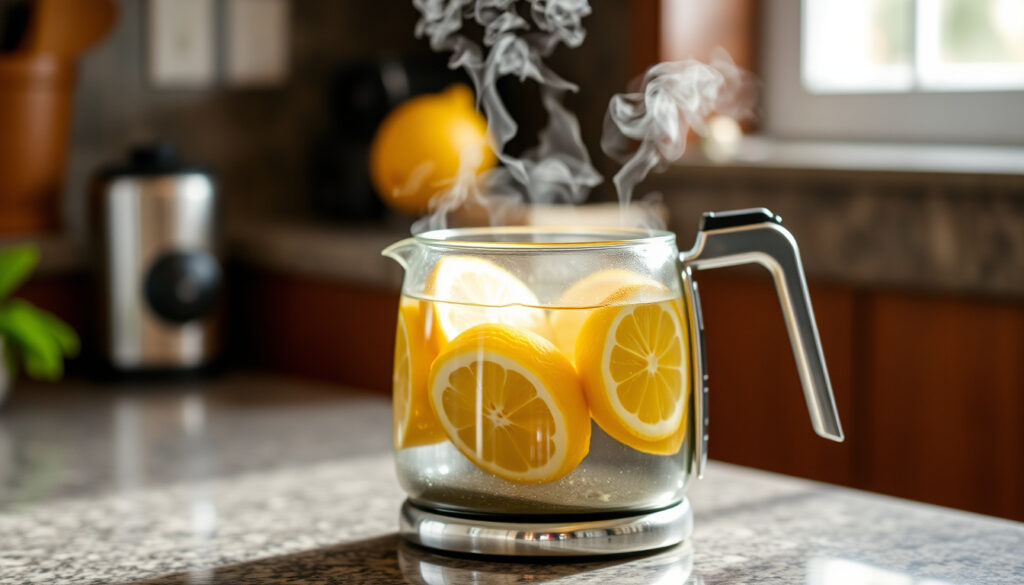
How to Descale a Kettle with Lemon: Easy Natural Steps
There’s a moment, right after the kettle clicks off, when you catch a chalky white crust at the bottom and realize your morning tea has been steeping against a mineral deposit — lemon juice fixes that without a chemical smell: its citric acid attacks limescale the same way the acids in Tefal’s kettle instructions do. The useful part is knowing which ratios actually work, which safety checks come first, and when lemon stops being enough.
Lemon’s active acid: citric acid (about 5%) ·
Limescale mineral: calcium carbonate ·
Common lemon ratio: about 1 part juice to 1 part water ·
Standard soak: up to 30 minutes after boiling
Quick snapshot
- Lemon juice contains citric acid, which reacts with the calcium carbonate in limescale. (Better Homes & Gardens Australia)
- Before any electric-kettle clean: unplug, cool, and never immerse the base (Bob Vila).
- Acid residue and smells clear with a fresh-water rinse and one re-boil after descaling (Bob Vila).
- Exact lemon-to-water ratios are not standardized across kettle manufacturers.
- Whether boiling lemon juice affects metal interiors over many cycles is not settled by published manufacturer data.
- Coke and Steradent claims for kettle descaling lack reliable comparative evidence.
- Fastest published route in this guide: citric acid at about 15 minutes (Tefal).
- Lemon soaks typically need up to 30 minutes to lift visible scale (Better Homes & Gardens Australia).
- Scale returns fastest in hard-water households — treat descaling as routine, not rescue (Tefal).
Nine small variables separate a clean kettle from a kettle that just smells like lemon.
| Variable | Value |
|---|---|
| Basic lemon recipe | About 1 part lemon juice to 1 part water |
| Bottled-juice dose | 1/4 cup bottled lemon juice + 1 cup water (Lowe’s) |
| Boil time | Bring the solution to a boil once, then switch off |
| Stand time | Up to 30 minutes; repeat the cycle if scale remains |
| Vinegar option | Equal parts vinegar and water (HG International) |
| Citric-acid route | 25 g citric acid in 0.5 L boiled water, left 15 minutes (Tefal) |
| Safety check | Unplug, cool, keep the base dry; never submerge electrical parts |
| Rinsing | Empty, rinse thoroughly, then boil fresh water once |
| Frequency | Monthly in hard-water households; less often with soft water |
Can you use lemon juice for descaling?
Yes — with two conditions: the scale has to be reachable, and the kettle has to accept acid cleaners.
Does lemon juice dissolve limescale?
- Lemon juice’s active acid is citric acid, a mild acid that reacts with the calcium carbonate in hard-water scale.
- Acid breaks the scale’s grip on the kettle wall; the loosened mineral can then be poured out with the solution.
- Because lemon is diluted, heavy buildup usually needs more than one pass or a stronger acid.
In chemistry terms, this is an acid–mineral reaction, not a cleaner that just masks buildup. It is also why acid-based descaling is the standard approach in most kettle care guides.
Is lemon juice safe for an electric kettle?
The compatibility answer is specific to your kettle. Home-improvement retailer Lowe’s warns that the appliance manual should be checked before using lemon juice or any acidic cleaner — and the electrical base must never be submerged (see the snapshot above).
Two rules apply across brands: unplug and cool before cleaning, and keep the heating base completely dry. If the manual says nothing about acid cleaners, the safest assumption is to skip lemon entirely.
How is lemon juice different from citric acid powder?
- Lemon juice is roughly 5% citric acid — effective for light buildup, slow on thick scale.
- Powdered citric acid is concentrated and nearly odorless; the key-facts table above shows the 25 g per 0.5 L route from Tefal.
Think of lemon as the convenience store of descaling and citric acid powder as the wholesale pack: both do the same chemistry, at very different speeds.
The trade-off is built in: lemon is the gentlest and best-smelling option, which is exactly why it needs more time when your water is hard.
How do you descale the inside of a kettle?
Start with the most useful ratio, then adjust for kettle size and scale thickness.
What is the basic lemon descaling ratio?
- About 1 part lemon juice to 1 part water is the general formula (Lowe’s).
- For a typical electric kettle, that means roughly half a cup of lemon juice and half a cup of water, or enough to cover the scale.
- Fresh lemon works too: place slices or juice in water that covers the limescale, heat, and leave to stand (Better Homes & Gardens Australia).
Bottled lemon juice is more consistent than fresh lemons; either way the goal is acid contact with the scale, not a full kettle of expensive juice.
Should I boil the lemon solution or let it soak?
- Boil once, then switch off — a rolling boil is unnecessary and can push acidic liquid toward the spout and lid seals.
- After the single boil, let the solution sit so the acid keeps working without added heat.
- Some manufacturer instructions reject heating acidic cleaners altogether; the lemon-and-vinegar section covers that.
The pattern: heat speeds up the reaction; standing time makes sure it actually finishes.
How long should I leave lemon juice in the kettle?
- Up to 30 minutes is the usual window for a lemon soak — check at 15, and extend if the water was heavily scaled.
- If scale remains, empty, rinse, and run a second cycle instead of hoping one long soak will do more.
- After the kettle is clear, rinse thoroughly — Tefal’s instructions specify five or six fresh-water rinses (Tefal).
What this means: lemon works, but it works on a schedule. Thick scale needs repeated exposure, not one heroic dose.
How do I clean a kettle with lemon and vinegar?
Combining the two most common kitchen acids sounds efficient, but it needs rules.
What ratio of lemon juice to vinegar should I use?
- No manufacturer-published lemon-plus-vinegar ratio exists, so treat each acid as a solo method at standard dilution.
- Vinegar’s own standard is equal parts distilled white vinegar and water — a formula that also applies to cleaning vinegar (HG International).
- If you combine lemon and vinegar, keep the total acid diluted and never add other cleaning chemicals.
More acid does not equal faster descaling; it mostly means a stronger smell and more rinsing.
Is it safe to mix lemon and vinegar in a kettle?
Mixing lemon and vinegar is safe in the sense that both are food acids, but mixing either with bleach or a commercial cleaner is not. Stick to one acid as the active cleaner and skip the rest.
Manufacturer instructions take priority. Tefal, for example, asks owners to leave 0.5 litre of commercial 8-degree vinegar in the kettle for one hour without heating it (Tefal) — a useful reminder that “boil a vinegar solution” is not universal advice.
How do I get the vinegar smell out?
- Empty the cooled solution and rinse the kettle several times with fresh water.
- Boil a full kettle of fresh water once and pour it out — a clean-water re-boil after descaling is the step practical guides recommend (Bob Vila).
- Leave the lid open until the interior is dry.
The takeaway: vinegar’s odor is the price of its strength — plan on one extra boil before your tea tastes normal again.
What dissolves thick limescale?
Lemon handles occasional scale; thick white crust is a different job.
Why does acid dissolve limescale?
- Limescale is mostly calcium carbonate, an alkaline mineral; acids break its crystalline structure.
- Stronger acid or longer contact equals faster breakdown — the chemistry is the same, only the speed changes.
This is the principle that makes every effective kettle cleaner an acid, regardless of the label on the bottle.
How do I remove heavy limescale from my kettle?
- Repeat the lemon cycle two or three times in one session rather than boiling once and scrubbing hard.
- Move up to powdered citric acid: 25 g in 0.5 L of boiled water, left for 15 minutes — the published dose from the key-facts table above.
- After the soak, wipe loosened scale with a soft cloth or sponge — skip abrasive scrubbers, which, as Williams Food Equipment notes, can scratch stainless-steel, glass, plastic, or nonstick interiors.
Powdered citric acid is lemon’s concentrated cousin: the 25 g/0.5 L route clears heavy scale in about 15 minutes, where a lemon soak can take twice as long and still need a repeat.
The pattern: thick scale is a contact-time problem. The right acid, left in the kettle long enough, does the work without scrubbing.
Can baking soda dissolve limescale?
- Baking soda is alkaline, so it does not dissolve calcium carbonate the way acids do.
- It works better as a gentle abrasive — a baking soda paste can scrub away residue after an acid soak.
- Baking soda with lemon adds abrasion to acid; it is a pairing for surface grit, not a limescale dissolver.
The takeaway: for thick scale, save the baking soda for the final polish and let an acid do the dissolving.
What household products can I use to descale a kettle?
If lemon is not your first choice, the alternatives still come from the kitchen cabinet.
Can I use white vinegar instead of lemon?
- White vinegar is a standard household descaler because its acetic acid softens the same mineral deposit.
- Cleaning vinegar is a stronger version and follows the same equal-parts-with-water rule, with about a half-hour contact time (HG International).
- The known downside is smell — vinegar does the job, then makes you rinse for it.
If odor is the blocker, the next option is the one with no smell at all.
How do I clean an electric kettle without vinegar and lemon?
- Powdered citric acid is the low-odor, high-strength route: the Tefal dose in the key-facts table is 25 g in 0.5 L, with no vinegar smell afterward.
- Commercial kettle descalers are formulated specifically for electric kettles — follow the product’s own directions and the manual’s guidance.
- A soft bottle brush or cloth handles any residue an acid soak loosens; keep abrasives away from the interior.
The hierarchy is simple: lemon for light scale, vinegar for budget descaling, citric acid or a commercial descaler when you want it gone in one pass.
Can I use baking soda with lemon to clean a kettle?
- Yes, in sequence: let the lemon soak dissolve the scale first, then use a baking soda paste to polish the interior.
- Skip baking soda if the manual forbids abrasive cleaning.
Used together, the combination covers two different jobs — dissolving and scrubbing — but only the acid actually removes limescale.
Lemon vs vinegar vs citric acid: which descaler wins?
Four household options, one pattern: every effective descaler is an acid — the differences are strength, speed, and smell.
| Option | Typical dose or ratio | Contact time | Best for |
|---|---|---|---|
| Lemon juice | About 1 part juice to 1 part water | Boil once, then soak up to 30 minutes | Light to moderate scale; citrus scent |
| Fresh lemon | Slices or juice, water to cover the scale | Heat, then stand | Same-day descaling with fresh fruit |
| White vinegar | Equal parts vinegar and water (HG International) | About 30 minutes | Budget deep-cleaning; smell lingers |
| Citric acid powder | 25 g in 0.5 L boiled water | About 15 minutes | Heavy scale; low odor |
| Commercial descaler | Follow the product label | Per product directions | Electric kettles with brand-specific rules |
The practical split: lemon is the most pleasant daily option, vinegar the cheapest heavy hitter, and powdered citric acid the fastest low-odor path.
Lemon descaling pros and cons
Every acid cleaner trades one thing for another; lemon’s trade is mildness for time.
Upsides
- Natural and food-safe — no harsh fumes in the kitchen.
- Pleasant smell compared with vinegar’s lingering odor.
- Mild strength is forgiving on light scale and weekly upkeep.
- Widely available and cheap.
Downsides
- Dilute citric acid means slower work on heavy buildup — expect repeat cycles.
- Acid residue needs thorough rinsing before the kettle is used again.
- Not all manufacturers approve lemon juice or acidic cleaners in their kettles.
- Boiling acidic solutions may be restricted by some appliance manuals.
The balance favors lemon for frequent light maintenance, and favors stronger acids when the scale has already won a few rounds.
Step-by-step: the basic lemon descale
Six steps, about 40 minutes in total, most of it waiting time.
- Unplug the kettle, let it cool completely, and lift it off the base so no electrical part can get wet.
- Confirm in the manual that lemon juice or an acidic cleaner is allowed in your model.
- Add about 1 part lemon juice to 1 part water — just enough to cover the scaled surface.
- Boil the solution once, switch off, and leave the lid closed for up to 30 minutes.
- Pour out the solution, rinse the kettle five or six times, and wipe loose scale with a soft cloth.
- Fill with fresh water, boil once, empty, and rinse — then the kettle is back to normal.
What’s settled and what’s still unclear
Confirmed facts
- Lemon juice contains citric acid, which can dissolve calcium-carbonate limescale.
- Boiling and soaking with an acid solution helps loosen scale (Better Homes & Gardens Australia).
- Rinsing and one fresh-water re-boil after descaling remove acid residue (Tefal rinse guidance in the key-facts table).
- Electric kettle bases must stay dry and should never be submerged (snapshot above).
What’s unclear
- Exact lemon-to-water ratios are not standardized; Lowe’s uses one ratio, Tefal’s vinegar route uses another, and neither is universal.
- The long-term effect of boiling lemon juice on all metal kettle interiors is not settled by published manufacturer data.
- Coke and Steradent are popular internet remedies, but their effectiveness against kettle scale is not established by reliable sources.
- Whether to heat a vinegar soak is debated even at manufacturer level: common guides say boil briefly, Tefal says leave it cold.
The distinction matters: lemon is proven chemistry for the right kettle and the right scale — what isn’t proven is whether it suits your particular model.
What the sources say
“A general lemon-juice method uses about one part lemon juice to one part water, followed by heating, a soak, emptying, and thorough rinsing.”
Lowe’s, home-improvement retailer
“Some manufacturer instructions specifically recommend leaving white vinegar in the kettle without heating it — 0.5 litre of commercial 8-degree vinegar for one hour.”
Tefal, kettle manufacturer
“Before descaling an electric kettle, unplug it, let it cool, and remove it from its heating base; the base and electrical components must not be immersed.”
Bob Vila, home-maintenance guide
“For fresh lemon, slices or juice can be placed in water sufficient to cover the limescale, then heated and left to stand before rinsing.”
Better Homes & Gardens Australia, home and lifestyle magazine
The range says it all: the safest method changes by model, which is why the manual beats any how-to.
Choosing your descaler
Every effective kettle cleaner in this guide is an acid; the only real decision is how strong, how fast, and how much smell you’ll tolerate for the next week. For an average household with a daily-use kettle and tap water that leaves streaks on glasses, the lemon method is a fine monthly routine — plain water simply won’t dissolve calcium carbonate once it has formed. For hard-water households, the decision is not lemon versus nothing: it is a 30-minute lemon ritual every few weeks, or a 15-minute citric-acid soak that ends with the same clean kettle and less waiting.
Frequently asked questions
How often should I descale a kettle?
It depends on water hardness and usage. A kettle used daily in a hard-water area can build visible scale quickly; soft-water areas can go longer. Once the manual approves acid cleaning, a monthly lemon soak is a reasonable maintenance rhythm.
Is it safe to drink water from a kettle cleaned with lemon juice?
Yes, after the rinse step. Empty the lemon solution, rinse the kettle several times, boil fresh water once, and pour it out before normal use. The residue that matters is the acid, and fresh water removes it.
Can I leave lemon juice in a kettle overnight?
Not recommended. A single boil plus a short soak handles typical limescale; longer exposure risks the metal interior and is not part of published manufacturer methods.
Will lemon remove limescale from the spout?
Only where the solution reaches. If the spout has scale, tilt the kettle so the lemon solution contacts it during the soak, then rinse and wipe the spout with a soft cloth.
What if my kettle has a metallic taste after descaling?
That usually means acidic residue is still inside. Rinse again, boil fresh water, empty, and repeat once more. The taste should disappear once no acid remains.
Are commercial descalers better than lemon juice?
They are stronger and faster, not chemically different in principle. Follow the product label and check the kettle manual first; for thick scale, a commercial descaler can save you two or three lemon cycles.
The pattern is clear: for routine maintenance, lemon is a reliable choice, but for heavy buildup, stronger acids may be needed.
Related reading
More related posts
 List of NZ Criminals: Notable Offenders, Cases & Stats
 BNZ KiwiSaver Withdrawal Form: Download PDF & Step-by-Step Guide
 UAE vs New Zealand T20 World Cup 2026: Scorecard & Analysis
 Mary-Louise Parker – Career Net Worth Family 2025
 What Makes Sergeant Fish Easy to Recognise
 Houses for Sale in Oamaru: 190+ Listings Under $300k
 Passport Photo Checker NZ: Free Online Tool & Requirements
 Fire Boy Water Girl: Complete Guide to All Games & How to Play
