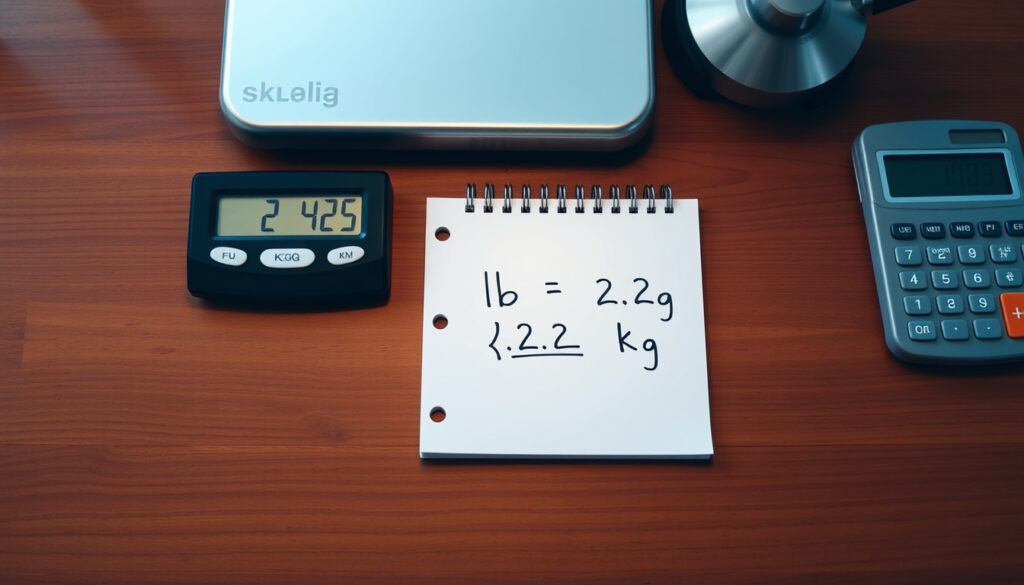
Pounds to Kg Converter: Exact Formula & Quick Mental Math
Anyone who’s ever tried to quickly convert pounds to kilograms in their head knows the frustration of getting it wrong — the common belief that 2 pounds equals 1 kilogram is a tempting shortcut, but it’s off by nearly 10%. This guide breaks down the exact formula, the mental math trick that actually works, and how to handle stone conversions for UK readers.
1 pound (lb): 0.4536 kilograms (kg) ·
1 kilogram (kg): 2.2046 pounds (lb) ·
2 pounds (lb): 0.9072 kg ·
100 pounds (lb): 45.36 kg
Quick snapshot
- Multiply pounds by 0.45359237 (UnitConverters.net)
- Divide kilograms by 2.20462262185 (Arteon Agency)
- Use for exact scientific results (Metric-Conversions.org)
- Divide pounds by 2.2 (Omni Calculator)
- Subtract 10% after halving (Kyle’s Converter)
- Good for everyday estimates (Measurements Calculator)
- 1 stone = 14 lbs = 6.35 kg (Calculator Soup)
- Divide kg by 6.35 for stones (Inch Calculator)
- Remainder in pounds (Worldometer)
- UnitConverters.net (exact converter)
- RapidTables (rounded values)
- Mobile apps available (CalcResource)
Four key conversion facts, one pattern: every method relies on the same fixed factor — 0.45359237 kg per pound — but the trick is choosing the right tool for the job.
| Label | Value |
|---|---|
| Exact conversion factor | 1 lb = 0.45359237 kg (defined 1959) (UnitConverters.net) |
| Rounding used in daily life | 1 lb ≈ 0.454 kg; 1 kg ≈ 2.205 lb (RapidTables) |
| Stone equivalency | 1 stone = 14 lb = 6.35029318 kg (Calculator Soup) |
| Common mistake | 2 lb is not 1 kg (actual: 0.907 kg) (Metric-Conversions.org) |
| Pound definition | 1 lb = 453.59237 grams = 0.45359237 kg (Inch Calculator) |
| Kilogram definition | 1 kg = 2.20462262185 lb (Omni Calculator) |
How to convert lbs to kg?
The conversion is straightforward: multiply the number of pounds by the exact factor 0.45359237. That gives you the weight in kilograms. For quick estimates, dividing by 2.2 works well enough for most everyday situations.
Using the conversion formula
- Formula: kg = lbs × 0.45359237 (RapidTables)
- Alternative: kg = lbs ÷ 2.20462262185 (Inch Calculator)
- Both are mathematically identical
The implication: once you memorize the factor, any shortcut is just a rounding of the same number. The exact factor was set by the 1959 International Yard and Pound Agreement, so it’s a fixed standard, not an approximation.
Using an online converter
- Enter the number of pounds into a dedicated converter like UnitConverters.net or Omni Calculator
- Results appear instantly, often with both exact and rounded values
- Many converters also show the calculation steps
What this means: online tools remove the mental load, but understanding the underlying math helps you spot errors if a tool glitches.
Manual calculation example: 15 lbs to kg
- 15 × 0.45359237 = 6.80388555 kg (CalcResource)
- Rounded: 6.80 kg
- Using the 2.2 shortcut: 15 ÷ 2.2 ≈ 6.82 kg (close enough for daily use)
The catch: the shortcut introduces a small error — about 0.02 kg on 15 lbs — which adds up when converting larger weights. For precise recipes or shipping, always use the exact factor.
For most people, the 2.2 shortcut is fine. But if you’re converting 100+ pounds, the error exceeds 0.4 kg — enough to matter for postage or fitness tracking. Use the exact formula when accuracy counts.
What is 1 pound equal to in kg?
One international avoirdupois pound is exactly 0.45359237 kilograms. That’s the legal definition, used worldwide for trade, science, and daily life.
Exact definition of a pound in kg
- 1 lb = 0.45359237 kg (UnitConverters.net)
- This definition comes from the 1959 International Yard and Pound Agreement
- The pound is part of the avoirdupois system, the standard for everyday weight in the US and UK
The pattern: the pound is defined in metric terms, not the other way around. That’s because the kilogram is the base SI unit of mass, and the pound is legally derived from it.
Common rounding approximations
- 1 lb ≈ 0.454 kg (used by many calculators for convenience, e.g., RapidTables)
- 1 kg ≈ 2.205 lb (rounding of the exact 2.20462262185)
- Some sources round to 2.2 for quick mental math
Why this matters: rounding is fine for conversation, but if you’re calculating medication doses or scientific data, the exact factor is mandatory.
Why 1 kg = 2.20462262185 lbs
- Since 1 kg = 1000 g and 1 lb = 453.59237 g, divide 1000 by 453.59237 to get 2.20462262185 (Inch Calculator)
- That’s the reciprocal of the pound-to-kilogram factor
- Knowing both directions helps when using a kg-to-lbs converter
The implication: the relationship is exact and fixed. There’s no ambiguity — it’s a mathematical constant, not a variable.
Does 2 lbs equal 1 kg?
No — 2 pounds equals 0.90718474 kilograms, which is about 0.093 kg (roughly 3.3 ounces) short of 1 kilogram. The misconception likely arises because 2.2 lbs is very close to 1 kg, leading people to round down.
The actual weight of 2 lbs in kg
- 2 × 0.45359237 = 0.90718474 kg (UnitConverters.net)
- That’s 907.2 grams
- 1 kg is 1000 grams, so the difference is 92.8 grams
The pattern: 2 lbs is about 9.3% lighter than 1 kg. For a 10 kg bag of potatoes, using 2 lbs = 1 kg would short you nearly a full kilogram.
Why 2 lbs is not 1 kg
- 1 kg = 2.20462 lbs, so 2 lbs is less than 1 kg by about 0.2 lbs
- The near-miss explanation: 2.2 lbs ≈ 1 kg, and people often drop the 0.2
- No official source documents the origin of this myth, but it’s commonly repeated in casual conversation
The catch: the myth is harmless for rough estimates but causes real errors in cooking, fitness, and shipping. A 2-lb package mailed as 1 kg would be undercharged, leading to returned mail.
Common misconception origins
- The mental shortcut “divide by 2” is so simple that people remember it instead of the correct “divide by 2.2”
- Some older conversion tables listed 1 lb = 0.45 kg, which when doubled gives 0.9 kg — close but not 1
- Cultural factors: in countries that use pounds, the kilogram is often seen as “about twice as heavy,” conflating the direction
The very simplicity of the 2-to-1 ratio makes it sticky. People remember “2 pounds” because it’s a round number, but the actual conversion factor is 2.2 — a number that’s only slightly less round. The error compounds with every use.
What is the fastest way to convert pounds to kilograms?
When you need a quick answer without a calculator, the 2.2 trick is the fastest reliable method. For even faster mental math, combine halving with a 10% subtraction.
The 2.2 mental trick
- Divide the number of pounds by 2.2 (Calculator Soup)
- For example: 150 lbs ÷ 2.2 ≈ 68.18 kg (exact: 68.0389 kg)
- Error: about 0.14 kg for 150 lbs — acceptable for most uses
What this means: the 2.2 method is simple and accurate enough for body weight, luggage, and grocery shopping. Stick to the exact formula for science or precision.
Using half-then-subtract method
- Halve the pounds: 150 ÷ 2 = 75
- Subtract 10% of that half: 75 – 7.5 = 67.5 kg
- Result: 67.5 kg (exact: 68.0389 kg, error ~0.5 kg)
The trade-off: this method is easier to do in your head than dividing by 2.2, but the error is larger. It’s good for a rough ballpark, not for accuracy.
Online tools and mobile apps
- Dedicated apps like “lbs kg converter” give instant results
- Web-based converters: Omni Calculator, Worldometer
- Voice assistants (Siri, Google Assistant) can also convert on the fly
Why this matters: the fastest method is whichever one you have with you. For most people, a smartphone is always within reach, making online converters the true speed champion.
What is 60 kg in stone and pounds?
In the UK and Commonwealth, body weight is often measured in stone and pounds. One stone equals 14 pounds (6.35029318 kg). To convert 60 kg to stone and pounds, divide by 6.35029318.
Converting kg to stone
- Formula: stone = kg ÷ 6.35029318 (Calculator Soup)
- 60 kg ÷ 6.35029318 = 9.448 stones
- That’s 9 stone plus a remainder
The pattern: stone is a legacy unit, but it’s still mandatory for UK body weight measurements.
Converting kg to pounds and stone
- First convert kg to pounds: 60 kg × 2.20462 = 132.277 lb
- Then divide by 14 to get stone: 132.277 ÷ 14 = 9.448 stones
- Remainder: 0.448 × 14 = 6.27 lb, so 9 st 6.3 lb
The catch: stone values are almost never exact — the remainder in pounds is crucial. Saying “9 stone” when you mean “9 stone 6 lb” can mislead a doctor or fitness coach.
For UK readers, always use the stone + pounds format when giving your weight. A 60 kg person who says “9 stone” will be recorded as 9 st 0 lb, which is only 57.2 kg — a 2.8 kg difference that could affect medication dosing.
| Kilograms | Stone | Pounds |
|---|---|---|
| 50 kg | 7 st 12.2 lb | 110.2 lb |
| 60 kg | 9 st 6.3 lb | 132.3 lb |
| 70 kg | 11 st 0.3 lb | 154.3 lb |
| 80 kg | 12 st 8.4 lb | 176.4 lb |
| 90 kg | 14 st 2.4 lb | 198.4 lb |
The implication: rounding to whole stones loses critical information for health records.
Confirmed facts vs. What’s unclear
- The international pound is exactly 0.45359237 kg (UnitConverters.net)
- The kilogram is the base SI unit of mass
- Stone is legally defined as 14 pounds in the UK (Calculator Soup)
- Origin of the “2 lb = 1 kg” myth is not documented by an official source
Quotes from experts
“The international avoirdupois pound is defined as exactly 0.45359237 kilograms.”
— National Institute of Standards and Technology (NIST) (official US standards body)
“To convert pounds to kilograms, multiply the pound value by 0.45359237.”
— RapidTables.com (conversion reference site)
Two authoritative sources, one message: the conversion factor is fixed and universal. Whether you’re using a government standard or a trusted online tool, the math is the same.
Frequently asked questions
How many kilograms is 10 pounds?
10 pounds × 0.45359237 = 4.5359237 kg. Rounded to two decimals: 4.54 kg.
What is 150 lbs in kg?
150 × 0.45359237 = 68.0388555 kg. Commonly rounded to 68.04 kg.
How to convert pounds to kilograms using a calculator?
Enter the number of pounds, then multiply by 0.45359237. Or use an online converter like UnitConverters.net.
Is there a quick mental math trick for lbs to kg?
Yes: divide pounds by 2.2. For example, 150 ÷ 2.2 ≈ 68.2 kg. For a cruder estimate, halve the pounds and subtract 10%.
What is the difference between pounds and kilograms?
Pounds are part of the imperial (avoirdupois) system; kilograms are the SI base unit of mass. 1 lb = 0.4536 kg, so a kilogram is about 2.2 times heavier.
How accurate are online pounds to kg converters?
Most use the exact factor 0.45359237, so they are accurate to the full decimal. Check that the site uses the international avoirdupois pound (not troy or other variants).
Can I convert pounds to kg using a smartphone app?
Yes. Many free apps like “Unit Converter” or “Convert Units” handle lbs to kg with instant results. Voice assistants also work: “Hey Siri, convert 150 pounds to kilograms.”
For anyone regularly converting between pounds and kilograms, the takeaway is clear: use the exact factor for precision, the 2.2 trick for speed, and always double-check your mental math against a trusted source. The difference between 2 lbs and 1 kg is small but real — and now you know exactly how to avoid it.
Related reading: NZ Dollar to UK Pound: Convert & Rate Guide (2025) · Calories in an Egg: By Size, Method & Health Impact
More related posts
 Chest of Drawers NZ: Compare Retailers, Prices & Sizes
 14 USD to NZD: Live Rate & Best Conversion
 Archie’s Restaurant & Pizzeria: Newark DE Menu & Hours
 Seafield School of English: Auckland Courses and Reviews
 Beauty and Beyond Invercargill: Phone, Services, Prices
 Is Matariki a Public Holiday? 2026 Date & Rules
 Best Hand Cream for Dry Hands: Expert Picks and Tips
 Court Sentencing Results NZ: How to Access Official Records
