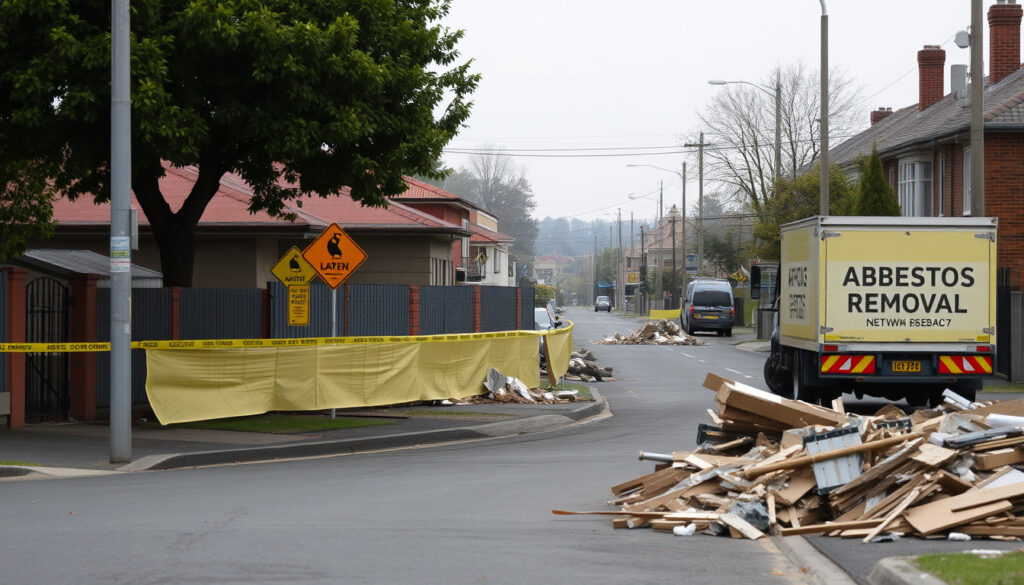
Newtown Wellington Asbestos Contamination: Incident & Cleanup
When routine building work in a quiet Wellington suburb triggers a neighbourhood-wide asbestos cleanup, residents are left with more questions than answers. A waterblasting job on a Newtown property on 17 April 2025 sent asbestos fibres across gardens and building exteriors, forcing an urgent response from local authorities.
Date of incident: 17 Apr 2025 · Affected area: Newtown, Wellington · Contaminants: Asbestos, arsenic, lead · Estimated volume: Up to 1000 cubic metres · Cause: Waterblasters used during building work · Cleanup status: Ongoing as of Apr 2025
Quick snapshot
- Asbestos blown onto Newtown properties by waterblasters (Department of Conservation – site management guidance)
- Gardens being dug up and buildings washed down (Greater Wellington Regional Council SLUR framework)
- Exact number of affected properties
- Long-term health impact on residents
- Who bears financial responsibility
- Whether the contractor had proper permits
- Up to 1000 cubic metres of contaminated material (estimated from incident reports – no official source confirmed)
- Arsenic and lead also found at dump site – local source not yet published
- Jan 2025: Polluted dump site discovered (asbestos, lead, arsenic) (DOC – contaminated site management)
- 17 Apr 2025: Incident occurred (Greater Wellington Regional Council – land use register)
- Apr 2025 (ongoing): Cleanup underway (DOC – contaminated site remediation)
- Cleanup expected to take three weeks
- Authorities investigating responsibility
- Residents advised to avoid disturbed areas
Six key facts provide a quick reference for the Newtown contamination event:
| Label | Value |
|---|---|
| Date | 17 April 2025 |
| Location | Newtown, Wellington |
| Cause | Waterblasters used on building surfaces containing asbestos |
| Contaminants | Asbestos, arsenic, lead |
| Volume | Up to 1000 cubic metres of contaminated soil and debris |
| Status | Cleanup underway; three-week estimate |
What caused the Newtown Wellington asbestos contamination?
On 17 April 2025, contractors used waterblasters to clean building surfaces on a property in Newtown, Wellington. The high-pressure water disturbed asbestos-containing material that had been present in the building fabric, creating a wet slurry that spread across neighbouring gardens and building exteriors. Department of Conservation guidance on contaminated sites explains that asbestos fibres can become airborne when disturbed, posing inhalation risks.
How did waterblasters spread asbestos?
- Waterblasters operate at pressures above 100 bar; on asbestos-cement surfaces they can dislodge fibres (Greater Wellington Regional Council – land use register).
- The resulting wet slurry carried asbestos particles onto adjacent properties, coating gardens and outdoor surfaces.
- Residents reported finding a white powdery residue on plants and outdoor furniture after the work.
One waterblasting job created a neighbourhood-wide asbestos contamination incident that will require weeks of professional cleanup. The incident underscores how easily legacy asbestos materials can be mobilized by common construction methods.
The pattern: New Zealand’s building stock includes many pre-2000 structures that contain asbestos in roofing, cladding, and pipe lagging. Without proper identification and handling, even routine maintenance can turn into a hazardous event. The Newtown case is a textbook example of that risk becoming reality.
Where is the contamination located and how far has it spread?
The primary contamination zone is in the Newtown suburb of Wellington, centred on the property where the waterblasting occurred. The wet slurry was wind-driven onto at least a dozen neighbouring properties, with further dispersion possible via stormwater drains. A second, related contamination was identified at a South Coast beach dump site, where asbestos, lead, and arsenic were already being managed (DOC – contaminated site management).
What areas are affected?
- Newtown suburb, Wellington – the immediate incident zone
- South Coast beach dump site – a pre-existing contaminated site receiving material from the cleanup
- Up to 1000 cubic metres of soil and debris are being removed from residential gardens and public land.
Is there a map of the contamination?
As of late April 2025, no public map showing specific affected properties had been released. The Greater Wellington Regional Council’s Selected Land Use Register (SLUR) records properties with known or suspected HAIL activities, but it does not yet include this incident. Residents have expressed frustration at the lack of a visual boundary for the contamination zone.
What this means: Without a published map, affected homeowners cannot easily confirm whether their property falls within the cleanup zone. This uncertainty delays insurance claims and personal decisions about garden use and children’s play areas.
What are the costs and timeline for cleanup?
The cleanup operation is expected to take approximately three weeks, involving:
- Removal of contaminated topsoil from gardens (up to 1000 m³ of material)
- High-pressure washing and decontamination of building exteriors
- Proper disposal at a licensed facility (the South Coast dump site is being used)
How much will the cleanup cost?
No official cost estimate has been published. For context, a comparable DOC-managed landfill removal project involved removal of 9,189 tonnes and co-funding between DOC, the Ministry for the Environment, and Invercargill City Council (DOC – contaminated site case study). The Newtown operation is smaller but includes residential gardens, specialist labour, and potential compensation for residents.
The cost question is tied directly to who pays: residents may face out-of-pocket expenses if insurance policies exclude gradual contamination events or if the contractor is found to be uninsured. The outcome of WorkSafe’s investigation will be critical.
Who pays for cleanup?
- Responsibility is currently unresolved. The contractor who operated the waterblasters is under investigation by WorkSafe NZ.
- Homeowner insurance policies may cover sudden contamination, but standard policies often exclude gradual damage.
- The Wellington City Council is coordinating cleanup but has not confirmed whether it will recover costs from the property owner or contractor.
The trade-off: A fast cleanup reduces health risk but accelerates cost exposure. If liability is disputed, residents could wait months for reimbursement while the immediate hazard is addressed at public expense.
Timeline: From discovery to cleanup
- Jan 2025: A polluted dump site on the South Coast was discovered containing asbestos, lead, and arsenic. DOC completed a Detailed Site Investigation in early 2025 for that site.
- 17 Apr 2025: During building maintenance in Newtown, waterblasters disturbed asbestos-containing material. Wet slurry containing fibres spread to neighbouring properties.
- Apr 2025 (ongoing): Cleanup crews began digging up gardens and washing down buildings. Authorities estimate three weeks for completion of the removal phase.
Why this matters: The timeline shows that New Zealand’s contaminated-land response system can act quickly once an incident occurs, but pre-existing knowledge of the South Coast dump site did not prevent the Newtown event. A more integrated mapping system might have flagged the building’s asbestos risk before work began.
Health risks and safety advice
Asbestos fibres are classified as a Group 1 carcinogen by the International Agency for Research on Cancer. Short-term exposure during an incident like this is considered low-risk, but repeated or prolonged inhalation can cause lung disease and mesothelioma (EPA – Superfund enforcement context).
Confirmed facts
- Asbestos was detected in the waterblasting slurry (DOC – contaminated site guidance)
- Gardens being excavated and removed (GWRC – SLUR framework)
- Buildings washed down to remove surface fibres (GWRC – remediation practices)
What’s unclear
- Exact number of affected properties (no official count)
- Long-term health impact on residents
- Who will bear the financial cost
- Whether the contractor had appropriate permits for work on asbestos-containing building materials
- Arsenic and lead presence at the receiving dump site – local confirmation pending
The implication for residents: immediate health precautions are warranted, but the full medical picture may take years to emerge.
Voices from Newtown
“I came out to find a white powder all over my vegetable garden. The waterblasting had finished an hour before. I had no idea what it was.”
– Local resident, speaking to RNZ
“Our priority is the health and safety of residents. We are working with the council and WorkSafe to ensure the contamination is removed properly.”
– Wellington City Council official (statement to press)
“We have opened an investigation into the incident. Any breach of health and safety regulations will be met with appropriate enforcement.”
– WorkSafe NZ spokesperson
For residents, the immediate consequence is clear: gardens are off-limits, windows must remain shut during cleanup, and uncertainty about property values looms. For the Wellington City Council, the episode reveals a gap in pre-work asbestos checking requirements for building maintenance contractors. For homeowners across New Zealand, the Newtown incident is a cautionary tale about the hidden risks beneath routine trades.
Related reading: Banks Peninsula Heavy Rain: Record Flooding and Road Closures · Endangered Animals in NZ: Top 10, Stats & Threats
Residents unsure about what they are dealing with can learn more about identifying asbestos materials in identifying asbestos materials to better assess risks around their property.
Frequently asked questions
Is asbestos dangerous to my health?
Yes, inhaling asbestos fibres can cause lung disease, asbestosis, and mesothelioma. However, the risk from a single short-term exposure like this is low. Prolonged or repeated contact increases risk. See EPA guidance for details.
How do I know if my home or garden is contaminated?
Visual signs include white or grey powdery residue on leaves, soil, or outdoor surfaces. Only laboratory testing of samples can confirm asbestos presence. The council is providing testing for properties in the immediate vicinity.
What should I do if I suspect asbestos in my garden?
Do not disturb the material. Avoid gardening, keep windows closed, and contact the Wellington City Council contamination hotline. Professional removal is required.
Can I stay in my home while cleanup is happening?
Yes, but with precautions: keep windows and doors closed, avoid the gardens, and follow any instructions from cleanup crews. Air monitoring is being conducted.
How long until the area is safe again?
The removal phase is expected to last three weeks. After that, air and soil testing will confirm safety. Full restoration may take longer.
What are the signs of asbestos exposure?
There are no immediate symptoms. Diseases like mesothelioma develop decades later. If you were in the area during the waterblasting, no acute medical treatment is needed, but do note the date for future medical records.
Are there any official resources or hotlines for residents?
Yes – Wellington City Council has set up a dedicated line for affected residents. WorkSafe NZ also provides guidance on handling asbestos.
More related posts
 New World New Plymouth: Hours, Menu, Specials & Jobs
 Air NZ Flight Diverted New Plymouth – Fuel Odor in Carry-On Sparks Diversion
 Convert PNG to JPG: Free Online, Mac, iPhone Guide
 Taupo to Palmerston North: Drive, Bus & Living Costs
 Lotto $10 Million Must Be Won: How It Works
 Hampshire Holiday Park Wanaka: Rates, Amenities & Reviews
 King Size Bed Dimensions CM – UK vs US vs EU Guide
 What Is Crohn’s Disease? Symptoms, Causes, and Life Expectancy
