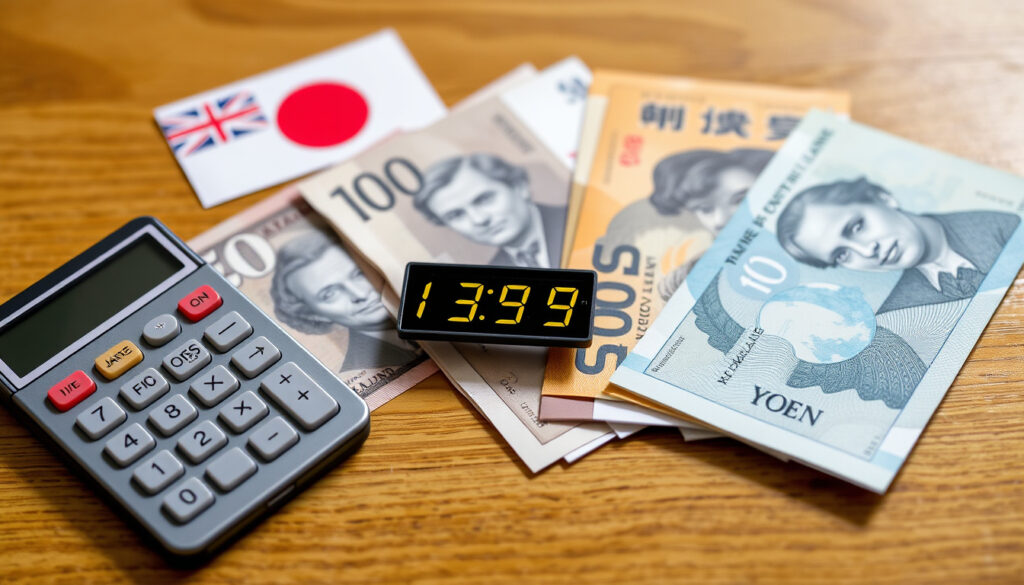
Convert Yen to NZD: Current Rates, Fees, and Value Guide
When you move money from Japan to New Zealand, the number that matters isn’t the yen amount on the screen — it’s what lands in the NZD account. Mid-market data from XE puts the rate near 0.0111 NZD per yen, so 1,000 yen becomes roughly 11 NZD before fees.
1 JPY to NZD (mid-market): 0.011 ·
1 NZD to JPY (mid-market): 90.8 ·
Typical transfer fee (fixed): ¥400 ·
1000 JPY converts to approximately: 11 NZD before fees
Quick snapshot
- The JPY to NZD mid-market rate sits near 0.0111 (XE (currency data provider))
- Remitly applies a flat 400 JPY fee per transfer (Remitly (money transfer service))
- Westpac New Zealand advertises no transfer fee on foreign currency overseas transfers (Westpac New Zealand (New Zealand bank))
- Future yen-NZD rate direction — no researched forecast confirms a trend
- Whether the lowest advertised fee equals the lowest total cost
- When exactly to convert for the best rate
- XE quotes moved between 0.0111 and 0.01119561 across timestamps (XE (currency data provider))
- Bank fees change by channel: NZD 5 online versus NZD 15 branch at ANZ New Zealand (ANZ New Zealand (bank))
- Compare the all-in cost: exchange-rate margin plus transfer fee (ANZ Australia (Australian bank))
- Check whether the provider excludes JPY from fee waivers (ANZ Australia (Australian bank))
Eight key figures, one pattern: the published rate is only half the story — fees and channel choices decide what actually arrives.
| Metric | Value |
|---|---|
| Current rate (1 JPY to NZD) | 0.011 |
| Current rate (1 NZD to JPY) | 90.8 |
| Typical transfer fee | ¥400 fixed (Remitly (money transfer service)) |
| 1000 JPY in NZD (before fees) | 11.0 NZD |
| 100 NZD in JPY (before fees) | 9,080 JPY |
| ANZ New Zealand online transfer | NZD 5 (ANZ New Zealand (New Zealand bank)) |
| Kiwibank internet banking (SHA) | NZD 10 (Kiwibank (New Zealand bank)) |
| ASB JPY fee tier | NZD 25 (ASB Bank (New Zealand bank)) |
The split is obvious: banks price transfers in blocky NZD fees, while specialists price them in yen or by setup. That difference decides whether a small transfer makes sense at all.
How much is 1000 yen in New Zealand dollars?
Current spot rate for JPY to NZD
- 1 JPY = about 0.0111 NZD at the mid-market rate as of (XE (currency data provider))
- 1 NZD ≈ 90 yen at the same quote — the inverse of the rate above
XE’s own readings moved between 0.0111 and 0.01119561 depending on the timestamp, so treat “the rate” as a moving target rather than a fixed number.
How to calculate yen to NZD manually
- Money going JPY to NZD: multiply the yen amount by 0.011 — 1,000 × 0.011 = 11 NZD
- Money going NZD to JPY: multiply the NZD amount by 90.8 — 100 × 90.8 = 9,080 yen
- Subtract the provider fee before converting, because most services deduct their charge first
The math is simple; the fee is not. A flat 400 JPY fee on a 1,000 yen transfer consumes 40% of the amount before the rate is even applied.
Send 1,000 yen through a bank channel that charges NZD 10 and the fee nearly equals the value of the transfer: 11 NZD sent, 10 NZD in charges. Small amounts belong with flat-fee services, not banks.
Real-world example: 1000 yen buying power
- 1,000 JPY converts to 11.0 NZD before any fees
- After a 400 JPY fee, the received amount drops to about 6.60 NZD
- Against a NZD 10 bank fee, the transfer is almost entirely consumed
The pattern: fees, not rates, dominate small yen transfers. For anything under roughly 50,000 yen, a low fixed fee matters more than a slightly better rate.
The implication: for amounts this small, the fee structure determines the result more than the rate itself.
Which is stronger, yen or NZD?
In exchange-rate terms, the answer is lopsided. One New Zealand dollar buys roughly 90 yen at current mid-market levels, which makes NZD the numerically stronger currency in this pair.
Exchange rate strength vs purchasing power
- 1 NZD buys about 90.8 JPY at the mid-market rate quoted above
- “Stronger” means one NZD commands many yen units — not that 90 yen buys more in Japan than 1 NZD buys in New Zealand
- Purchasing power depends on local prices, which an exchange rate does not measure
The distinction decides who feels the rate. A New Zealander heading to Japan sees a big yen number per NZD; a Japanese visitor to New Zealand hands over many yen to get one NZD. Same rate, opposite experiences.
Historical trends: JPY vs NZD over 5 years
- The research for this guide did not confirm a clean five-year trend for the pair
- The clearest signal is short-term: XE’s sampled quotes already varied across timestamps
- Any confident “stronger forever” claim about currencies overstates the evidence
Confident forecasts of a five-year pattern need data this guide does not have. What the quotes do show is movement — which is why the timeline signal here is volatility, not direction.
When one currency is stronger for travelers
- For NZD holders: about 9,080 yen per 100 NZD before fees
- For JPY holders: about 11 NZD per 1,000 yen before fees
- Fees then cut into whichever side you start from
The implication: the NZD’s numerical edge is real, but it only matters once the cost of the conversion is subtracted. A slightly better rate rarely survives a heavy fixed fee; the all-in cost is what counts.
What is $100 NZ in yen?
The reverse conversion flips the same rate. At 90.8 yen per NZD, 100 New Zealand dollars produces a much larger number in yen — and the fee question does not go away.
Convert NZD to JPY at current rate
- 100 NZD × 90.8 = 9,080 yen before fees
- Using XE’s higher reading of 0.01119561, one NZD buys about 89.3 yen, which puts 100 NZD closer to 8,930 yen
- The difference between quotes is small but real, so use the rate at the moment of transfer
The practical answer is a range: about 8,900 to 9,100 yen for 100 NZD, depending on the live rate and the provider’s margin.
How much yen you get for 100 NZD
- The mid-market figure is the ceiling before fees
- Kiwibank lists NZD 10 for an internet-banking international payment with charges SHA (Kiwibank (New Zealand bank))
- That fixed cost equals about 10% of the sent amount on a 100 NZD transfer
Fees behave differently on the reverse route because they are charged in NZD. A 10 NZD fee on 100 NZD is 10% in one transaction; on 1,000 NZD it is 1%. Size changes the verdict.
Impact of fees on reverse conversion
- A NZD 10 fee turns 100 NZD into roughly 90 NZD of actual exchange value
- At 90.8 yen per NZD, that fee costs about 908 yen of your receiving side
- Large transfers dilute the fee; small transfers magnify it
And the fine print matters. ANZ Australia says it may cover correspondent fees on ANZ Plus international transfers, but the policy explicitly excludes JPY (ANZ Australia (Australian bank)) — a reminder that advertised waivers often come with currency carve-outs.
Is 1000 yen worth a lot in Japan?
The short answer: not really — but the more useful answer is what it becomes once you convert it. At the rate quoted above, 1,000 yen equals about 11 NZD.
Cost of common items in Japan in yen
- 1,000 yen is the kind of note you use for one modest purchase — a casual meal at a budget spot
- It is not a meaningful amount for a transfer once fees apply
- The same note produces 11 NZD on the other side, which is likewise a small purchase in New Zealand
This is the purchasing-power point that exchange rates hide: the rate tells you the conversion, not the value. A strong NZD gives you many yen, but those yen buy everyday goods at Japanese prices.
What 1000 yen can buy in Japan
- As a rule of thumb, a casual meal — not a multi-course dinner
- In transfer terms, it is the smallest practical amount, because fixed fees outpace the value
- The 400 JPY flat fee structure becomes 40% of the transfer at this size
That last point is the real finding: at 1,000 yen, the fee percentage is the story, not the exchange rate.
Comparison with New Zealand prices
- 11 NZD in New Zealand is also a small amount — a modest purchase, not a budget line
- Price levels differ between the two countries, so the same converted note stretches differently
- For remittances or investment, 1,000 yen sits below the threshold where conversion through a bank makes sense
The takeaway for anyone on either side of the pair: a single 1,000 yen note is pocket money, not a transfer. Bundle larger amounts, or the fees decide the result for you.
Is it a good time to buy Yen?
No one can reliably time a currency pair, and the yen has been the weaker side of this one at current mid-market levels. The factors that change that are broader than any single headline.
Factors influencing JPY exchange rate
- Interest rate differences between Japan and New Zealand shift demand for each currency
- Economic data and geopolitical events move the rate day to day
- The studied quotes moved between 0.0111 and 0.01119561 — evidence the market is already moving while you read
None of these factors were the subject of a forecast in the research for this guide. What the data shows is activity, not a signal.
Current market sentiment
- No researched source confirmed a near-term direction for JPY to NZD
- Confidence in any “good time to buy” claim is low
- The safest reading: rates are dynamic, so timing is a guess unless you use tools like limit orders
Treat anyone who promises a precise moment to convert with skepticism. A provider comparison from Wise notes the gap between the cheapest advertised fee and the cheapest total cost (Wise (money transfer service)) — that gap is where the real saving lives.
Strategies for timing currency purchases
- Compare all-in costs before timing the market: rate margin plus fee
- For large amounts, consider splitting the conversion across a few days to average the rate
- Read the fine print on fee waivers — yen is often the excluded currency
That exclusion is a concrete example of the rule: the advertised “no fee” is often followed by a list of currencies that do not qualify.
The yen’s numerical weakness against the NZD is visible in every quote in this guide. Buying yen on a dip is speculation; the researched data supports cost control, not market timing.
The honest verdict: the best time to convert yen is when the all-in cost is lowest — which is a matter of provider math, not market prediction.
JPY to NZD providers compared
Seven providers, one pattern: specialists publish a flat fee and a separate rate, while banks attach fees to channels — and the cheapest option flips depending on the transfer size.
| Provider | Fee structure | Rate approach |
|---|---|---|
| Wise | Transfer fees from 292 JPY to 3,500 JPY depending on setup (Wise (money transfer service)) | Mid-market rate shown separately from the fee |
| Remitly | Flat 400 JPY on transfers; first transfers may have no fee (Remitly (money transfer service)) | Exchange-rate information shown on the converter page |
| OFX | No intermediary or bank fee in the displayed example (OFX (foreign exchange provider)) | Example customer rate of 0.010755 |
| ANZ New Zealand | NZD 0 and NZD 5 fee options on the published international rates page (ANZ New Zealand (New Zealand bank)) | Bank’s own international rate schedules |
| Kiwibank | NZD 10 internet (SHA), NZD 20 internet (OUR); branch from NZD 25 (Kiwibank (New Zealand bank)) | Bank’s foreign exchange rate page |
| ASB Bank | NZD 25 fee tier for JPY (ASB Bank (New Zealand bank)) | Bank’s fee schedule |
| Westpac New Zealand | No transfer fee on foreign currency overseas transfers (Westpac New Zealand (New Zealand bank)) | Bank’s foreign exchange page |
On a 100,000 yen transfer, a 3% rate margin costs about 3,000 yen — enough to erase the advantage of any low flat fee in this comparison. The rate is where large transfers lose money; the fee is where small transfers lose money.
Two catches hide in the table. OFX’s example customer rate of 0.010755 sits below the mid-market quotes shown earlier, and a “no transfer fee” row from a bank can still carry correspondent charges or a rate margin that is not advertised on the same line. Read the fee and the rate as one number: a NZD 25 ASB tier is irrelevant on a big transfer and fatal on a small one.
Specialist service or bank: the trade-offs
One decision, two cost structures. Specialists publish flat fees in yen with a separate rate; banks publish NZD channel fees and sometimes exclude yen from waivers.
Upsides
- Flat, predictable specialist fees: Remitly at 400 JPY, Wise from 292 JPY (Wise (money transfer service))
- Some banks list zero transfer fees for foreign currency overseas transfers (Westpac New Zealand (New Zealand bank))
- Comparison pages show the rate separately from the fee, which makes the true cost visible
Downsides
- Bank fixed fees dominate small transfers: Kiwibank’s NZD 10 internet fee is nearly all of a 1,000 yen transfer’s value
- Branch channels cost more than online: NZD 15 at ANZ New Zealand, from NZD 25 at Kiwibank
- Fee waivers often exclude JPY — ANZ Australia’s ANZ Plus waiver is one example (ANZ Australia (Australian bank))
The trade-off: specialists win on small and mid-size transfers; banks only compete when a zero-fee channel applies and the rate stays close to mid-market.
How to convert yen to New Zealand dollars: step by step
Five steps, in order: check the rate, size the transfer, compare total costs, pick the channel, confirm the receiving amount.
- Check the live mid-market rate first, so you know the ceiling before fees.
- Choose a transfer size — the fee structure that suits 10,000 yen will not suit 1,000,000 yen.
- Compare the all-in cost, rate margin plus fee, on provider pages like OFX’s, which display the customer rate and any displayed fees together (OFX (foreign exchange provider)).
- For small amounts, prefer flat-fee specialists; for large amounts, check bank channels like ANZ’s online transfer, which costs NZD 5.
- Confirm the receiving amount in NZD before sending, and verify whether the provider excludes JPY from fee waivers.
The sequence is the same every time — rate, provider, channel, confirmation. The fee structure is the only variable worth your attention.
Confirmed facts vs what’s still unclear
The research for this guide is uneven: fee schedules are published and verifiable, while timing and market direction are not. Here’s the split.
Confirmed facts
- Wise’s MUFG Bank comparison shows a transparent 229 JPY fee to send 1,000 JPY, with the mid-market rate on the same page (Wise (money transfer service))
- ASB’s fee page lists JPY in a NZD 25 tier and shows a 0.00% rate line for JPY balances in the 500,000 to 1,000,000 range (ASB Bank (New Zealand bank))
- OFX’s Japan-to-New Zealand page shows an example customer rate of 0.010755 with no intermediary or bank fee in the displayed example (OFX (foreign exchange provider))
What’s still unclear
- Future rate direction for JPY to NZD — no researched forecast confirms a trend
- Whether the lowest advertised fee equals the lowest total cost — provider comparisons warn the gap exists
- Which XE quote applies at the moment you actually send, since readings differed across timestamps
- The exact level of correspondent fees on bank transfers — the researched pages do not publish them
- Whether any “good time to buy yen” call holds — low-confidence territory by nature
What the confirmed list shows is that published fees are dependable; what the unclear list shows is that anyone predicting the rate is guessing. Plan around the first list, not the second.
What the banks and providers actually publish
Two statements from the researched pages capture the whole decision: one side advertises zero fee, the other shows a rate that quietly carries the cost.
“Foreign currency overseas transfers can be sent with no transfer fee.”
Westpac New Zealand (New Zealand bank)
“The example customer rate for a Japan-to-New Zealand transfer was 0.010755, with no intermediary or bank fee in the displayed example.”
OFX (foreign exchange provider)
Both institutions are telling the truth, and both statements hide the same lesson: the quoted rate and the delivered rate are two different numbers. The gap between them is the actual cost of converting yen to NZD.
Yen-to-NZD conversion is a fee problem dressed up as a rate problem. The mid-market rate near 0.0111 tells you the ceiling; the provider’s margin and fee tell you the floor. For anyone converting yen from Japan to New Zealand, the choice is clear: use a flat-fee specialist for small and mid-size transfers, and compare the all-in rate for large ones — otherwise the fixed fee decides the outcome for you.
Frequently asked questions
How do I convert yen to New Zealand dollars?
Multiply the yen amount by the current JPY to NZD rate (about 0.011), then subtract the provider’s fee. For 1,000 yen, that is about 11 NZD before fees. Use a live converter at the moment of transfer because the rate moves.
Are there fees when converting yen to NZD?
Yes. Specialists like Remitly charge a flat 400 JPY; banks like Kiwibank charge NZD 10 (SHA) online and more in branch. Westpac New Zealand lists no transfer fee for foreign currency overseas transfers, and Wise ranges from 292 JPY to 3,500 JPY depending on setup.
What is the current JPY to NZD exchange rate?
XE’s mid-market quote was near 0.0111 NZD per yen, equal to about 90 yen per NZD. Rates change by the minute, so check a live converter before sending.
Where can I exchange yen for NZD?
Through specialist services like Wise, Remitly, or OFX, or through a New Zealand bank such as ANZ, Kiwibank, ASB, or Westpac. The cheapest channel depends on the transfer size and whether JPY is excluded from fee waivers.
How to get the best exchange rate for yen to NZD?
Compare the all-in cost — exchange-rate margin plus fee — rather than the advertised fee alone. The provider pages in this guide show how the two components vary, and a 3% rate margin can outweigh any flat fee on large transfers.
Is it cheaper to convert yen in Japan or New Zealand?
The research for this guide did not confirm a consistent price difference by country. The deciding factors are the provider’s fee structure and the live rate, not where the transfer is initiated.
More related posts
 E-Bikes for Sale in Ireland: Legal Guide & What to Avoid
 What Is a BSB Number? Compare IBAN, SWIFT, Sort Code
 Best Conditioner and Shampoo: Top Picks for Every Hair Type
 Citadines Walker North Sydney: 88 Walker St Review & Price
 Nottm Forest vs Leeds United: Head-to-Head, Debt & Payroll
 White Tail Spider Bite NZ: Symptoms & Treatment
 How Old Is Cliff Richard? Age, Biography & Health Facts
 Sweet and Sour Chicken Recipe: Easy, Crispy, and Authentic
