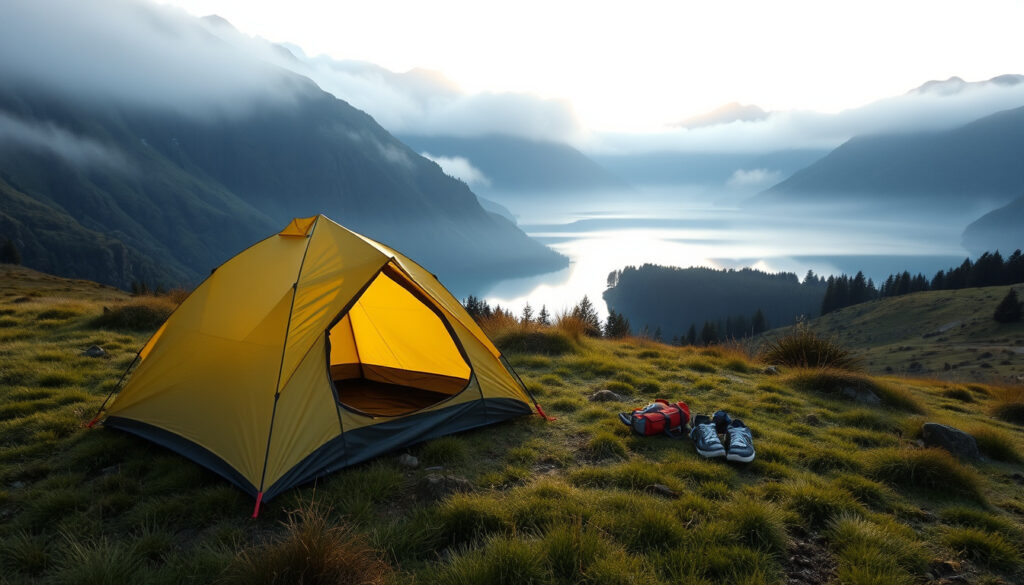
Best 2 Person Tent NZ: Top Picks for Camping & Hiking
Anyone who has watched a New Zealand forecast change three times before lunch knows why a tent choice matters. Store listings here put two-person tents anywhere from 1.63 kg to 2.76 kg, with waterproof ratings from 1,000 mm to 4,000 mm — a wider spread than most buyers expect.
Average price range: NZD 200–1,000 ·
Most common brands stocked: MSR and Macpac ·
Typical packed weight (camping tent): 2.5–3.5 kg ·
Typical floor area: 2.8–3.2 m² ·
Minimum waterproof rating for NZ: 1,500 mm hydrostatic head
Quick snapshot
- The North Face Trail Lite 2 lists a 2.01 kg trail weight and a 2.31 kg total weight (The North Face New Zealand spec sheet).
- Kiwi Camping’s Weka 2 Hiker Tent rates its fly and floor at 4,000 mm double-coated (Kiwi Camping product listing).
- Macpac’s Duolight V3 weighs 2.18 kg with a waterproof, factory seam-taped fly (Macpac product page).
- Which model is “best” depends on priorities; Backwoods stocks ultralight domes and heavier tramping tents side by side (Backwoods 2-person tent range).
- 2026 replacement line-ups are not listed yet on NZ retail pages; catalogues still lead with current-season stock (Gearshop current listing).
- Long-term durability of sub-$200 tents is hard to predict; budget builds with fibreglass poles are a genuine gamble. (Backwoods 2-person tent range)
- No major redesign cycle is visible in the NZ market: current retailer catalogues still centre on 2024/2025 models (based on Backwoods 2-person tent range).
- Brands appear to be refining rather than replacing, so a well-chosen current-season tent will not feel outdated next year (based on Gearshop current listing).
- Current NZ retailer catalogues still centre on 2024/2025 models, with no major redesign cycle visible (Backwoods 2-person tent range).
- Brands are refining rather than replacing, so a well-chosen current-season tent will not feel outdated next year (Gearshop current listing).
- Set your weight ceiling first: NZ two-person listings range from 1.63 kg (The Warehouse) to 2.76 kg (Kiwi Camping).
- Then compare waterproof ratings: the spread runs from 1,000 mm to 4,000 mm, and the cheapest tents are almost always the least waterproof. (The Warehouse)
Five numbers tell most of the story about a two-person tent in NZ. Averaged across the product pages cited here, a typical model looks like this:
| Metric | Typical value |
|---|---|
| Average price | NZD 350–800 |
| Average packed weight | 2.2 kg |
| Average floor area | 2.9 m² |
| Average peak height | ~105 cm |
| Common waterproof rating | 1,500–3,000 mm hydrostatic head |
What is the best 2-person tent in New Zealand?
The honest answer: there is no single SKU that wins for everyone. The best two-person tent depends on whether you are carrying it up the Kepler Track or driving it to a festival field. The specifications that separate the right tent from a regret are consistent though — waterproofing, packed weight, pole quality, and vestibule space.
What features make a tent ideal for New Zealand conditions?
- Backwoods, a long-running NZ outdoor retailer, tells buyers to look for a tent with a 2,000 mm+ waterproof rating, strong poles, and a good rainfly (Backwoods’ NZ camping-tent guide).
- Rain and wind arrive together here, so a full rainfly matters more than brand name; a stable build like Macpac’s Duolight V3 uses DAC Featherlite NSL poles and a Torrentwear tub floor for wet ground (Macpac’s Duolight V3 page).
- Check the floor before you trust the fly: The North Face’s Trail Lite 2 carries a 1,500 mm PU-coated floor, which matters on saturated campsites (The North Face New Zealand spec sheet).
- Layout decides comfort in bad weather: Kiwi Camping’s Weka 2 uses a double vestibule and a single-room layout so wet gear stays out of the sleeping area (Kiwi Camping product listing).
Top recommended models for 2025
- MSR Elixir 2 — the most common name in NZ shop catalogues for first-time buyers; treat its fly and floor ratings as the spec to verify.
- Macpac Duolight V4 — a technical lightweight shelter with a factory seam-taped fly and silicone/PE coating (detailed in the waterproof section below).
- The North Face Trail Lite 2 — a balanced hiker’s tent with a bathtub floor and non-PFC DWR finish.
- Kiwi Camping Weka 2 — the wet-weather specialist in this round-up.
- Kathmandu and Torpedo7 — two local chains with their own two-person line-ups, both worth checking for seasonal deals.
The trade-off: a tent that handles every NZ condition will weigh more and cost more than a fair-weather dome. Decide which three conditions you actually camp in, then let that shortlist drive the spec.
NZ buyers do not need the lightest or the cheapest tent — they need the tent whose weakest spec still matches their worst-case forecast. In a market where weight varies from 1.63 kg to 2.76 kg and waterproofing from 1,000 mm to 4,000 mm, that mismatch is where most buying mistakes happen.
The implication: NZ buyers should weigh their weather tolerance against their carrying capacity.
What is the best budget 2-person tent?
Under NZD 200, the market splits into two groups: featherlight basic domes and heavier tents with better weather protection. The best-documented options in current NZ listings are below.
Budget tents under NZD 200
- The Warehouse Backyard Sleepout 2 Person — 1.63 kg with a 1,000 mm rating, a 185T polyester shell, and fibreglass poles (The Warehouse product page). Light enough for a track, but the rating points to fair-weather camping.
- Desert & Fox Ultralight 2 Person — roughly 1.85 kg with a PU 2,000 mm rating; Backwoods calls it one of the cheapest two-layer tent options in NZ (Backwoods’ Desert & Fox listing).
- Torpedo7’s Hideaway series is the other name that keeps appearing in NZ budget round-ups; expect similar compromises on weight or waterproofing.
Key features to look for in an affordable tent
- Factory-sealed seams and a full-coverage rainfly, because budget tents often skip the first and skimp on the second.
- A bathtub floor: ground water pools quickly on wet campsites, and a seamed floor is the only real defence.
- Pole material: fibreglass keeps the price down and the weight up; aluminium is a stiffer upgrade if the budget stretches.
The catch: the cheapest NZ tents are not bad tents — they are narrowly built tents. A 1,000 mm rating is fine for a dry summer paddock and wrong for a West Coast night.
Budget prices and waterproofing move in opposite directions: the cheapest two-person tent in this round-up carries the lowest hydrostatic head. Buyers who split the difference usually land on a 2,000 mm-rated dome with factory-sealed seams.
The pattern: budget buyers trade weight for waterproofing, and the trade is safest when seams are factory-taped.
What size tent is best for 2 people?
Size is the spec buyers forget until 2 a.m. A two-person tent rated for two adults with sleeping bags is not the same as a two-person tent rated for two adults plus gear.
Minimum floor area for two people
- As a rule of thumb, a comfortable two-person floor lands between 2.5 and 3.5 m²; below that, two wide sleeping mats start to overlap.
- Most NZ two-person tents use a single-room layout, so vestibule space does the heavy lifting for gear storage.
Importance of peak height and vestibule space
- Peak height of about 100 cm lets most adults sit up comfortably to change clothes; tents pitched lower save weight and accept the crouch.
- Vestibules add roughly 0.5–1.0 m² of dry storage — enough for a pack and boots, which is why double-vestibule designs earn their keep in wet NZ conditions.
Why this matters: floor area and peak height are published on nearly every NZ product page, but most buyers compare price first. Reading those two numbers before buying prevents the most common tent complaint — cramped nights.
What is the best waterproof two-person tent for camping?
Waterproofing is sold in millimetres of hydrostatic head, and the NZ market spans that scale from one end to the other. The listing data makes the tiers easy to see.
Understanding waterproof ratings (HH)
- Hydrostatic head measures how much water pressure a fabric resists: 1,000 mm handles light showers, 1,500 mm is the usual entry benchmark for NZ camping, and 2,000 mm+ gives real confidence in sustained rain — the level Backwoods recommends in the guide cited above.
- Seam taping matters as much as the fabric number: a factory seam-taped fly removes the stitch holes where water sneaks in. Macpac’s Duolight V4 page describes a waterproof fly that is factory seam taped, with silicone coatings outside and a PE coating inside (Macpac’s Duolight V4 page).
- The floor rating is the second number to check; the Trail Lite’s 1,500 mm PU-coated floor, cited above, is a sensible baseline for NZ campsites.
Top waterproof tents available in New Zealand
- Kiwi Camping Weka 2 — the outlier in this market, with a 4,000 mm double-coated fly and a 4,000 mm poly-oxford floor.
- The North Face Stormbreak 2 — fully seam-taped canopy and floor, with a 1,200 mm rainfly and a 1,500 mm floor; the full spec is quoted below.
- MSR Hubba Hubba and Macpac Minaret — frequent names in waterproof-tent discussions; apply the same 1,500 mm floor / seam-taped fly benchmark to both.
The pattern: NZ waterproofing tiers are clear. Budget tents sit near 1,000 mm, mid-range tents at 1,500–2,000 mm, and dedicated wet-weather tents at 4,000 mm. Decide which tier your camping actually needs before you compare brands.
A 1,500 mm floor can be perfectly waterproof on a tent pitched on grass. The same tent on saturated sand or a hardstand site faces a different test — and that is when the 4,000 mm floor on a wet-weather tent stops looking like overkill.
The implication: the right waterproofing tier depends on where you pitch, not how much you spend.
How heavy should a 2 person tent be?
Weight is the spec that sorts NZ tents into use cases faster than price. The right number depends on how far the tent has to travel on your back.
Weight ranges by tent type
- Car-camping tents run roughly 3–5 kg packed; hikers’ tents run 1.5–3 kg; ultralight shelters drop under 1.5 kg.
- The current NZ listings sampled for this guide cluster between 1.63 kg (The Warehouse, cited above) and 2.76 kg (Kiwi Camping, cited above).
- Gearshop’s Domex Ascent 2-3 sits in the middle at a 1.9 kg minimum weight and 2.2 kg packed weight (Gearshop’s Domex Ascent listing).
Trade-offs between ultralight and durable
- Going light means thinner fabrics, smaller interiors, and a higher price per gram; the trade-offs are real in NZ conditions.
- Budget ultralight picks such as the Desert & Fox (1.85 kg, 2,000 mm, cited above) show that light weight and reasonable waterproofing can coexist — at the cost of two-layer pack space.
- If your trips are coastal or alpine, sacrificing 300 g for a stronger pole set and a higher floor rating is usually the smarter trade.
The trade-off: every 100 g saved comes from somewhere — fabric, poles, or floor strength. Choose the weight that lets you actually carry the tent, then accept the consequence in durability or price.
The pattern: weight and waterproofing trade places — the lightest model is also the least waterproof, and the most waterproof is the heaviest.
Six tents, one pattern: weight and waterproofing trade places. The lightest model in the group is also the least waterproof, and the most waterproof model is the heaviest.
| Model | Packed weight | Fly/floor rating | Construction | Best for |
|---|---|---|---|---|
| The North Face Trail Lite 2 | 2.01 kg trail / 2.31 kg total | 20D rainfly; 1,500 mm floor | Bathtub floor, non-PFC DWR | Hikers who want a trusted brand |
| The North Face Stormbreak 2 | 2.41 kg | 1,200 mm fly / 1,500 mm floor | Fully seam-taped canopy and floor | Campers who want a simple, durable dome |
| Macpac Duolight V3 | 2.18 kg | Waterproof fly, factory seam taped | DAC Featherlite NSL poles, Torrentwear tub floor | Trampers wanting a technical lightweight shelter |
| Kiwi Camping Weka 2 | 2.76 kg | 4,000 mm fly / 4,000 mm floor | Double vestibule, single room | Coastal and wet-weather camping |
| Desert & Fox Ultralight 2 | ~1.85 kg | PU 2,000 mm | Two-layer construction | Budget-conscious hikers |
| The Warehouse Backyard Sleepout 2 | 1.63 kg | 1,000 mm | 185T polyester, fibreglass poles | Fair-weather car camping |
The pattern: no single tent wins every column, and the two lightest entries are also the two least waterproof — a reminder that weight and weather protection are bought from the same budget.
Seven specifications separate a tramping-grade shelter from a festival dome. Here is what current NZ listings show:
| Spec | What NZ listings show |
|---|---|
| Packed weight range | 1.63–2.76 kg across the models sampled in this guide |
| Fly waterproofing | 1,000–4,000 mm HH |
| Floor waterproofing | 1,000–4,000 mm HH |
| Common NZ benchmark | 1,500 mm+ on floors; 2,000 mm+ recommended by Backwoods (cited above) |
| Pole materials | Fibreglass on budget builds (cited above) to DAC aluminium on Macpac’s Duolight (cited above) |
| Seam taping | Factory seam taping on Macpac Duolight and The North Face Stormbreak (cited above) |
| Floor style | Bathtub floor on the Trail Lite; Torrentwear tub on Macpac Duolight (cited above) |
| Vestibules | Single or double; Kiwi Camping’s Weka 2 uses two (cited above) |
| Typical floor area | About 2.9 m² |
| Typical peak height | About 105 cm |
Ultralight 2-person tents: upsides and downsides
Upsides
- You can carry the tent all day: the lightest NZ models in this guide start around 1.6 kg.
- Technical lightweight builds such as Macpac’s Duolight V4 keep a seam-taped, waterproof fly at a tramping-friendly weight.
- Two-layer budget ultralights like the Desert & Fox offer 2,000 mm protection without a premium price.
Downsides
- Ultralight materials cost more per gram, which pushes good tents past the NZD 400 mark.
- Thinner fabrics and smaller interiors reduce durability in alpine scrub or coastal winds.
- Weight savings usually come out of the floor and fly ratings, so the lightest tents often carry the lowest hydrostatic head.
The trade-off: buy the lightest tent that still clears your waterproofing floor — not the lightest tent on the shelf.
What’s confirmed, what’s still unclear
Confirmed facts
- A two-person tent is built for two adults with minimal gear; brand listings throughout this guide refer to 2-person capacity.
- Hydrostatic head above 1,500 mm is the accepted entry point for waterproofing in NZ retail, with 2,000 mm+ recommended for real conditions.
- Macpac, Kathmandu, and The North Face are among the most visible tent brands in NZ retail catalogues.
What’s unclear
- Which single model is “best” — performance depends on trip type, season, and personal tolerance for a cramped night.
- 2026 model releases are not yet announced on NZ retail pages; current catalogues still lead with 2024/2025 stock.
- Long-term durability of budget tents under NZD 200 is unproven; fibreglass poles and 1,000 mm coatings suggest fair-weather expectations.
The uncertainty is not a flaw in the market — it is a sign that the right tent depends on the trip. That is exactly why the spec sheets deserve more attention than the brand stickers.
Voices from the product pages
Fully seam-taped canopy and floor, with a 1,200 mm PU-coated rainfly and a 1,500 mm PU-coated floor.
The North Face New Zealand, Stormbreak 2 listing
The Backyard Sleepout Tent 2 Person weighs 1.63 kg and is listed with a 1,000 mm waterproof rating, using 185T polyester and fibreglass poles.
The Warehouse, product listing
The Domex Ascent 2-3 Person Tent has a minimum weight of 1.9 kg, a packed weight of 2.2 kg, and a 2,000 mm polyurethane/silicone coating.
Gearshop, Domex Ascent listing
Across these listings, the same message repeats: check the seams, check the floor, and never trust a tent’s name more than its numbers.
The takeaway for NZ buyers
New Zealand’s tent market is small but specific: the retailers stock exactly the kind of wind-and-rain gear the country demands, and the spec sheets are public. The fastest route to a good purchase is to set a packed-weight ceiling, check the hydrostatic head on the fly and the floor, and verify seam taping and pole material before comparing prices. For trampers, the choice is clear: buy the lightest tent that clears a 1,500 mm floor and a seam-taped fly, or carry the extra weight on every climb. For car campers, the choice is equally clear: spend the saved grams on a 2,000 mm+ rating, because the tent that fails at midnight is the one you will remember.
Related reading: White Tail Spider Bite NZ · NZ Cheap Cars North Shore
bushbuck.co.nz, equipoutdoors.co.nz, trademe.co.nz, equipoutdoors.co.nz
Frequently asked questions
Is the MSR Elixir 2 suitable for heavy rain in New Zealand?
The Elixir 2 is one of the tents NZ retailers most commonly list for two-person use. For heavy rain, apply the same benchmark as any other model: a 1,500 mm+ floor and a seam-taped, full-coverage rainfly, with 2,000 mm+ giving real confidence in sustained conditions.
What is the best 2-person tent for a beginner camper?
A beginner needs forgiveness, not grams. The Warehouse’s Backyard Sleepout is the cheapest way into the category, and Macpac’s Duolight line shows what a technical shelter adds. Beginners should favour a full rainfly and a bathtub floor over brand names.
Do I need a footprint for a two-person tent?
A footprint protects the floor from stones and hardstand sites, and some NZ models, such as the Macpac Duolight, use reinforced tub floors that reduce the need. If a tent includes one, as with the MSR Elixir 2, use it; if not, a light groundsheet does the same job.
Can a 2-person tent comfortably fit two large backpackers?
Comfort depends on floor area and layout. In the current NZ market, packed weights range from 1.63 kg to 2.76 kg, and floor areas typically sit around 2.5–3.5 m². Two large sleepers should look for the upper end of that range and at least one vestibule for gear.
What is the lifespan of a typical 2-person tent?
With reasonable care, a tent with aluminium poles and a seam-taped fly lasts many seasons; budget tents with fibreglass poles and thinner coatings degrade faster, especially after long UV exposure. The durability of sub-$200 tents varies widely.
Are ultralight tents worth the higher price?
Yes, if you carry the tent for hours; no, if it only sits in the car. Ultralight models in NZ drop to about 1.85 kg, but they cost more, pitch smaller, and use lighter fabrics, so check the durability trade-off before buying.
How do I set up a 2-person tent correctly?
Pitch the tent so the long side faces the prevailing wind, peg the rainfly taut, and keep the inner tent from touching the fly so condensation stays on the outside. If the tent has a double vestibule, use the windward side for gear to add stability.
More related posts
 1212 Angel Number Meaning: Love, Bible & Guidance
 New Zealand Tax Rates 2025: Brackets & Salary Guide
 UAE vs New Zealand T20 World Cup 2026: Scorecard & Analysis
 Less Than or Equal To Symbol (≤): Meaning, Examples, Typing Guide
 Anzac Day: History, Traditions, and Key Facts
 Jobs in Nelson NZ – 2025 Guide to Opportunities
 Mr and Mrs Potato Clyde: Menu, Hours & Reviews
 Latency vs Bandwidth: What’s the Difference
