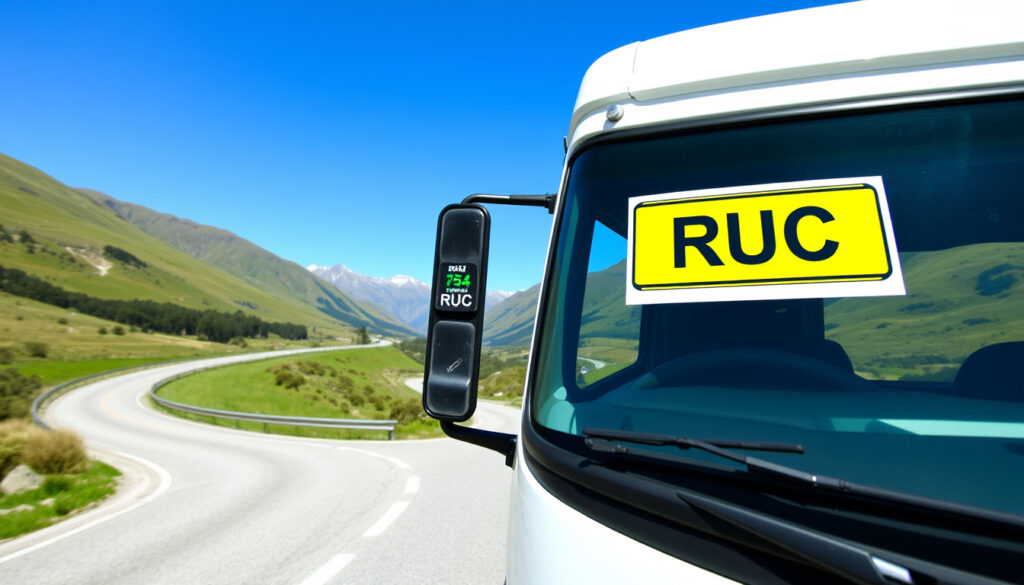
Road User Charges NZ: Costs, Who Pays & How to Buy RUC
If you’re hiring a campervan or driving a diesel in New Zealand, there’s a good chance you’ll hit a road user charge at some point. The system works differently here than in most countries — instead of fuel taxes alone, vehicles that skip the petrol levy pay by the kilometre. For visitors and newcomers, that catch-up moment usually arrives when a rental agent mentions an extra charge per kilometre, or when you notice your EV no longer has a free pass. The rules changed in April 2024, and they’ll shift again for heavy electric vehicles by the end of 2025. Here’s what you need to know before you drive.
RUC rate for light diesel (under 3.5t): $76 per 1,000km ·
Licence increments: 1,000km units ·
Administered by: NZ Transport Agency Waka Kotahi ·
Who pays: Diesel, electric, hybrid vehicles ·
Purchase options: Online, post offices, agents
Quick snapshot
- Light diesel and EV RUC is $76 per 1,000km (Tyre Dispatch RUC guide)
- RUC licences sold in 1,000km blocks only (NZTA Waka Kotahi official site)
- EV exemption ended 31 March 2024 after fleet hit ~100,000 vehicles (NZ Transport Ministry policy document)
- Whether exact 2026 rate adjustments will occur post-2025 heavy EV changes
- Specific penalty amounts for driving without a valid RUC licence
- Regional enforcement variations between North and South Island
- 1 April 2024: Light EVs/PHEVs began paying RUC
- 31 May 2024: Deadline for EV owners’ first post-exemption purchase
- End of 2025: Heavy EV exemption expires
- All heavy electric trucks and buses join the RUC system from 2026
- Online RUC purchasing becoming the dominant route for personal vehicles
- Electronic RUC (eRUC) automating compliance for fleet operators
Five key facts, one pattern: road user charges in New Zealand target every vehicle type that skips the petrol fuel excise duty — and that list has grown since April 2024.
| Label | Value |
|---|---|
| Primary payers | Diesel, electric, hybrid vehicles |
| Standard rate (light diesel) | $76 per 1,000km |
| Licence size | 1,000km minimum |
| Official site | NZ Transport Agency Waka Kotahi |
| Rate update | 1 July 2020 |
How much does 1000 RUC cost in NZ?
For most light vehicles under 3.5 tonnes — whether diesel, battery electric, or plug-in hybrid — the rate sits at $76 per 1,000 kilometres. That’s consistent across light diesels and full battery electric vehicles (BEVs). PHEVs face a lower bracket: plug-in petrol hybrids pay $53 per 1,000km, while plug-in diesel hybrids jump back to the $76 rate.
The system is weight-banded, so heavier vehicles pay more. A campervan up to 3.5 tonnes carries the same $76/1,000km as a light vehicle, but a 3.5-to-6-tonne campervan moves to $82/1,000km, and a 6-to-9-tonne unit reaches $167/1,000km.
Rates by vehicle type and weight
Two factors determine your bill: the lesser of your vehicle’s Gross Vehicle Mass (GVM) or the Vehicle Dimensions and Mass (VDAM) limit, and the number of axles for heavier vehicles. The NZ Transport Agency official site carries the full rate schedule, but the headline numbers for light vehicles are straightforward — $76 for diesel and BEV, $53 for petrol plug-in hybrid, $76 for diesel plug-in hybrid.
Changes since July 2020
The most recent material change for light vehicles came on 1 July 2020, when rates were adjusted. The next watershed moment arrived in 2024: the light EV exemption, in place since 2012 to encourage uptake, ended once the fleet crossed the 2% threshold of approximately 100,000 vehicles.
What cars have to pay road user charges in NZ?
Road user charges exist because fuel excise duty (FED) — built into every litre of petrol at the pump — pays for road maintenance. Vehicles running on untaxed fuel, or no fuel at all, skip that contribution. In New Zealand, that means diesels, full EVs, and plug-in hybrids all owe road user charges.
Diesel vehicles
Every diesel-powered vehicle in New Zealand pays RUC. That’s the deal for diesels: they burn fuel without FED, so they cover the road-use gap by the kilometre. Light diesel vehicles (under 3.5 tonnes) currently sit at $76 per 1,000km.
Electric and plug-in hybrids
Battery electric vehicles were exempt from RUC from 2012 until 31 March 2024. The exemption existed to accelerate EV uptake, and it worked — approximately 100,000 light EVs hit New Zealand roads, triggering the expiry. Since 1 April 2024, light BEVs have paid $76 per 1,000km. Plug-in hybrids followed the same date: petrol plug-in hybrids now pay $53/1,000km, diesel plug-in hybrids $76/1,000km.
Regular (non-plug-in) hybrids don’t pay RUC — they run primarily on FED-taxed petrol and don’t qualify for the exemption or charge.
Exemptions
Three current exemptions stand out: petrol vehicles, regular hybrids, and heavy electric trucks and buses. Heavy EVs — trucks, buses, and other large commercial vehicles — remain exempt until the end of 2025. Petrol-powered vehicles, whether conventional or regular hybrid, cover their road-use contribution through the fuel excise duty already included at the pump.
The moment you switch from a regular hybrid to a plug-in hybrid, you inherit RUC liability. Plug-in status matters — regular hybrids pay nothing, plug-in hybrids pay from day one.
The implication: understanding whether your vehicle is a regular hybrid or a plug-in hybrid determines whether RUC applies to you.
Can I buy road user charges online?
Yes, and it’s the most cost-effective route. The NZ Transport Agency (NZTA) runs the official purchase portal, where a standard online transaction costs $12.44 in admin fees. Agents — including post shops — charge $13.71 for the same transaction, so online purchasing saves you $1.27 every time you top up.
Steps to buy RUC licence online
The process is straightforward: create or log into your NZTA account, select your vehicle from the registered list, choose your licence type (standard or eRUC), pick a distance amount, and pay. The system accepts multiple licences at once — NZTA allows buyers to purchase up to six RUC licences in a single transaction, which is useful if you want to stock up before a long trip.
Licences come in 1,000km blocks only. There’s no sliding scale or custom amount — you buy whole units and must purchase a new licence before exhausting your current one.
NZTA login process
You’ll need a RealMe account to access the NZTA online services portal. If you don’t have one, the registration takes a few minutes with a New Zealand driver’s licence or passport. Once logged in, your registered vehicles appear automatically, and RUC purchases link directly to your number plate and odometer records.
Agents and post offices
For those without online access or a RealMe account, agents and New Zealand Post shops handle RUC purchases in person. You bring your vehicle details, pay the transaction, and receive a licence confirmation. The trade-off is the higher admin fee and potentially longer queues.
For a 10,000km RUC licence, the admin fee runs roughly 12–14% of the total cost. Buying online and buying in bulk both chip away at that percentage — six licences at once means one $12.44 fee spread across 6,000km of prepurchase.
What happens if you don’t pay road user charges in NZ?
The consequences escalate. NZTA monitors vehicle registrations against odometer records during warrant of fitness (WoF) inspections. If your mileage exceeds your purchased RUC distance, you’ll receive a RUC assessment — essentially a bill for the unpaid kilometres, calculated at the applicable rate plus an administration charge.
Penalties and fines
Driving without a valid RUC licence isn’t a fixed-penalty ticket situation — it flows through a formal assessment process. NZTA can pursue unpaid RUC assessments as civil debt, and repeated non-compliance may trigger vehicle registration suspension. In serious cases, vehicles have been impounded.
RUC assessments process
When NZTA identifies unpaid distance — usually at WoF or during a roadside check — they issue a RUC assessment notice. The vehicle owner has a window to respond, either paying the assessed amount or disputing with evidence (such as records of off-road periods or ferry crossings). If unpaid, the assessment converts to a debt owed to the Crown.
Vehicle impoundment risks
Persistent non-payment carries escalation risk. While routine enforcement focuses on assessments and fines, vehicles with multiple unpaid assessments or demonstrated wilful evasion can face impoundment under the Land Transport Act. For fleet operators and rental companies, this is a compliance risk with real operational consequences.
The eRUC system — which automates distance recording and licence purchasing for eligible vehicles — reduces compliance friction for fleet operators. For personal vehicle owners, the manual process requires active odometer monitoring. Let a licence lapse without buying the next block, and you build up unpaid kilometres from the date your old licence expired.
The catch: even a single missed purchase window can result in a bill that includes all kilometres driven since your previous licence expired, not just the overage at inspection.
What is the new RUC law NZ?
The framework is the Road User Charges Act 2012, which governs the system for vehicles not covered by fuel excise duty. The “new” elements most relevant to current drivers are the extension of RUC to light electric vehicles from April 2024, and the upcoming inclusion of heavy electric trucks and buses from the end of 2025.
Recent law changes
Two policy triggers changed the scope. First, the light EV exemption sunset clause activated once battery electric vehicles reached approximately 2% of the light vehicle fleet — around 100,000 vehicles. Second, the heavy EV exemption, which protected trucks and buses from RUC to support the decarbonisation of freight, expires at the end of 2025.
Impact on drivers and fleets
For light EV and PHEV owners who bought since April 2024, RUC is a new cost line — approximately $76 per 1,000km for BEVs, $53 for petrol plug-in hybrids. For heavy commercial fleet operators, the 2025 deadline gives roughly a year to factor RUC into operating cost models. The policy rationale from NZ Transport Ministry is explicit: as a distance and weight-based charge, RUC is fairer because it ties payment directly to road usage.
Upsides
- EV exemption successfully drove uptake to ~100,000 vehicles
- Online purchasing with $12.44 admin fee is simple and accessible
- Weight-based rates fairly distribute costs by road impact
- Some rental companies (Europcar, Ezi) absorb RUC into flat rates
Downsides
- New cost for former exempt EV and PHEV owners
- Admin fees represent up to 14% of small licences
- Manual odometer tracking required without eRUC
- Some rental providers pass tourist RUC charges at $0.0874/km
Buying RUC: step by step
Whether you’re topping up a diesel, your first post-exemption EV licence, or a rental campervan charge, the process follows the same steps:
- Check your current licence — Log into your NZTA account and verify remaining kilometres on your current RUC licence. The key rule: buy before you exhaust it, not after.
- Choose your purchase amount — RUC licences come in 1,000km units only. If you drive frequently, consider buying multiple units in one transaction to minimise admin fee impact.
- Select purchase method — Online via NZTA portal ($12.44 admin fee) saves versus an agent or post shop ($13.71). Both options are available island-wide.
- Confirm and pay — Payment processes through the NZTA secure portal. You’ll receive a licence confirmation linked to your vehicle registration and number plate.
- Record your odometer — Note your odometer reading at purchase. When your remaining kilometres approach zero, repeat from step 1.
The implication: proactive topping up is cheaper and avoids the assessment process. For EVs especially — where you’re adjusting to a new cost line post-April 2024 — building RUC monitoring into your vehicle routine is worth the habit.
“You must buy a new licence before you’ve driven all the distance covered by your current licence.”
“As a distance and weight-based charge, RUC is a fairer way for people to pay, as it relates directly to how much someone uses the road.”
For diesel drivers, this is the baseline cost of road access you’ve always paid — but one that deserves monitoring if you cover high annual kilometres. For light EV owners, April 2024 marked the end of free road use, and the $76/1,000km charge now sits alongside your electricity savings. For tourists in rental campervans, the charges flow through the rental company — and whether you pay per kilometre or absorb it into a flat rate depends entirely on who you’re renting from.
Related reading: NZ Road Code Test
getroadtrip.app, vroomvroomvroom.co.nz, goto.nz, beta.imoova.com
Frequently asked questions
How to buy RUC online NZ login?
Log into the NZ Transport Agency portal using your RealMe account. Once logged in, your registered vehicles appear under “my vehicles.” Select the vehicle, choose “buy RUC licence,” pick your distance in 1,000km units, and complete payment. The $12.44 admin fee applies to online transactions.
Are there toll roads in New Zealand?
Yes, but toll roads operate independently from road user charges. Tolls apply to specific routes (like the Tauranga Eastern Link or the Transmission Gully Motorway) and are charged separately. RUC covers general road maintenance funding — tolls are route-specific user charges managed by NZTA separately.
Do tourists need to pay road tolls in NZ?
Tourists pay tolls on toll roads via rental vehicle agreements or through the NZTA Toll Account system. Road user charges for tourists depend on their vehicle: if renting a diesel or EV, the rental company typically handles RUC and either absorbs the cost or passes it through at a per-kilometre rate. Petrol rental vehicles don’t carry RUC fees.
Is it worth buying a diesel car in NZ?
It depends on your annual mileage and how you value the diesel driving experience versus the cost of RUC. At $76 per 1,000km, a driver covering 20,000km annually pays $1,520 in RUC alone — on top of diesel fuel costs. Against that, diesel vehicles typically offer better fuel efficiency. For high-mileage drivers who value diesel performance, the trade-off may still work; for average commuters, the RUC cost erodes one of diesel’s traditional advantages.
What is the 12 second rule in New Zealand?
The 12-second rule relates to RUC licence validity, not road user charges directly. The phrase isn’t standard NZTA terminology — it’s sometimes used informally to describe the window before your current RUC licence expires when you should purchase the next one. The practical implication: don’t wait until your odometer shows the last kilometres; buy your next licence in advance.
How much is 10,000 RUC in NZ?
10,000km at the standard light vehicle rate of $76 per 1,000km comes to $760 in RUC charges, before admin fees. Online admin fee adds approximately $12.44, bringing the total to roughly $772.44 for a 10,000km licence purchased online. That’s the all-in cost for a typical light diesel or BEV driving 10,000km.
Road user charges NZ diesel specifics?
Diesel vehicles in New Zealand have always been subject to RUC — they burn fuel without fuel excise duty, so the distance-based charge covers their road-use contribution. Light diesel vehicles (under 3.5 tonnes) pay $76 per 1,000km. The rate increases with vehicle weight and axle count for heavier commercial diesel vehicles.
More related posts
 Auckland to Doha Flight Time Duration and Tips
 Breaking News Hamilton NZ: Police Incidents & City Updates
 I Know What You Did Last Summer: Complete Franchise Guide
 Archie’s Restaurant & Pizzeria: Newark DE Menu & Hours
 Sweet and Sour Chicken Recipe: Easy, Crispy, and Authentic
 Is It Father’s Day Today? 2026 Dates for Ireland & USA
 Pet Vet Lower Hutt: Costs & Affordable Care Guide
 How to Repair a Screen Door: Fix Mesh and Rollers
