New Zealand Sea Lion Guide: Facts, Habitat, Safety
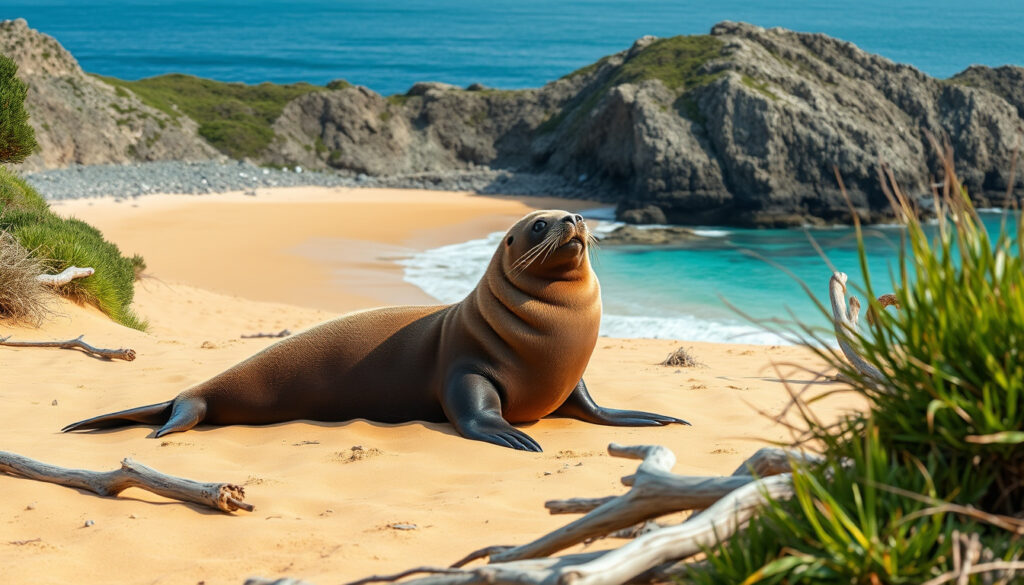
There’s something quietly extraordinary about a sea lion the size of a grand piano treating a Dunedin beach like its front porch — after more than 150 years of breeding almost entirely in the subantarctic, New Zealand sea lions are showing up on South Island beaches again, a return documented by the New Zealand Department of Conservation (national wildlife authority). This guide covers how to tell them apart from fur seals, where to see them safely, and what the comeback really means for visitors.
Scientific Name: Phocarctos hookeri ·
IUCN Status: Endangered ·
Estimated Population: ~12,000 individuals ·
Adult Male Weight: 300–450 kg ·
Adult Female Weight: 150–200 kg ·
Breeding Season: December to February
Quick snapshot
- Phocarctos hookeri is endemic to New Zealand and among the world’s rarest sea lion species (DOC (national wildlife authority))
- Most breeding happens at the Auckland Islands and Campbell Island/Motu Ihupuku (DOC (national wildlife authority))
- Protected under the Marine Mammals Protection Act 1978 (DOC (national wildlife authority))
- Legal viewing distance: 20 metres, dogs included (DOC (national wildlife authority))
- Exactly how many sea lions live on the mainland versus the subantarctic islands (DOC (national wildlife authority))
- How climate change will affect long-term recovery (DOC (national wildlife authority))
- Whether current bycatch mitigation measures are effective (DOC (national wildlife authority))
- Returning to mainland beaches after more than 150 years of near-total absence (DOC (national wildlife authority))
- Breeding season runs December to February — the peak mainland viewing window (DOC (national wildlife authority))
- Small breeding colonies now established around Rakiura/Stewart Island, Otago, and the Catlins (DOC (national wildlife authority))
- Report non-emergency sightings online with date, time, location, and photos (DOC (national wildlife authority))
- Call 0800 DOC HOT (0800 362 468) for distressed, injured, or harassed animals (DOC (national wildlife authority))
- Keep dogs on leads at Otago beaches DOC identifies as sea lion sites (DOC (national wildlife authority))
The pattern: DOC’s own records keep pulling the sea lion’s story back to the mainland, not just its subantarctic strongholds.
Eight entries, one pattern: the sea lion’s weight, diet, and breeding schedule set the terms for where it can survive.
| Attribute | Detail |
|---|---|
| Scientific Name | Phocarctos hookeri |
| Common Names | New Zealand sea lion, Hooker’s sea lion, pakake |
| IUCN Status | Endangered (DOC (national wildlife authority)) |
| Population Estimate | ~12,000 individuals (IUCN); DOC’s current guidance puts the total around 10,000 (DOC (national wildlife authority)) |
| Adult Male Weight | 300–450 kg |
| Adult Female Weight | 150–200 kg |
| Breeding Season | December to February |
| Typical Diet | Fish, squid, crustaceans |
Are New Zealand fur seals actually sea lions?
Short answer: no. The New Zealand fur seal and the New Zealand sea lion share a family — Otariidae, the eared seals — but they are different genera, and the safety guidance for each is not identical (DOC (national wildlife authority)).
What is the difference between a seal and a sea lion?
- Both are otariids — eared seals — but in different branches: fur seals belong to Arctocephalus, sea lions to Phocarctos.
- Sea lions have small, visible external ear flaps, large front flippers, and can walk on land.
- Fur seals are named for their coats: far thicker and denser than a sea lion’s.
- In New Zealand, the confusion is between the New Zealand fur seal (Arctocephalus) and the New Zealand sea lion (Phocarctos hookeri).
The New Zealand sea lion — also called pakake or whakahao in te reo Māori — is found nowhere else on Earth, and DOC’s species guidance lists it as one of the world’s rarest sea lions (DOC (national wildlife authority)).
The word “seal” is doing double duty. DOC files the sea lion under its seals collection, yet the animal is not a seal in the everyday sense — a different genus, with different behavior and different rules.
How to tell them apart?
- Coat: fur seals look shaggier and thicker; sea lions look sleeker.
- Ears: a sea lion’s small ear flaps are visible; a fur seal’s ears hide under dense fur.
- Movement: sea lions use their large front flippers to move with surprising ease on land.
The distinction changes beach behavior. DOC notes that, unlike with fur seals, a person may walk between a sea lion and the water — unless the animal is heading toward the sea (DOC (national wildlife authority)).
Where can I see sea lions in NZ?
The old answer was “fly to the subantarctic.” The new answer is closer: Dunedin (Ōtepoti) is now the most practical mainland option for visitors, with DOC flagging Otago as a key viewing region (DOC (national wildlife authority)).
Best beaches in Dunedin
- Tomahawk
- Smaills Beach
- Warrington
- St Clair
- St Kilda
- Allans Beach
- Aramoana
- Kaka Point and Tautuku, south toward the Catlins
DOC identifies all of these as Otago-area locations associated with sea lions, with beaches and dunes treated as important visitor-viewing areas (DOC (national wildlife authority)). Sea lions also rest in dunes and coastal forest, where their coloring makes females and young males genuinely hard to spot (DOC (national wildlife authority)).
A sea lion asleep in the dunes is not a photo opportunity; it’s an Endangered animal at rest. DOC’s beach list doubles as a list of places to keep your dog leashed and your distance.
Other locations on South Island
- Rakiura/Stewart Island — small breeding populations (DOC (national wildlife authority))
- The Catlins — Kaka Point and Tautuku (DOC (national wildlife authority))
- The Auckland Islands and Campbell Island/Motu Ihupuku — where most breeding still occurs (DOC (national wildlife authority))
- Non-breeding sea lions occasionally appear along the South Island’s south and east coasts (DOC (national wildlife authority))
Treat the mainland as the front line and the subantarctic as the stronghold. DOC’s population data makes clear that the species’ future still depends on those remote islands (DOC (national wildlife authority)).
When is the best time to visit?
- December to February — breeding season, and the peak window for pups on beaches (DOC (national wildlife authority))
- Year-round — non-breeding sea lions can appear in any month (DOC (national wildlife authority))
- Summer caveat — more beach-goers means more chance of accidental encounters; the 20-metre rule stays fixed (DOC (national wildlife authority))
The trade-off: the best odds of seeing a pup fall in the busiest beach months, when keeping 20 metres is hardest. That is exactly when Otago needs the most patience.
How many NZ sea lions are left?
Thousands, not tens of thousands — and the exact count depends on who is counting (DOC (national wildlife authority)).
Population trends
- Around 10,000 — DOC’s current public guidance estimate (DOC (national wildlife authority))
- ~12,000 — the population estimate cited in IUCN-framed profiles, compared with DOC’s ~10,000 (DOC (national wildlife authority))
- Most breeding at the Auckland Islands and Campbell Island/Motu Ihupuku (DOC (national wildlife authority))
- Smaller breeding populations around Rakiura/Stewart Island, Otago, and the Catlins (DOC (national wildlife authority))
Population figures for this species vary by source. We cite both the IUCN-framed estimate (~12,000) and DOC’s current public guidance (~10,000) so readers can see the range rather than a single false-precise number.
The distribution is the species’ core vulnerability: a large share of the world population depends on a handful of subantarctic beaches that are far from monitoring and rescue networks. That concentration is why population counts remain cautious (DOC (national wildlife authority)).
IUCN status
- The IUCN Red List lists Phocarctos hookeri as Endangered — a designation DOC’s species guidance reflects (DOC (national wildlife authority))
- Endemic to New Zealand — found nowhere else (DOC (national wildlife authority))
- Among the world’s rarest sea lion species (DOC (national wildlife authority))
“Endangered” is not a vague label. In the IUCN framework it means the species faces a high risk of decline unless the pressures on it are managed — and in this case the pressures have names: bycatch, disease, and disturbance (DOC (national wildlife authority)).
Threats
- Fishing bycatch — the leading documented threat (DOC (national wildlife authority))
- Disease outbreaks — a recurring concern for a small, concentrated population (DOC (national wildlife authority))
- Habitat disturbance on beaches, including by people and dogs (DOC (national wildlife authority))
- Climate-driven changes to the marine environment — impact still uncertain (DOC (national wildlife authority))
Bycatch is the number to watch. Until there is clear evidence that current mitigation measures work, every fishing season is an open question for a population that breeds on so few beaches.
Will a sea lion hurt a human?
Sea lions do not hunt people, but they are not cuddly, either. They are large, territorial, and intensely curious — and the New Zealand Sea Lion Trust warns that a sea lion may investigate a person with its mouth, which is precisely the situation to avoid (NZ Sea Lion Trust (conservation charity)).
Are sea lions aggressive?
- Males are territorial and may charge if they feel threatened, especially during breeding season (December to February).
- Hissing is the warning signal — it means “back off.”
- Curiosity is not friendliness: a sea lion that approaches and opens its mouth is one step from a bite (NZ Sea Lion Trust (conservation charity)).
DOC’s guidance treats aggression as preventable: don’t crowd the animal, don’t corner it, and don’t let a dog get near it (DOC (national wildlife authority)).
What to do if a sea lion approaches you
- On land: stay calm, avoid direct eye contact, and back away slowly (DOC (national wildlife authority))
- In the water: move away slowly and avoid direct eye contact (DOC (national wildlife authority))
- Never touch, feed, chase, or pose next to it (NZ Sea Lion Trust (conservation charity))
- Keep dogs leashed and at least 20 metres away (DOC (national wildlife authority))
- Report a sea lion that is severely distressed, seriously injured, entangled, or being harassed: 0800 DOC HOT (0800 362 468) (DOC (national wildlife authority))
One DOC detail surprises most people: unlike with fur seals, you may walk between a sea lion and the water — unless the animal is heading toward the sea. The principle is not to trap it or block its route (DOC (national wildlife authority)).
A calm sea lion is not giving you permission; it is deciding whether you count as a threat. The Trust’s warning is blunt: curiosity plus mouths equals unsafe.
Why do sea lions hiss?
- Hissing is a warning that you are too close (DOC (national wildlife authority))
- It often happens when the animal’s path to the water is blocked.
- If you hear it, back away slowly and leave a clear escape route (DOC (national wildlife authority)).
Why this matters: most sea lion “attacks” are warnings that were ignored. The hiss is a distance rule written in behavior — and DOC’s 20 metres is the translation (DOC (national wildlife authority)).
What predator kills sea lions?
Ask any marine biologist which animal eats New Zealand sea lions, and the answer is a remarkably short list: orcas, great white sharks, and — far deadlier — fishing gear (DOC (national wildlife authority)).
Natural predators in New Zealand
- Orcas (killer whales) are known predators of sea lions in New Zealand waters (DOC (national wildlife authority))
- Great white sharks take sea lions, particularly young animals (DOC (national wildlife authority))
- Fishing bycatch remains the leading documented killer of New Zealand sea lions (DOC (national wildlife authority))
On land, the opposite is true: New Zealand has no native predator capable of taking a healthy adult sea lion. The real land-based threat is disturbance from humans and dogs — the reason DOC keeps pushing the 20-metre rule (DOC (national wildlife authority)).
Biggest predator in NZ waters
- The orca is New Zealand’s largest apex marine predator (DOC (national wildlife authority))
- Orcas hunt in groups and are known to take sea lions (DOC (national wildlife authority))
- White sharks complete the short list of natural predators (DOC (national wildlife authority))
The pattern: nature gives the sea lion a short list of predators, but human fishing activity outranks them all. That is why the Endangered status is a management problem as much as a biological one.
Six rows, one pattern: two close cousins that humans keep collapsing into one word — “seal” — even though their coats, ears, and beach behavior differ.
| Trait | New Zealand fur seal | New Zealand sea lion |
|---|---|---|
| Family | Otariidae (eared seals) | Otariidae (eared seals) |
| Genus | Arctocephalus | Phocarctos |
| External ears | Small flaps, often hidden by thick fur | Small, visible ear flaps |
| Coat | Thick, dense, shaggy fur | Sleeker, shorter coat |
| Front flippers | Long flippers built for swimming | Large, powerful flippers that also work well on land |
| New Zealand species | New Zealand fur seal (Arctocephalus) | Phocarctos hookeri — pakake/whakahao (DOC (national wildlife authority)) |
The catch: on a New Zealand beach, “it’s just a seal” is not a good enough ID. The sea lion’s behavior and legal protection are distinct enough that a loose label gets people into trouble.
Twelve facts, one pattern: a heavy, long-lived, Endangered animal whose breeding season lasts barely three months.
| Attribute | Detail |
|---|---|
| Scientific name | Phocarctos hookeri |
| Māori names | pakake, whakahao |
| Family | Otariidae (eared seals) |
| IUCN status | Endangered (DOC (national wildlife authority)) |
| Population estimate | ~12,000 (IUCN); ~10,000 per DOC guidance (DOC (national wildlife authority)) |
| Adult male weight | 300–450 kg |
| Adult female weight | 150–200 kg |
| Breeding season | December to February |
| Typical diet | Fish, squid, crustaceans |
| Lifespan | 20–25 years |
| Legal protection | Marine Mammals Protection Act 1978 (DOC (national wildlife authority)) |
| Primary breeding sites | Auckland Islands; Campbell Island/Motu Ihupuku (DOC (national wildlife authority)) |
What this means: a short breeding window and a small set of breeding beaches concentrate the whole species’ risk into a few summer weeks.
Confirmed facts
- Phocarctos hookeri is endemic to New Zealand (DOC (national wildlife authority))
- Most breeding occurs at the Auckland Islands and Campbell Island/Motu Ihupuku (DOC (national wildlife authority))
- Disturbing, harassing, harming, or killing a sea lion is illegal under the Marine Mammals Protection Act 1978 (DOC (national wildlife authority))
- DOC’s legal viewing distance is 20 metres; dogs must be leashed at the same distance (DOC (national wildlife authority))
What’s unclear
- How many sea lions actually live on the mainland versus the subantarctic (DOC (national wildlife authority))
- Whether the new mainland breeding colonies will keep growing (DOC (national wildlife authority))
- The long-term impact of climate change on the population (DOC (national wildlife authority))
- Whether current fishing bycatch mitigation is working (DOC (national wildlife authority))
- How rising visitor numbers will interact with a recovering species (DOC (national wildlife authority))
DOC and the New Zealand Sea Lion Trust agree on the fundamentals — here is the advice they repeat to visitors.
“If a sea lion approaches on land, stay calm, avoid direct eye contact, and back away slowly.”
— New Zealand Department of Conservation (national wildlife authority)
“Sea lions can be curious and may investigate people with their mouths, making interaction unsafe.”
— New Zealand Sea Lion Trust (conservation charity)
“Don’t touch, feed, chase, pose with, or otherwise engage a sea lion.”
— New Zealand Sea Lion Trust (conservation charity)
The New Zealand sea lion’s return to mainland beaches is a rare conservation win with a new condition attached: humans have to share the sand. For visitors to Otago and the Catlins this summer, the choice is clear — keep 20 metres, leash the dog, and treat a hiss as a final warning, or watch a species that spent 150 years away get pushed back to the edge it just climbed away from.
mpi.govt.nz, doc.govt.nz, doc.govt.nz, en.wikipedia.org, learnz.org.nz
Frequently asked questions
Which is friendlier, a seal or a sea lion?
Neither is friendly in the pet sense. New Zealand sea lions are curious and may approach people, which the NZ Sea Lion Trust (conservation charity) warns can become unsafe if the animal investigates with its mouth. The safest animal is the one that keeps its distance.
Who is more aggressive, a seal or a sea lion?
Male New Zealand sea lions can be aggressive when threatened, especially during breeding season from December to February, and may charge. Hissing is the warning to back away (DOC (national wildlife authority)).
What is the biggest predator in New Zealand?
The orca (killer whale) is New Zealand’s largest apex predator and is a known predator of sea lions (DOC (national wildlife authority)).
Is sea lion meat tasty?
It is not a legal food option. New Zealand sea lions are fully protected under the Marine Mammals Protection Act 1978, so hunting, killing, or possessing sea lion meat is illegal (DOC (national wildlife authority)).
How long do New Zealand sea lions live?
Roughly 20–25 years (DOC (national wildlife authority)).
What do New Zealand sea lions eat?
Fish, squid, and crustaceans (DOC (national wildlife authority)).
Are sea lions protected in New Zealand?
Yes. The Marine Mammals Protection Act 1978 makes it illegal to disturb, harass, harm, injure, or kill a New Zealand sea lion, and DOC’s guidance sets a 20-metre viewing distance (DOC (national wildlife authority)).
More related posts
 His and Hers Netflix: Complete Plot, Killer & Cast Guide
 Cast of Nine Perfect Strangers: Seasons 1 & 2 Guide
 How to Register a Company in New Zealand: Step-by-Step Guide
 What Time is the Warriors Game Tonight – Start Time, TV & Injuries
 A Week in Paradise (2022): Cast, Plot & Filming Location
 Black Snow Season 2: Release, Cast, Episodes & Season 3
 Bluetooth Transmitter for Car – Best Picks and Buying Guide
