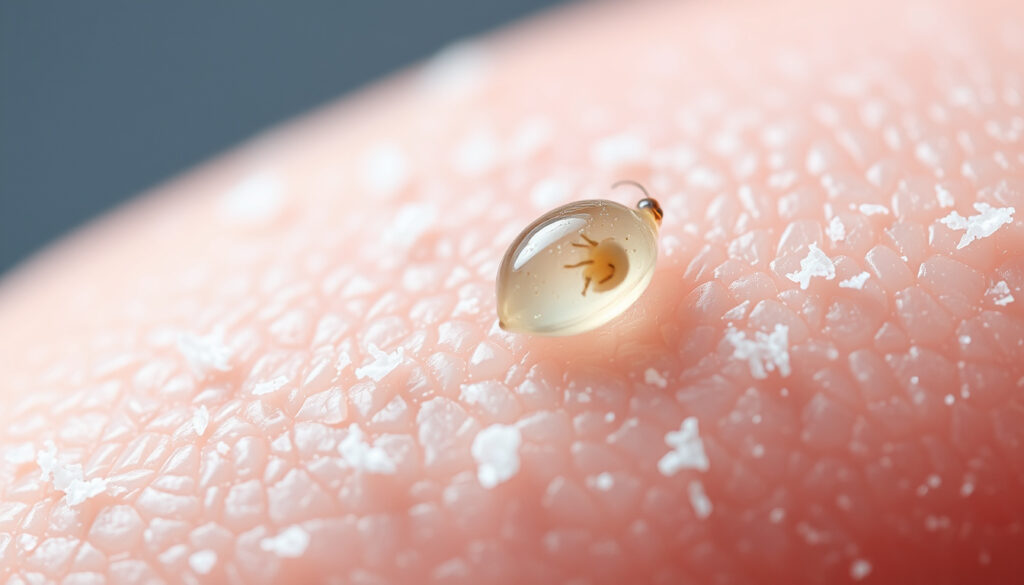
Lice Egg on Finger: ID vs Dandruff & Removal
You just spotted a pale speck on your finger — a head-louse egg, or nit, measures only about 0.8 mm long, roughly the size of a sesame seed. Here’s how to tell a lice egg on your finger from dandruff and lint, what the squash test really proves, and how to remove nits for good.
Egg size: about 0.8 mm ·
Hatch time: 6–9 days ·
Survival off scalp: up to 48 hours ·
Eggs per day: 6–10 ·
Nits per child: 50–150
Quick snapshot
- Dandruff flakes slide off hair fibers, while nits stay attached (Head & Shoulders UK (dandruff treatment brand))
- A live egg may make a pop sound if crushed between fingernails (Better Health Channel (Victoria state government health service))
- Oval, sesame-seed shape; about 0.8 mm by 0.3 mm (Healthgrades (medical information platform))
- Nits can be white, grey, or yellowish — the same palette as fluff, dandruff, or dirt (Fraser Health (Canadian regional health authority))
- Eggs hatch 6–9 days after being laid (INTEGRIS Health (Oklahoma-based nonprofit health system))
- Roughly 9–12 days later, the nymph becomes an adult capable of laying eggs. (INTEGRIS Health (Oklahoma-based nonprofit health system))
- Egg casings are pesticide-resistant and can outlast a completed treatment (University of Georgia Extension (public university research service))
- Comb wet, conditioned hair with a fine-tooth nit comb every 3–4 days for at least 2 weeks (Better Health Channel (Victoria state government health service))
- Screen in strong light with a magnifier or phone camera — daily for 10 days after treatment (University of Georgia Extension (family health guide))
- Wash bedding hot and seal soft toys to break the cycle. (Better Health Channel (Victoria state government health service))
Six specs, one pattern: a nit is a tiny anchored capsule, not a loose flake — and every measurement matters for field identification.
| Attribute | Value | Source |
|---|---|---|
| Egg length | 0.8 mm (0.03 in) | Healthgrades (medical information platform) |
| Color before hatch | Tan to dark brown | University of Georgia Extension (public university research service) |
| Color after hatch | White or translucent | Fraser Health (Canadian regional health authority) |
| Attachment method | Cement-like glue from female louse | Head & Shoulders UK (dandruff treatment brand) |
| Time to hatch | 6–9 days at scalp temperature | Healthgrades (medical information platform) |
| Distance from scalp for viable eggs | Usually within 1 cm (0.4 in) | INTEGRIS Health (Oklahoma-based nonprofit health system) |
How to tell if it’s a lice egg on your finger?
Start with geometry. A nit looks like a tiny teardrop or sesame seed pressed onto a hair; dandruff looks like a crushed chip.
Visual characteristics of a lice egg versus dandruff
- Location: nits glue themselves to hair near the scalp, while dandruff flakes move freely when you run your hands through hair or shake your head (INTEGRIS Health).
- Shape: nits are oval to teardrop-shaped; dandruff flakes are irregular and flat.
- Size: the same sesame-seed scale mentioned above — about 0.8 mm long.
The most useful single clue is adhesion. Dandruff chips off when you drag a fingernail across it; a nit resists.
Adhesion test: why lice eggs stick to hair and fingers differently
A nit’s glue is waterproof and tough — that’s the whole point. If a speck on your finger slides off with zero resistance, it’s probably not a living egg.
- On hair: nits stay attached while dandruff slides off — the core contrast that makes the ID possible.
- On a finger: an egg that turns up loose almost certainly came off during scratching or brushing, not from hatching on skin.
- A nit that reaches a finger is usually dead, empty, or already dislodged from its glue.
Try the slide test: rest the speck on a flat surface and drag a fingernail over it. Dandruff crumbles; a nit rolls or pops.
What could be mistaken for lice eggs on the finger?
- Hair product residue: greasy, clumped, and smears under pressure.
- Lint or fabric fibers: fuzzy edges, visible threads, usually white or colored.
- Scabs or dry skin: brownish, irregular, and attached to broken skin rather than hair.
None of these have the two signature traits of a nit: a smooth oval shell and a firm grip on a hair strand.
Can you squish a lice egg on your finger?
Yes — and the sound it makes is the useful part. This is the closest thing head-lice removal has to a field test.
The ‘pop’ test: identifying live vs dead eggs
- A live egg may make an audible pop when crushed between fingernails — the Better Health Channel (Victoria state government health service) describes exactly this.
- Hatched shells and old eggs are flat, dry, and crush silently.
- The pop is pressure release, not proof of a baby louse inside.
Crush a live nit on a tissue and you’ll often see a small wet spot — the interior of a fresh egg is fluid. An empty shell simply cracks dryly.
What a squished lice egg looks like
- Fresh egg: a tiny moisture mark, possibly a brownish dot, with the oval shell split open.
- Old or hatched shell: flat, dry, whitish — it fractures into papery pieces.
- Dandruff: crumbles into powdery dust instead of popping.
Don’t judge by eye alone. A phone camera zoomed in or a drugstore magnifier shows the difference between a smooth shell and an irregular flake.
Squishing one egg is identification, not treatment. Every popped nit is confirmed — but the rest of the scalp still needs a comb, not a thumbnail.
The trade-off: a pop is strong evidence of a live egg when you hear it, but silence proves nothing — tiny eggs can squash without a sound.
Why am I finding lice eggs but no bugs?
Few things feel grosser than finding eggs and no insects. It’s also one of the most common questions lice-removal pros hear.
Lice lifecycle: eggs visible before adults
- The hatch window sits at 6–9 days, so eggs can appear before adults are obvious (INTEGRIS Health).
- It takes roughly 9–12 days for a nymph to become an adult, leaving a window where eggs exist but adult lice haven’t shown up yet.
- A female louse lays a steady stream of eggs — the stats line above puts it at 6–10 per day.
So finding nits without bugs can simply mean the infestation is young, or that you’re looking at the tail end of an old one.
Incomplete cure or residual nits
- Head-lice eggs are resistant to pesticides, which is why manual removal is often needed — and why a finished shampoo doesn’t mean a finished infestation.
- After treatment, empty egg shells can stay glued to hair for weeks, making it look like the lice never left.
- Health services keep pushing the comb because the shampoo alone misses the eggs.
The empty-shell effect is the most common reason parents re-treat a head that’s already clear.
Pets and environment factors
- Lice are human parasites — they don’t come from dogs, cats, or furniture.
- Eggs on pillows are unlikely to hatch; a scalp is the only incubator they use.
- If new eggs keep appearing, the likely source is another human head: hats, helmets, shared brushes, pillowcases, or head-to-head contact.
The implication: eggs without bugs usually means leftover shells, an early infestation, or a missed contact — not an outbreak from your sofa.
How to remove lice eggs from hair permanently?
Permanent removal is a system, not a single magic squeeze. The reliable protocol combines chemical treatment, wet combing, and five minutes of patience every few days.
What kills lice eggs instantly?
- Most over-the-counter treatments kill live lice but not all eggs; repeat application is usually required.
- Heat kills eggs — which is why hot-water laundering is part of the protocol.
- No single product kills every egg instantly. The phrase shows up in ads; the science shows up in repeat combing.
Pharmacy treatments with permethrin or spinosad are the usual first line, but many labels tell you to re-treat after about a week — matching the 6- to 9-day hatch window.
Wet combing technique
Conditioner on wet, detangled hair makes lice grip less — that’s the trick. Slick hair plus a fine-tooth comb removes what chemicals can’t.
Here’s the protocol public-health services keep coming back to:
- Wet the hair and apply conditioner generously.
- Detangle first, then divide the hair into small sections.
- Comb each section from root to tip with a fine-tooth nit comb.
- Wipe the comb on a paper towel after each pass and look for eggs.
- Repeat every 3–4 days for at least 2 weeks. This catches newly hatched nymphs before they mature.
Using a nit comb correctly
- Work in a well-lighted area and use a magnifier or phone camera to spot nits.
- Comb in thin sections, not big handfuls — missed strands are how eggs survive.
- Metal combs keep their tooth spacing better than cheap plastic ones; a specialty fine-tooth nit comb is the tool to keep.
Screen daily for about 10 days after treatment — that rhythm is what catches the second-generation hatch.
The pattern: consistent wet combing is the only way to ensure no eggs remain and break the cycle.
Can I sleep in my bed if I have lice?
Short answer: yes, once you wash the bedding. Head lice are not bed bugs — they don’t live in mattresses or come out at night.
How long lice survive on pillows and bedding
- An adult louse survives only about 48 hours off the scalp at room temperature — and it rarely leaves a head voluntarily.
- Eggs need scalp warmth to hatch; a pillow at room temperature is a dead end.
- The real risk is hair-to-hair contact, not your pillowcase.
The short survival window is why household cleaning is important but should stay proportionate.
Cleaning recommendations for infested bedding
- Wash bedding in hot water — at least 130°F (54°C) — and dry on high heat.
- Stuffed animals and non-washables can be sealed in a plastic bag for two weeks.
- Brushes and combs should soak in hot water; a quick rinse won’t dislodge glued eggs.
You don’t need to fumigate the house. The head is the ecosystem; the bedding is just a transit stop.
Why this matters: parents often exhaust themselves cleaning the bedroom while the actual source — another head — keeps re-infesting. Spend the energy on combing, not on furniture spray.
Lice egg vs dandruff on a finger
Six quick comparisons, one pattern: nits are engineered to stay put, while dandruff and lint leave at the lightest touch.
| Feature | Nit (lice egg) | Dandruff or debris | Source |
|---|---|---|---|
| Shape | Oval, teardrop, sesame-seed | Irregular flakes or chips | Head & Shoulders UK (dandruff treatment brand) |
| Size | About 0.8 mm × 0.3 mm | Variable, often larger, no set shape | Healthgrades (medical information platform) |
| Color | Tan, brown, gray-white before hatch; pale after | White, gray, yellowish | Fraser Health (Canadian regional health authority) |
| Adhesion | Glued to hair; resists brushing | Slides off or crumbles | Head & Shoulders UK (dandruff treatment brand) |
| Crush response | Live egg pops; empty shell flattens | Crumbles into powder | Better Health Channel (Victoria state government health service) |
| Location | On hair strands, usually near the scalp | On scalp skin and scattered through hair | INTEGRIS Health (Oklahoma-based nonprofit health system) |
The pattern: every row on the left describes something fixed and durable; every row on the right describes something loose and temporary. That’s the whole identification trick.
Nit identification specs
Eight field specs, one takeaway: if it doesn’t have the shape, the size, and the glue, it’s not a nit.
| Spec | Measurement | Why it matters |
|---|---|---|
| Length | About 0.8 mm | Sesame-seed scale; invisible from across a room. |
| Width | About 0.3 mm | More oval than round — a key shape clue. |
| Pre-hatch color | Tan to brown, grayish-white | Matches many hair colors and hides well. |
| Post-hatch color | White or translucent | Empty shells linger for weeks after treatment. |
| Adhesive | Water-resistant cement | Normal shampooing won’t remove it. |
| Distance from scalp | Within 1 cm (0.4 in) for viable eggs | Farther down the strand usually means hatched. |
| Hatch window | 6–9 days | Re-treat and comb around day 9–10 to catch nymphs. |
| Off-scalp survival | Up to 48 hours at room temperature | Bedding risk is real but low; hot-water washing closes it. |
The trade-off: the same traits that make nits hard to remove — glue and a tough shell — are exactly what make them identifiable.
How to get nits out for good: step-by-step
The order matters as much as the tools. This sequence follows public-health guidance from the Better Health Channel and the University of Georgia Extension.
- Treat. Apply a pharmacy or prescription product with permethrin or spinosad according to the label; most protocols include a second application 7–9 days later.
- Condition and detangle. Slick, conditioned hair makes it harder for lice and eggs to cling during combing.
- Comb in sections. With a fine-tooth nit comb, work through small, clipped sections from root to tip.
- Wipe and inspect. After each pass, wipe the comb on a paper towel and inspect for eggs under strong light or a magnifier.
- Repeat. Comb every 3–4 days for at least 2 weeks to catch newly hatched nymphs before they mature.
- Screen and clean. Check every head in the household, wash bedding in hot water, and dry on high heat.
The catch: treatment kills the insects, but the comb removes the future. Skip the comb and you’ll be back at step one in about nine days.
What we know — and what we don’t
The head-lice literature is heavily weighted toward what works for live lice; the egg side is thinner. Here’s the balanced read.
Confirmed facts
- Dandruff slides off hair while nits stay attached — that contrast is the standard reference point.
- A live egg can pop when crushed; hatched shells flatten instead.
- Nits are oval, around 0.8 mm long, and usually found close to the scalp.
What’s unclear
- Off-scalp survival beyond 48 hours varies with humidity and is hard to predict.
- Home remedies such as tea tree oil and mayonnaise are widely repeated but lack consistent clinical evidence for killing eggs.
- Visual ID alone can’t always separate a live egg from an empty shell without magnification.
- A single “pop” isn’t a guarantee — tiny live eggs can crush without an audible sound.
The pattern: the more confident the claim, the better sourced it should be. The uncertain list matters just as much, because over-the-counter solutions overpromise on eggs.
What the experts say
“Nits are firmly attached to the hair shaft and cannot be brushed off easily.”
— Better Health Channel (Victoria state government health service), head lice and nits guide
“Dandruff flakes slide easily off hair fibers, while nits stay attached.”
— Head & Shoulders UK (dandruff treatment brand), lice vs dandruff comparison
“A nit will not move until it is dislodged.”
— Fraser Health (Canadian regional health authority), head lice information
The through-line: every expert source names the same two clues — glued to the hair, not loose on the scalp.
The final takeaway
A speck on your finger is rarely an emergency, but it’s an early warning system. Check the shape, try the adhesion test, and if it rolls instead of crumbling, treat it like a nit until proven otherwise. For parents combing through a child’s hair at midnight, the choice is clear: learn the pop test and keep a fine-tooth nit comb in the bathroom drawer — or spend the next two weeks wondering whether that speck is going to hatch.
Related reading
- White Tail Spider Bite NZ: Symptoms & Treatment — another small-and-scary skin mystery, identified by evidence.
- How Long Does Viagra Last? Duration & Key Facts — a plain-numbers guide to a question everyone asks differently.
scienceinsights.org, lcasacramento.com, soporte.colineal.com, nit-picky.com, myliceadvice.com
Frequently asked questions
Can lice eggs survive off the human body?
Lice can survive up to about 48 hours off the scalp at room temperature. Eggs are a bit sturdier, but they still need scalp warmth and moisture to hatch reliably.
How long does it take for lice eggs to hatch?
About 6–9 days after being laid at scalp temperature. That’s why re-treatment and combing around day 9–10 matters.
Do lice eggs look like dandruff on the hair?
Yes — that’s the most common ID mistake. Nits are oval and glued to the strand; dandruff is irregular and slides off easily.
What is the difference between a nit and a louse?
A nit is the egg; a louse is the insect. A female louse lays the eggs, the eggs hatch into nymphs, and the nymphs become adult lice.
Can you get lice from a pillow?
In theory yes — lice can survive up to 48 hours off the scalp — but it’s rare, because lice prefer a live scalp. Washing bedding in hot water and drying on high heat removes the risk.
Do lice prefer clean or dirty hair?
No. Lice feed on blood from the scalp, so hair hygiene doesn’t attract or repel them.
Is it possible to have only lice eggs and no adults?
Yes, especially after treatment. Live eggs can hatch 6–9 days later, and empty shells can remain glued to hair for weeks, so keep combing.
More related posts
 Chri tma with the Krank : Where to Stream in 2025
 Pulled Beef Slow Cooker: Best Cuts, Tips & Mistakes
 Less Than or Equal To Symbol (≤): Meaning, Examples, Typing Guide
 Wet and Forget Christchurch: Buy, Recall, and Usage Guide
 BNZ KiwiSaver Withdrawal Form: Download PDF & Step-by-Step Guide
 How to Reduce Cortisol: Signs, Best Reducer & Fastest Way
 White Tail Spider Bite NZ: Symptoms & Treatment
 Who Is the New Pope? Meet Pope Leo XIV (Robert Prevost)
