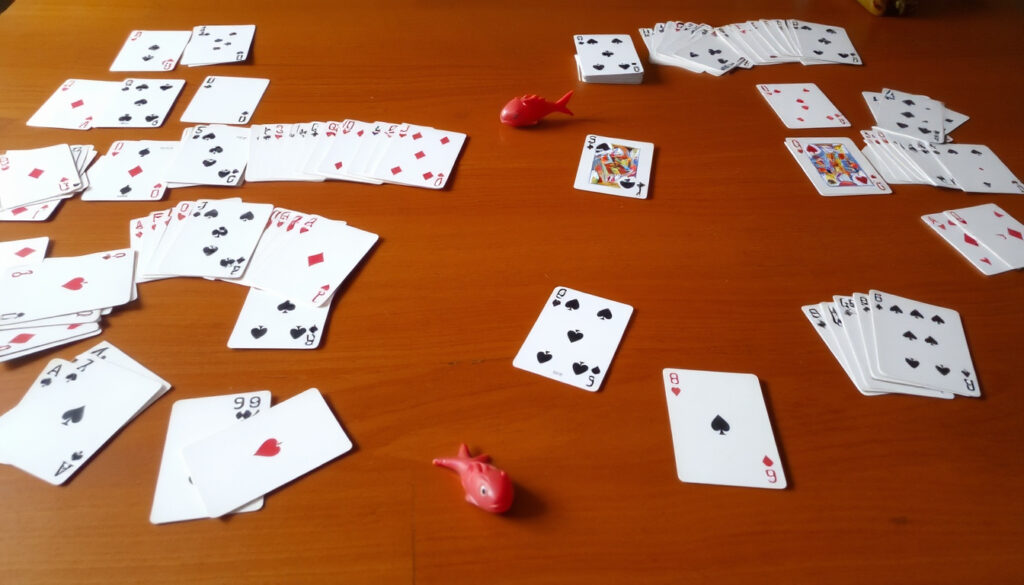
How to Play Go Fish: Rules and Card Count
There’s something almost magical about teaching a child a card game for the first time. Go Fish is often the first game kids learn, and for good reason: the rules are simple, the pace is gentle, and the only real requirement is remembering which cards you’ve seen. In this guide, we’ll walk through the official rules, card counts for different player numbers, and how to keep the game fun for everyone—whether you’re a parent, teacher, or just brushing up on the basics.
Players: 2–6 ·
Deck: 52 cards (standard) ·
Age: 4+ ·
Goal: Collect the most pairs ·
Deal (2–4 players): 7 cards each ·
Deal (5–6 players): 5 cards each
Quick snapshot
- Official rules require players to truthfully answer when asked for a card (Official Game Rules (game reference site))
- 2–4 players receive 7 cards each; 5–6 players receive 5 each (University of Waterloo (child development research))
- Whether drawing a card that creates a pair always grants an extra turn—some sources say yes, others tie it to asking only
- House rules about lying vary; no universal penalty
- Players take turns asking for cards; each successful ask grants another turn; a failed ask ends the turn (My Baba (parenting resource))
- After all pairs are collected or draw pile exhausted, the player with the most pairs wins (My Baba (parenting resource))
The essential data on dealing, play, and winning appears in the table below.
| Attribute | Value |
|---|---|
| Players | 2–6 |
| Deck | 52 cards |
| Age | 4+ |
| Game length | 10–20 minutes |
| Goal | Collect the most pairs (books) |
| Brand required | No specific brand required |
How do you play Go Fish?
The basic loop of Go Fish is deceptively simple. After the deal, each player looks at their hand. On your turn, you ask one opponent for a specific rank—for example, “Do you have any sevens?”—but you must already hold at least one card of that rank to ask (My Baba (parenting resource)).
- If the opponent has cards of that rank, they must give all of them to you. You then take another turn.
- If the opponent has none, they say “Go fish!” and you draw one card from the draw pile. Your turn ends (Official Game Rules (game reference site)).
- If the drawn card matches the rank you asked for, many rule sets let you continue your turn (Official Game Rules (game reference site)).
- When you collect four cards of the same rank, that set—called a “book”—is placed face up on the table (Official Game Rules (game reference site)).
What do you do when someone asks you for a card in Go Fish?
If you have the requested card (or cards), you must hand over all copies to the asker. If you don’t have any, you say “Go fish!” and the asker draws from the pile (University of Waterloo (child development research)).
Do you always keep 7 cards in Go Fish?
No—the number of cards dealt depends on how many people are playing. The most commonly cited rule comes from the University of Waterloo’s Children’s Communication Lab (child development research): for 2 to 4 players, each player gets 7 cards; for 5 to 6 players, each gets 5 cards. A similar guideline from Ducksters (kids’ educational site) says 7 cards for 2–3 players and 5 for more than 3.
The pattern is clear: more players mean fewer cards per hand to keep the game moving. Some sources, like My Baba (parenting resource), suggest that when playing with more than 6 players, you should reduce the deal further or split into groups.
For a group of five or six kids, the 5-card deal ensures no one waits too long between turns. The trade-off: fewer cards mean less strategy and more luck, which is perfect for very young players.
The implication: selecting the right deal count is the simplest way to match the game to your group’s attention span.
Are you allowed to lie in Go Fish?
Standard official rules do not allow lying. When asked for a card, you must truthfully answer whether you have it. Official Game Rules (game reference site) states: “If the player asked has any cards of the named rank, he must give all of them to the asker.” The University of Waterloo (child development research) confirms that the asked player “must give” all cards of that rank.
Many house rules do permit bluffing, but this is not part of the classic game. If you introduce lying as a house rule, it’s wise to set a clear penalty—such as losing a turn or giving up a book—to keep it fair.
Allowing lies turns Go Fish into a different game, one that older kids or adults might enjoy as a variation. For families, the standard no-lying rule is simpler and avoids hurt feelings.
The pattern: house rules that permit lying shift the game from a memory exercise to a social-bluffing contest.
Do you go again if you get a pair in Go Fish?
Yes. The turn-continuation rule is one of the most important to get right. Official Game Rules (game reference site) explains: if you successfully collect a card from another player by asking, you get another turn. If you draw a card that completes a pair, most rules also grant you an extra turn after laying the pair down.
Your turn only ends when you ask for a card that the opponent does not have—then you “go fish” and your turn passes to the left. So the pattern is: ask → if yes, go again; if no, draw and end turn. Laying down a pair (whether from asking or drawing) always gives you one more turn.
The implication: a player who keeps guessing correctly can have a long turn, which keeps the game exciting but also means the other players need to pay attention.
What happens if someone loses all their cards in Go Fish?
When a player runs out of cards, the rules vary slightly. The University of Waterloo (child development research) resource says that if a player has no cards left, they can pick up another 7 cards from the draw pile. However, the My Baba (parenting resource) states that the game ends when the draw pile runs out or when a player has no cards left, depending on the rule set.
Most commonly, if the draw pile is empty and a player has no cards, that player is out. The game continues until all pairs have been formed or no more plays can be made. The winner is the player with the most books (sets of four) at the end (My Baba (parenting resource)).
How to tell who wins in Go Fish?
Count the books each player has collected. The player with the most books wins. Ties can be broken by the total value of cards in their books (aces high, face cards 10 each, or using a point system) or simply replayed.
How to explain Go Fish to a kid?
Teaching a child Go Fish requires breaking the rules into small, digestible pieces. Start with the goal: “We’re trying to match two cards that are the same number.” Then walk through one turn at a time. The University of Waterloo (child development research) suggests playing open-handed for the first few rounds so the child sees how the game flows.
- Use simple language: “Ask your friend for a card you want to match.”
- Focus on the matching: “If you get a pair, put them down and go again.”
- No lying: “You must tell the truth when asked.”
- For very young children, play with a smaller deck—e.g., remove face cards or use only numbers 1–6.
- Set a shorter goal: “First to get three pairs wins.”
The NSW Department of Education (curriculum authority) even adapts Go Fish for math lessons by having kids solve doubles facts before keeping a pair. That kind of variation turns the game into a stealth learning tool.
Young kids can get frustrated if they don’t understand the ask rule. Before playing for real, practice asking “Do you have any threes?” with the cards visible. It builds confidence and keeps the mood light.
The catch: simplifying the rules for a preschooler means sacrificing some strategic depth, but the trade-off is a successful first gaming experience.
Clarity: What we know and what’s still debated
Confirmed facts
- Official rules require truthfulness when asked for a card (Official Game Rules (game reference site))
- Cards dealt: 7 for 2–4 players, 5 for 5–6 players (University of Waterloo (child development research))
- A player who collects cards from another gets another turn (Official Game Rules (game reference site))
- Books (four of a kind) are laid face up and count toward winning (My Baba (parenting resource))
What’s unclear
- Whether drawing a card that creates a pair always grants an extra turn (some sources tie it to asking only)
- House rules about lying vary; no universal penalty exists
- Exact number of players for which 5 cards are dealt—some sources say 5 for 2 players as well
Expert perspectives on Go Fish
“If the player asked has any cards of the named rank, he must give all of them to the asker. The asker then gets another turn.”
— Bicycle Cards (classic playing card manufacturer), official Go Fish rules
“Each player gets 7 cards. The rest of the cards are placed in a pile in the middle as the draw pile. Players try to make matches, that is, pairs of cards.”
— NSW Department of Education (curriculum authority), teaching resource for mathematics
The beauty of Go Fish lies in its adaptability. For parents and educators, the game reliably practices turn-taking, honesty, and basic number recognition. The key is knowing when to stick to the standard rules and when to add a variation that fits the age group. For a preschooler, keep it short and celebrate every pair. For an older child, introduce the penalty for lying as a way to teach consequences. The trade-off between simplicity and depth makes Go Fish a perennial favorite: easy enough for a four-year-old, yet tweakable for a classroom of ten-year-olds. For the adult teaching the game, the choice is clear: start with the official rules, then adapt based on the players in front of you, or risk turning a fun learning moment into a frustrating one.
Related reading: Official Go Fish game rules · Go Fish rules
reddit.com, lovetoknow.com, tabletopgameplanet.com, kidfriendlythingstodo.com, en.wikipedia.org, tothood101.com, kidscardgame.com
Frequently asked questions
Can you play Go Fish with 3 players?
Yes. For 3 players, deal 7 cards each. The game works exactly the same as with 2 or 4 players (University of Waterloo (child development research)).
What is the penalty for lying in Go Fish?
There is no penalty in standard rules because lying is not allowed. In house rules that permit bluffing, common penalties include losing a turn, forfeiting a book, or being forced to draw extra cards (Official Game Rules (game reference site)).
Do you need a special deck for Go Fish?
No. A standard 52-card deck is all you need. Some themed decks exist but are not required (My Baba (parenting resource)).
Can you play Go Fish with more than 6 players?
Yes, but with more than 6, the deal should be reduced—often 4 or 5 cards each—to keep the game from dragging. Alternatively, split into two groups (My Baba (parenting resource)).
What happens if you ask for a card you don’t have?
Official rules require that you must already hold at least one card of the rank you ask for. If you ask for a card you don’t hold, some house rules penalize you by ending your turn or making you draw extra (My Baba (parenting resource)).
Is Go Fish a good game for preschoolers?
Yes, with modifications. Use a smaller deck, play with open hands, and aim for fewer pairs to win. The simple asking-and-answering mechanic builds vocabulary and social skills (University of Waterloo (child development research)).
How do you shuffle the deck for Go Fish?
Any standard shuffle works—riffle, overhand, or a simple mixing on the table. The draw pile just needs to be random (Official Game Rules (game reference site)).
How long does a typical Go Fish game last?
With 2–4 players, a game usually lasts 10–20 minutes. Larger groups take longer because of the increased number of turns (Ducksters (kids’ educational site)).
More related posts
 Bridal Veil Falls Raglan: Walk, Swim & Visitor Guide
 Slot Trial pglucky88.win VIP: Verified & Unverified
 Kids Shoe Size Chart: UK EU US by Age & cm Guide
 Te Aroha Hot Pools: Prices, Hours, Reviews Guide
 Otago Boys’ High School: Fees, Ranking, Principal & More
 St Marks Breast Centre Guide: Services, Cost, and Patient Tips
 How Old Is Cliff Richard? Age, Biography & Health Facts
 Natalie Viscuso (2021–Present) – Henry Cavill Relationship Timeline
