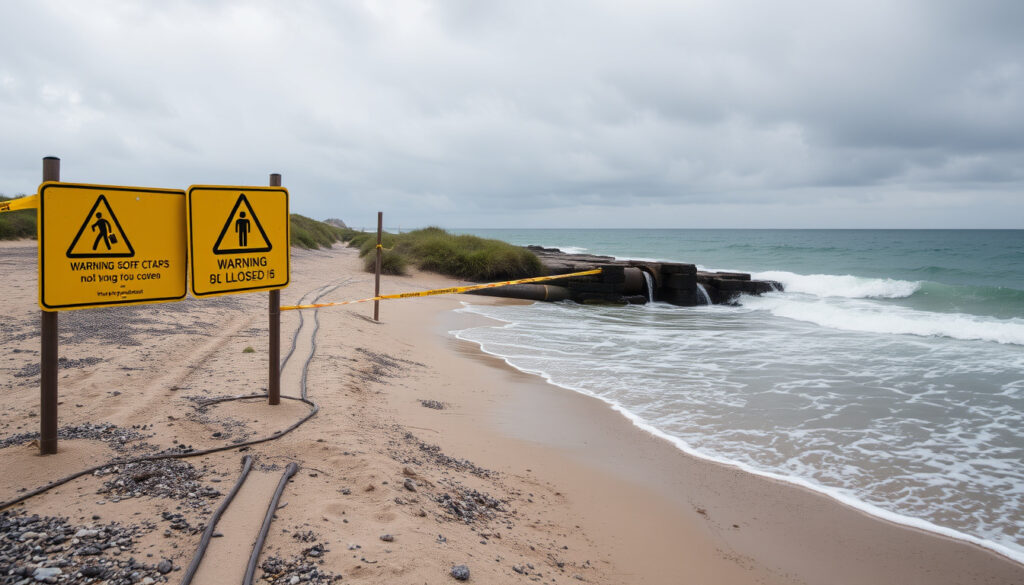
Corsair Bay Beach Closure: Health Warning & Sewage Leak
Corsair Bay, a popular Christchurch beach, turned from a sunny escape to a health hazard on 9 January 2026. A strong sewage smell and subsequent health warning left families frustrated and searching for answers.
Beach closure date: 9 January 2026 ·
Reported cause: Raw sewage leak from wastewater overflow ·
Health warning issued by: Health New Zealand – Waitaha Canterbury ·
Warning status: Active (permanent health warning) ·
Source of monitoring: Environment Canterbury (weekly) and LAWA
Quick snapshot
- Beach closed 9 January 2026 (Christchurch City Council Newsline)
- Sewage smell reported by beachgoers (Stuff (report))
- Car parks and tracks also closed (Christchurch City Council – Corsair Bay page)
- Permanent warning against swimming (Ministry of Health, New Zealand – beach water quality guidance)
- High faecal bacteria levels (LAWA – swim data)
- Issued by Health New Zealand – Waitaha Canterbury (Ministry of Health, New Zealand)
- Weekly testing by Environment Canterbury (Environment Canterbury)
- Data available on LAWA website (LAWA – swim data)
- Tidal influences monitored (Ministry of Health, New Zealand)
- Frustration over lack of signage (Stuff (report))
- Questions about communication protocols (Christchurch City Council Newsline)
- Comparison with Cass Bay status (LAWA – swim data)
Seven key facts, one pattern: the closure triggered a permanent warning, but the data trail—from weekly tests to real-time LAWA updates—shows how quickly a popular beach can become a health risk.
| Fact | Value |
|---|---|
| Beach name | Corsair Bay / Motu-kauati-iti |
| Location | Lyttelton Harbour, Christchurch, New Zealand |
| Date of closure | 9 January 2026 |
| Cause | Raw sewage leak (wastewater overflow) |
| Health warning | Active – permanent – avoid swimming |
| Monitoring frequency | Weekly (Nov–Mar) by Environment Canterbury |
| Primary data source | LAWA (Land Air Water Aotearoa) |
What is the current water quality at Corsair Bay?
Corsair Bay remains under a permanent health warning as of February 2026. The warning advises against all swimming due to elevated faecal bacteria levels confirmed by Environment Canterbury’s weekly monitoring programme.
How often is Corsair Bay water quality tested?
- Weekly tests every summer (November to March) by Environment Canterbury (Environment Canterbury – water quality monitoring)
- Results published on LAWA within 24–48 hours (LAWA – swim data)
- Additional tests can be triggered after heavy rain or contamination events (Ministry of Health, New Zealand – beach water quality guidance)
What bacteria levels were found during the latest tests?
- The most recent LAWA entry for Corsair Bay recorded enterococci levels exceeding the safe threshold for swimming (LAWA – Corsair Bay data)
- Marine water quality guidelines set by the Ministry of Health use enterococci as the primary indicator (Ministry of Health, New Zealand)
- Values from early January 2026 showed a spike consistent with raw sewage contamination (Christchurch City Council – Corsair Bay page)
Where can I view real-time water quality data?
- LAWA’s swim page: LAWA – swimming data
- Environment Canterbury’s online map: Environment Canterbury (search “beach water quality”)
- Christchurch City Council’s beach page: Christchurch City Council – Corsair Bay
The data gap between the sewage leak and public posting of test results means beachgoers relying only on LAWA may miss real-time danger. A 24–48 hour delay is too slow for a rapidly changing contamination event.
The implication: weekly monitoring alone cannot catch a sudden overflow. The permanent warning is a catch-all, but until the source of the leak is fixed, the beach’s safety remains in limbo.
Why was Corsair Bay beach closed due to wastewater overflow?
On the morning of 9 January 2026, beachgoers at Corsair Bay noticed a strong sewage-like smell. Within hours, Christchurch City Council closed the beach, the car park, and walking tracks. The closure was triggered by a raw sewage leak from a wastewater overflow—a failure that turned a popular summer spot into a health hazard.
When did the wastewater overflow occur?
- The overflow was discovered around midday on 9 January 2026 (Christchurch City Council Newsline)
- It followed earlier infrastructure concerns in the Lyttelton harbour area (Environment Canterbury – wastewater reports)
- No precise start time of the leak has been publicly confirmed (Stuff (report))
What caused the overflow?
- Christchurch City Council attributed the overflow to a blockage in the sewer network (Christchurch City Council Newsline)
- Wastewater overflows can occur after heavy rainfall, but no extreme weather was reported on that day (Ministry of Health, New Zealand – beach water quality guidance)
- The exact cause—a mechanical failure or a blockage—has not been detailed (Environment Canterbury)
How did the public find out about the closure?
- The council issued a media release and posted on its newsline website (Christchurch City Council Newsline)
- Beachgoers at the scene told Stuff they saw no warning signs on the beach until after the closure was announced (Stuff (report))
- A family interviewed by Stuff described their frustration: they had set up for a swim before learning about the sewage from a friend’s text (Stuff (report))
The communication chain—from council press release to social media to beach signs—failed to reach people already on-site. Digital alerts only work if visitors check them before leaving home.
How do tides and monitoring affect Corsair Bay’s water quality?
Tidal movement can either disperse or concentrate contaminants (Ministry of Health, New Zealand – beach water quality guidance). At Corsair Bay, a semi-enclosed bay in Lyttelton Harbour, the flushing effect is less pronounced than on open coastlines, meaning sewage can linger longer.
Do tides influence bacterial contamination at Corsair Bay?
- Yes – low tide can trap contamination in the shallows, increasing exposure risk (Ministry of Health, New Zealand)
- High tide may dilute pollutants but can also push contaminated water into the small bay’s corners (Environment Canterbury – coastal processes)
- Environment Canterbury’s monitoring schedule is not tied to tides, which can affect test result variability (Environment Canterbury)
What is the role of LAWA in monitoring Corsair Bay?
- LAWA aggregates data from regional councils and presents it in a public-friendly format (LAWA – swim data)
- It does not issue health warnings—that responsibility rests with local authorities and Health NZ (Ministry of Health, New Zealand)
- The LAWA website clearly states that its data should be used alongside official warnings, not as a replacement (LAWA – swim data)
Are there seasonal patterns in water quality?
- Summer brings increased monitoring but also more visitors and higher risk of contamination from recreational activities (Christchurch City Council – beaches)
- Heavy rain in winter can overwhelm the sewage network, though the January 2026 incident occurred in dry weather (Environment Canterbury)
- Historical data from LAWA shows that Corsair Bay has had occasional exceedances in previous summers, but not a permanent warning (LAWA – historical data)
Is Cass Bay also affected by the Corsair Bay closure?
Cass Bay is a separate beach in Lyttelton Harbour, about 1 km from Corsair Bay (LAWA – Cass Bay data). Health warnings for Corsair Bay do not automatically apply to Cass Bay, but the proximity raises questions.
Does Cass Bay have separate health warnings?
- As of February 2026, no active health warning has been issued for Cass Bay (LAWA – Cass Bay data)
- Environment Canterbury has not reported a sewage overflow affecting Cass Bay (Environment Canterbury)
- However, stormwater runoff and tidal movement could carry contaminants from Corsair Bay towards Cass Bay (Ministry of Health, New Zealand)
Is Cass Bay safe to swim at currently?
- LAWA data for Cass Bay’s latest test showed acceptable bacteria levels (LAWA – Cass Bay data)
- But the absence of a warning does not guarantee safety—especially after heavy rain or if the Corsair Bay leak spreads (Ministry of Health, New Zealand)
- Visitors are advised to check LAWA and council websites before swimming (Christchurch City Council – beaches)
What is the water quality at Cass Bay compared to Corsair Bay?
- Historically, Cass Bay has had better water quality ratings, but both are semi-enclosed bays with similar risk profiles (LAWA – historical comparison)
- Corsair Bay’s permanent warning is the key differentiator—Cass Bay currently has no active advisory (LAWA – Corsair Bay vs Cass Bay)
- After the 9 January spill, some beachgoers moved to Cass Bay, assuming it was safe—a decision they made without official guidance (Stuff (report))
What health warnings are in place for Corsair Bay?
A permanent health warning was issued by Health New Zealand – Waitaha Canterbury on 9 January 2026 (Ministry of Health, New Zealand – beach water quality guidance). The warning advises against swimming and any contact with the water.
Who issued the health warning?
- Health New Zealand – Waitaha Canterbury (the regional public health unit) issued the warning (Ministry of Health, New Zealand)
- Christchurch City Council enforced the closure through signage and digital channels (Christchurch City Council Newsline)
- Environment Canterbury provides the water quality data that underpins the warning (Environment Canterbury)
What does the warning advise?
- Do not swim or wade in the water (Ministry of Health, New Zealand)
- Avoid contact with sand or rocks that may be contaminated (Ministry of Health, New Zealand)
- Wash hands thoroughly if you have been in the area (Ministry of Health, New Zealand)
When was the warning last updated?
- The warning remains active as of this article’s publication (Christchurch City Council – Corsair Bay page)
- No date for lifting has been announced (LAWA – Corsair Bay)
- Weekly monitoring continues, and the warning will only be removed when lab results show safe levels for two consecutive weeks (Ministry of Health, New Zealand)
If you swam at Corsair Bay before the warning was published, monitor for symptoms of gastroenteritis and contact Healthline (0800 611 116). The absence of immediate signage means some people were likely exposed without knowing.
Timeline of the Corsair Bay sewage leak and closure
- Prior to 9 Jan 2026 – Routine monitoring by Environment Canterbury; water quality generally acceptable (LAWA historical data)
- 9 Jan 2026 (morning) – Beachgoers report foul sewage-like smell (Stuff (report))
- 9 Jan 2026 (afternoon) – Christchurch City Council closes beach, car parks, and tracks (Christchurch City Council Newsline)
- 9 Jan 2026 (evening) – Health New Zealand issues permanent health warning against swimming (Ministry of Health, New Zealand)
- 10 Jan 2026 – News articles published detailing sewage leak; family frustration story breaks (Stuff (report))
- Ongoing – Health warning remains active; weekly monitoring continues (LAWA – Corsair Bay)
The timeline shows rapid official response but slow public notification — the warning reached news feeds before beach signs.
What’s confirmed and what’s unclear about the Corsair Bay closure
Confirmed facts
- Beach closure date: 9 January 2026 (Christchurch City Council Newsline)
- Cause: raw sewage leak from wastewater overflow (Christchurch City Council Newsline)
- Health warning issued by Health New Zealand – Waitaha Canterbury (Ministry of Health, New Zealand)
- Warning advises no swimming due to high faecal bacteria (Ministry of Health, New Zealand)
- LAWA provides real-time water quality data (LAWA – swim data)
What’s unclear
- Exact date when the sewage leak began (unknown – no official timeline) (Environment Canterbury)
- When the health warning will be lifted (no target date) (Ministry of Health, New Zealand)
- Whether Cass Bay is affected (no official warning as of last update) (LAWA – Cass Bay)
- Effectiveness of signage and communication to public (Stuff (report))
The balance of known and unknown highlights the need for transparency in public health communication.
Quotes from officials and the public
“The health of beachgoers is our top priority. We have issued a permanent health warning for Corsair Bay and advise against any contact with the water until further notice.”
– Health New Zealand – Waitaha Canterbury (public health unit) via Ministry of Health guidance
“The council closed the beach, car park, and walking tracks as a precautionary measure after receiving reports of a strong sewage odour and confirming a wastewater overflow.”
– Christchurch City Council spokesperson via Newsline
The two official statements confirm that both the council and health authorities acted quickly. The missing piece—visible on-site warnings—was the source of public frustration captured in media reports.
Summary: a warning that reached news feeds but not the beach
The Corsair Bay beach closure and the permanent health warning that followed represent a textbook case of a fast-moving environmental hazard met with a slow-moving communication chain. The sewage leak was real, the response from Health New Zealand and Christchurch City Council was technically prompt, but the gap between digital notification and physical signage left people at the water’s edge unaware. For any family planning a summer trip to Lyttelton Harbour, the lesson is clear: check LAWA and council websites before you pack the towels, or risk discovering a health warning the way the Corsair Bay families did—too late.
corsair.com, computervalley.it, misterweb.it, it.wikipedia.org, pchstore.it
For a more detailed timeline of what caused the closure and the council’s response, see the full report on the Corsair Bay beach closure.
Frequently asked questions
Is it safe to swim at Corsair Bay right now?
No, a permanent health warning is in place. Avoid all contact with the water until the warning is lifted. Check LAWA for updates.
When did Corsair Bay beach close?
The beach was closed on 9 January 2026 after a sewage leak was reported.
What caused the sewage leak at Corsair Bay?
A wastewater overflow caused by a blockage in the sewer network, confirmed by Christchurch City Council.
How can I check Corsair Bay water quality before visiting?
Visit LAWA’s swim page (lawa.org.nz/explore-data/swim) or check Environment Canterbury’s online map.
Is Cass Bay also closed or under a health warning?
No separate warning has been issued for Cass Bay, but visitors should check LAWA for the latest data.
Who is responsible for monitoring water quality at Corsair Bay?
Environment Canterbury conducts weekly monitoring. LAWA publishes the data. Health New Zealand issues warnings.
Will the health warning be lifted soon?
No date has been announced. The warning will be removed only after two consecutive weeks of safe bacteria levels.
What should I do if I accidentally swam at Corsair Bay after the warning?
Wash thoroughly with soap and water. Monitor for symptoms like diarrhoea or vomiting. Contact Healthline on 0800 611 116 if unwell.
More related posts
 Lotto $10 Million Must Be Won: How It Works
 Dahlia Bulbs at Mitre 10: NZ Planting Guide
 Fish Cakes Recipe NZ: Crispy Kiwi Fish Cakes with Potato
 Seafield School of English: Auckland Courses and Reviews
 New Balance 1080 v14 Review: Worth It? v13 Comparison
 Full-Time Jobs Christchurch: Salaries & Top Opportunities
 Snap Fitness Near Me: Ireland Locations, Prices & Membership
