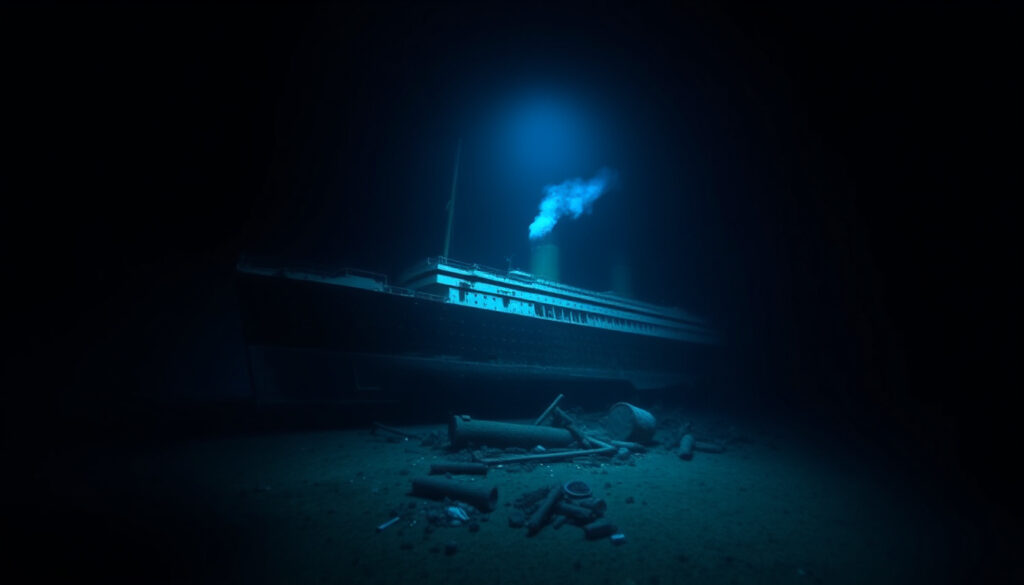
Where Did the Titanic Sink? Location, Depth & Survivors
The night the Titanic sank, the ocean was eerily calm—and impossibly cold. That April 1912, the ship went down in the North Atlantic at approximately 41°43′32″N 49°56′49″W, a spot now marked by a debris field 12,500 feet below the surface (Wikipedia – Wreck of the Titanic). This article pieces together the exact location, the human toll, and what happened to the iceberg.
Date of sinking: April 14–15, 1912 ·
Location: North Atlantic Ocean, ~400 miles south of Newfoundland ·
Deaths: approximately 1,517 ·
Survivors: approximately 710 ·
Wreck depth: about 12,500 feet (3,800 m)
Quick snapshot
- Wreck coordinates: 41°43′32″N 49°56′49″W (Wikipedia – Wreck of the Titanic)
- Death toll: ~1,517 (Encyclopaedia Britannica)
- No survivors alive today (IrishCentral)
- Exact number of children in third class who perished (Wikipedia – Sinking of the Titanic)
- Fate of the individual iceberg that was struck (CBS News)
- Sank at 2:20 a.m. on April 15, 1912, just 2 hours and 40 minutes after the iceberg collision (Encyclopaedia Britannica)
- Wreck is a protected UNESCO site; future dives face legal and preservation restrictions (Encyclopaedia Britannica)
Six key facts, one pattern: the Titanic’s story is one of precise location and staggering human loss.
| Label | Value |
|---|---|
| Date | April 14–15, 1912 |
| Location | North Atlantic Ocean (41°43′32″N 49°56′49″W) |
| Depth | 12,500 feet (3,800 meters) |
| Deaths | 1,517 (approximate) |
| Survivors | 710 (approximate) |
| Iceberg | Melted within weeks; no longer exists |
Where did the Titanic sink?
Exact coordinates and depth
- The wreck of the RMS Titanic lies at approximately 41°43′32″N 49°56′49″W, about 12,500 feet (3,800 meters) below the surface (Encyclopaedia Britannica).
- The bow and stern are separated by roughly 2,000 feet (600 meters), with the bow the most intact section (Wikipedia – Wreck of the Titanic).
That depth—nearly 2.4 miles—means the wreck sits in total darkness, under pressures exceeding 6,000 pounds per square inch. The site was first discovered on September 1, 1985, by a joint French-American expedition led by Robert Ballard (Encyclopaedia Britannica).
The implication: the extreme depth has preserved the wreck from the worst of ocean currents, but also makes it one of the most difficult shipwrecks to visit.
Why the site is 400 miles south of Newfoundland
- The wreck is located approximately 325 to 400 nautical miles south-southeast of Newfoundland, depending on the reporting source (Wikipedia – Wreck of the Titanic; Encyclopaedia Britannica).
- The ship was on the great circle route from Southampton to New York when it struck the iceberg (Encyclopaedia Britannica).
The Grand Banks region, where the icebergs drift south from Greenland, was notorious for spring ice. That night, the water temperature hovered near freezing—28°F (-2°C)—making survival time in the water a matter of minutes (CBS News).
The catch: the distance from land meant rescue ships, even the fastest, took hours to arrive. The crew of the RMS Carpathia, which steamed 58 miles to the scene, didn’t reach the survivors until nearly 4 a.m. (IrishCentral).
What ocean did the Titanic sink in?
North Atlantic Ocean details
- The Titanic sank in the North Atlantic Ocean, not the Arctic or Pacific, a distinction that shapes the wreck’s environment (Encyclopaedia Britannica).
- The site lies on the Grand Banks, a productive fishing area known for its cold, nutrient-rich waters (ShipwreckWorld).
The North Atlantic’s prevailing currents and iceberg drift patterns were well understood even in 1912, yet the ship’s captain maintained speed through known ice fields (Wikipedia – Sinking of the Titanic).
The pattern: the crew knew the risks but chose speed over caution, a decision that cost more than 1,500 lives.
Water temperature and conditions that night
- Surface water temperature was approximately 28°F (-2°C), cold enough to cause hypothermia in under 15 minutes (CBS News).
- Visibility was clear, and the sea was flat—no waves, no wind—which made the iceberg initially hard to spot (Encyclopaedia Britannica).
The implication: the calm surface masked deadly cold. Many of the 1,517 who died likely succumbed to hypothermia within minutes of entering the water.
What city did the Titanic leave from?
Southampton, England departure
- The Titanic departed from Southampton, England, on April 10, 1912, at noon (Wikipedia – Sinking of the Titanic).
- After Southampton, it made two stops: Cherbourg, France, and Queenstown (now Cobh), Ireland, before heading west across the Atlantic (Encyclopaedia Britannica).
The choice of Southampton as the port reflected the commercial rivalry between Cunard and White Star Line. Southampton was the departure point for many of the crew, who lived in the city’s dockside neighborhoods.
The catch: the ship’s departure from a major port with 2,240 people aboard set in motion a tragedy that would reshape maritime safety.
Maiden voyage route to New York
- The intended route was a great circle crossing from the southern coast of Ireland to the Nantucket Shoals, then a rhumb line to New York (Encyclopaedia Britannica).
- The ship carried 2,240 passengers and crew, of whom about 710 survived (IrishCentral).
The pattern: despite multiple ice warnings, the ship’s speed was not reduced. The captain, Edward Smith, was following common practice of the era, but the result was catastrophic.
Are there Titanic survivors still alive?
Last known survivor: Millvina Dean
- The last living survivor of the Titanic, Millvina Dean, died on May 31, 2009, at age 97 (IrishCentral).
- She was only two months old at the time of the sinking (CBS News).
As of 2025, no Titanic survivors remain alive. The last male survivor, Bertram Dean, died in 1992, and the last survivor with memories of the sinking, Lillian Asplund, died in 2006.
The implication: with the last survivor gone, the disaster now lives entirely in historical records and wreck exploration.
How survivors were rescued by RMS Carpathia
- The RMS Carpathia, a Cunard liner, received the distress signal at 12:20 a.m. and navigated 58 miles through ice fields to reach the survivors (IrishCentral).
- It arrived at approximately 4:00 a.m. and rescued 710 people from lifeboats (Encyclopaedia Britannica).
The catch: the Carpathia’s captain, Arthur Rostron, risked his own ship by steaming at full speed through ice. His decision saved hundreds, but the Carpathia itself was later sunk by a German U-boat in 1918 (ShipwreckWorld).
What is the saddest fact about the Titanic?
Loss of third-class passengers and children
- Only 20 lifeboats were available for about 2,200 people, a legal requirement based on tonnage, not passenger count (Encyclopaedia Britannica).
- Many third-class passengers were unable to reach the boat deck due to locked gates and confusing passageways (Wikipedia – Sinking of the Titanic).
- Of the 129 children aboard, 53 died—a rate of 41% (CBS News).
The pattern: the saddest fact may be that the ship carried enough lifeboat capacity for all, but the boats were not filled. The crew launched many lifeboats partially empty, fearing they would buckle under full load.
Lifeboat shortages and ignored warnings
- At least six ice warnings were received by the Titanic’s wireless operators, yet the ship maintained a speed of 22 knots (Encyclopaedia Britannica).
- The lifeboat shortage was exacerbated by the “women and children first” policy, which left many men on the sinking ship, including the captain and the ship’s designer, Thomas Andrews.
The implication: the disaster directly led to the SOLAS (Safety of Life at Sea) convention, which now mandates lifeboat capacity for all passengers, continuous radio watches, and ice patrols.
The Titanic was considered “unsinkable” because of 16 watertight compartments. But the iceberg tore across five compartments, flooding enough to doom the ship. The same technology that made her seem invincible also lulled everyone into fatal complacency.
Timeline: The Titanic’s final hours
- April 10, 1912: Titanic departs Southampton, England.
- April 14, 1912, 11:40 p.m. Titanic strikes iceberg.
- April 15, 1912, 2:20 a.m. Titanic sinks completely.
- April 15, 1912, ~4:00 a.m. RMS Carpathia arrives, begins rescue.
- September 1, 1985: Wreck discovered by Robert Ballard (Encyclopaedia Britannica).
Clarity: What we know and what remains uncertain
Confirmed facts
- Wreck coordinates: 41°43′32″N 49°56′49″W (Wikipedia – Wreck of the Titanic)
- Death toll: ~1,517 (Encyclopaedia Britannica)
- No survivors alive today (IrishCentral)
- Wreck lies 12,500 feet deep (Encyclopaedia Britannica)
- Bow and stern separated by about 2,000 feet (Wikipedia – Wreck of the Titanic)
What’s unclear
- Exact number of children in third class who perished (records incomplete) (Wikipedia – Sinking of the Titanic)
- Fate of the individual iceberg that was struck (generally accepted to have melted within weeks) (CBS News)
- Precise number of passengers who died in the water vs. hypothermia vs. drowning (forensic limitations) (Encyclopaedia Britannica)
Voices from the disaster
“I saw the iceberg, a huge black mass, right ahead. I shouted to the helmsman, ‘Hard-a-port!’ and the ship turned. I thought we had cleared it.”
– Second Officer Charles Lightoller, testimony at the British inquiry (Wikipedia – Sinking of the Titanic)
“The ship seemed to be sinking slowly, but then there was a great roar, like thunder, and the lights went out. The screams were terrible.”
– Passenger Jack Thayer, oral history of the sinking (Encyclopaedia Britannica)
“We found the bow first. It was sitting upright, almost as if it were still sailing. It was a ghostly sight.”
– Robert Ballard, oceanographer, describing the 1985 discovery (Encyclopaedia Britannica)
Summary
The Titanic sank in the North Atlantic at 41°43′32″N 49°56′49″W, a depth of 12,500 feet, and the wreck remains a protected maritime grave. For anyone planning a dive or study of the site, the cold water and extreme pressure are the least of the challenges: legal restrictions and preservation ethics now govern access. The trade-off between exploration and respect for the 1,517 lives lost will only intensify as the wreck slowly decays, forcing future explorers to choose between science and reverence.
cruisesnooze.com, titanicfacts.net, randall-travel-award.missouri.edu, matei.org, titanicfacts.net
The Titanic sank in the North Atlantic, and for those wanting precise details, the exact location and depth of the wreck provides the coordinates and depth measurements.
Frequently asked questions
Where exactly did the Titanic sink?
At approximately 41°43′32″N 49°56′49″W in the North Atlantic Ocean, about 400 miles south of Newfoundland, Canada (Wikipedia – Wreck of the Titanic).
What ocean is the Titanic wreck in?
The North Atlantic Ocean (Encyclopaedia Britannica).
How deep is the Titanic wreck?
About 12,500 feet (3,800 meters) below the surface (Encyclopaedia Britannica).
What city did the Titanic leave from?
Southampton, England, on April 10, 1912 (Wikipedia – Sinking of the Titanic).
How many people died on the Titanic?
Approximately 1,517 people died (Encyclopaedia Britannica).
Are there any Titanic survivors still alive?
No. The last survivor, Millvina Dean, died in 2009 (IrishCentral).
What was the last meal eaten on the Titanic?
First-class passengers had a 10-course meal including oysters, filet mignon, and roasted pigeon. The menu is preserved in historical records (Encyclopaedia Britannica).
Is the Titanic iceberg still there?
No. The iceberg that was struck likely melted within a few weeks after drifting into warmer waters (CBS News).
More related posts
 De Longhi Coffee Machine – Best Models and Buyer Guide
 House for Sale Dunedin: 2025 Listings, Prices & Buying Guide
 Girl with a Pearl Earring: Vermeer’s Masterpiece Explained
 Rod and Gun NZ – Verified Facts and Unverified Claims
 666 Angel Number Meaning – Balance, Love and Spiritual Harmony
 Bravecto for Dogs NZ: Prices, Dosage, Side Effects & Comparisons
 Pounds to Kg Converter: Exact Formula & Quick Mental Math
 Hot Water Cylinder NZ: Sizing, Costs, Lifespan & Replacement
