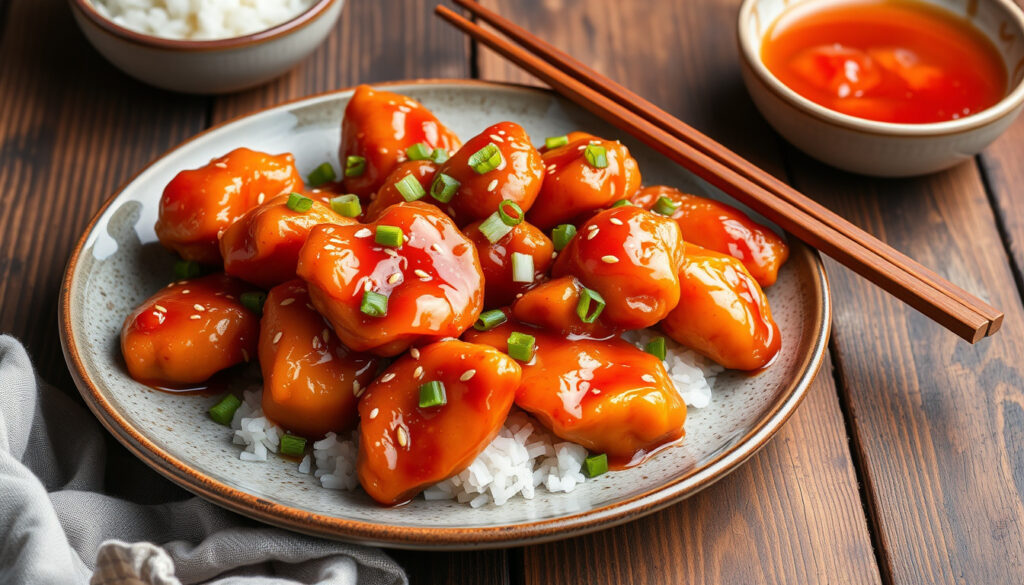
Sweet and Sour Chicken Recipe: Easy, Crispy, and Authentic
There’s a reason sweet and sour chicken consistently tops takeout menus — that perfect contrast of tangy sauce and crispy chicken is hard to beat, but replicating that restaurant crunch at home is simpler than you might think. With the right technique and a few pantry staples, you can make a version that rivals your local Chinese takeaway.
Prep time: 15 minutes ·
Cook time: 20 minutes ·
Servings: 4 ·
Difficulty: Easy
Quick snapshot
- Sweet and sour chicken is a staple of Chinese-American cuisine (Made With Lau – family recipe tradition)
- The classic sauce balances sugar, vinegar, and ketchup (The Kitchn – recipe analysis)
- Crispy coating requires deep-frying in batter (BBC Food – cooking method)
- Whether the original Cantonese recipe included pineapple — BBC Food includes it, but many American-Chinese versions do not (BBC Food – pineapple ingredient)
- Exact origin of the dish: Cantonese adaptation or Western invention? (Made With Lau – family history notes)
- Sweet and sour chicken evolved from Cantonese goo lo yuk to become a Chinese-American icon; Made With Lau’s family recipe has been remade over 100,000 times, reflecting its lasting popularity (Made With Lau – recipe count)
- Home cooks are gravitating toward easier methods: Delish’s simplified version uses a cornstarch dredge instead of batter, pointing to a trend of accessible techniques (Delish – recipe approach)
Five key facts, one pattern: the dish is defined by its contrast of textures and flavors, achieved through specific ingredients and techniques.
| Fact | Detail |
|---|---|
| Origin | Cantonese cuisine, adapted globally (Made With Lau – tradition) |
| Popularity | One of the most ordered Chinese takeout dishes (The Kitchn – takeout staple) |
| Main flavor profile | Sweet and sour from sugar and vinegar (The Kitchn – sauce profile) |
| Key technique | Double frying for crispiness (The Kitchn – double-fry) |
| Sauce base | Ketchup, vinegar, sugar, soy sauce (The Kitchn – sauce ingredients) |
What are the ingredients for making Sweet and Sour Chicken?
What are the essential ingredients for the chicken coating?
- Chicken breast or thigh cut into bite-sized pieces (BBC Food – cutting instructions)
- Cornstarch for dredging or batter base (The Kitchn – batter ingredients)
- Egg, flour, and water for a classic batter (The Kitchn – batter mix)
- Salt and pepper for seasoning (Delish – seasoning)
The implication: a simple coating of cornstarch alone works, but a batter yields the signature crunchy shell you get from takeout.
What are the essential ingredients for the sauce?
- Ketchup provides color and tang (The Kitchn – ketchup)
- Rice vinegar or white vinegar for acidity (The Kitchn – vinegar)
- Brown sugar or white sugar for sweetness (The Kitchn – sugar)
- Soy sauce for umami depth (Delish – soy sauce)
- Pineapple juice or crushed pineapple for natural sweetness and fruitiness (BBC Food – pineapple)
- Cornstarch slurry for thickening (The Kitchn – slurry)
Why this matters: the sauce is a balancing act — too sugary and it cloys, too acidic and it bites. Getting the ratio right makes the dish.
Home cooks who nail the 2:1 sugar-to-vinegar ratio (by taste) and use pineapple juice for natural sweetness will already outperform most takeout versions.
The pattern: the best sauces layer sweetness from multiple sources so no single note dominates.
What is the secret to the best sweet and sour sauce?
How to balance sweetness and acidity?
- A common ratio is 2 parts sugar to 1 part vinegar, but many recipes adjust to 1:1 for a sharper sauce (The Kitchn – ratio)
- Pineapple juice adds natural sweetness and helps balance the acidity without extra refined sugar (BBC Food – pineapple juice)
- Ketchup contributes both sweetness and tanginess from tomato and vinegar (Delish – ketchup role)
The pattern: the best sauces layer sweetness from multiple sources (sugar, juice, ketchup) so no single note dominates.
What thickener works best?
- Cornstarch slurry (1 part cornstarch to 2 parts cold water) creates a glossy, translucent finish (The Kitchn – cornstarch slurry)
- BBC Food uses cornflour (same as cornstarch) mixed with pineapple juice for extra flavor (BBC Food – cornflour-pineapple thickener)
- Overcooking the sauce after thickening can break the starch bonds and make it watery — add slurry at the last minute and simmer only 30–60 seconds (BBC Food – timing)
The trade-off: a cornstarch-based sauce is crystal-clear but thin; if you prefer a thicker, more clinging sauce, increase the slurry slightly.
Sauce that looks perfect in the pan can separate when tossed with hot fried chicken. Toss gently and serve immediately to keep the coating crisp.
The implication: careful tossing and immediate serving are essential to maintain the sauce’s texture.
How do Chinese places make sweet and sour chicken?
What is the typical batter used?
- The classic batter combines all-purpose flour, cornstarch, egg, salt, and water — sometimes baking powder for extra lift (The Kitchn – batter composition)
- The Kitchn’s version adds egg whites and canola oil for a particularly crisp, tempura-like texture (The Kitchn – egg white oil batter)
- Some cooks rest the battered chicken for 15 minutes to let the coating adhere better (Hapanom – resting batter)
What this means: the batter should be thick enough to cling, but light enough to puff up in hot oil.
How do they achieve crispiness?
- Double-frying is the hallmark: fry once at a lower temp (about 350°F) until cooked through, then fry again at 375°F for 30–60 seconds until golden and crunchy (The Kitchn – double-fry method)
- The Cozy Cook heats oil to 365°F and uses a two-step coating: first cornstarch, then a quick dip in beaten eggs before frying (The Cozy Cook – egg dip method)
- Using a wok over high heat ensures the oil stays hot even when adding chicken pieces (BBC Food – wok technique)
The implication: you don’t need a deep-fryer — a heavy pot or wok with at least 1 inch of oil works, as long as you monitor temperature.
A thicker sauce coats the chicken better but can become gluey if over-thickened. Aim for the texture of warm maple syrup.
What this means: consistency control is key to the final dish.
How to make Chinese takeaway style sweet and sour sauce?
What ingredients mimic takeaway flavor?
- Ketchup, rice vinegar, brown sugar, soy sauce — the core quartet (The Kitchn – base ingredients)
- Pineapple juice (or crushed pineapple) adds the fruity note typical of British-Chinese takeaway versions (BBC Food – pineapple juice)
- Garlic and ginger give the sauce aromatic depth (Delish – garlic ginger)
Why this matters: takeaway sauce is not just sweet and sour — it has a savory umami base from soy and aromatics.
How to adjust consistency?
- Thicken with a cornstarch slurry (1 tbsp cornstarch + 2 tbsp water) for a glossy, pourable sauce (The Kitchn – slurry ratio)
- Simmer the sauce for 2–3 minutes to meld flavors before adding the slurry (Delish – simmer time)
- If the sauce is too thick, add a splash of water or pineapple juice; if too thin, add more slurry in small increments (BBC Food – consistency adjustment)
The pattern: adjusting consistency is a simple matter of slurry balance.
How do I make a quick sweet and sour sauce?
What is a 4-ingredient sweet and sour sauce?
- Combine ½ cup ketchup, ¼ cup rice vinegar, ¼ cup brown sugar, and 2 tbsp soy sauce — shake or whisk until dissolved (The Kitchn – 4-ingredient sauce)
- No cooking required for a quick dipping sauce; heat only if you want it thickened (Delish – no-cook option)
- For a thicker sauce, whisk in 1 tsp cornstarch dissolved in 2 tsp water and microwave for 30 seconds (The Cozy Cook – quick thickening)
The pattern: this basic formula is endlessly adaptable — add pineapple juice, garlic, or chili flakes to customise.
What is the simplest sauce to make?
- Literally just ketchup and vinegar (50:50) plus a pinch of sugar — that’s the stripped-down version used in many fast-food kitchens (The Kitchn – minimalist version)
- Delish’s simplest version uses honey, apple cider vinegar, and ketchup — no cornstarch needed because honey naturally thickens (Delish – honey sauce)
The implication: you can always simplify further if needed.
What is the famous Chinese sauce?
What sauces do Chinese takeaways use most?
- Sweet and sour sauce is one of the most popular worldwide, alongside General Tso’s, orange chicken, and Szechuan sauce (Made With Lau – popularity context)
- In takeaway shops, sweet and sour sauce is typically a thickened, bright red-orange sauce made from ketchup, sugar, and vinegar (The Kitchn – takeaway sauce profile)
- Regional variations exist: Cantonese-style sauce is thinner and more vinegary, while American-Chinese versions are sweeter and thicker (Made With Lau – regional differences)
How does sweet and sour compare to other sauces?
- Unlike General Tso’s (which is spicy-sweet) or Szechuan (numbing and savory), sweet and sour is defined by its bright acidity and high sugar content (The Kitchn – flavor contrast)
- It is one of the few Chinese sauces that relies on ketchup as a base, giving it a distinct tomato sweetness not found in other sauces (Delish – ketchup base)
The implication: sweet and sour sauce occupies a unique space — it’s the most approachable, family-friendly sauce, which is why it remains a takeaway staple.
Step-by-step: How to make sweet and sour chicken at home
- Prepare the chicken: Cut 500g chicken breast into 1-inch pieces. Marinate with 1 tbsp soy sauce, 1 tbsp rice vinegar, and 1 tsp cornstarch for 30 minutes (The Kitchn – marinade).
- Make the batter: Mix ½ cup flour, ¼ cup cornstarch, 1 tsp salt, ½ tsp baking powder, 1 egg, and ½ cup water until smooth. Let rest 10 minutes (The Kitchn – batter recipe).
- Heat the oil: In a wok or deep pot, heat 1 inch vegetable oil to 365°F (The Cozy Cook – oil temp).
- First fry: Dip each chicken piece in batter, then fry in batches for 4–5 minutes until pale golden. Drain on paper towels (The Kitchn – first fry timing).
- Second fry: Increase oil to 375°F. Fry all pieces again for 30–60 seconds until deep golden and crispy (The Kitchn – second fry).
- Make the sauce: In a saucepan, combine ½ cup ketchup, ¼ cup rice vinegar, ¼ cup brown sugar, 2 tbsp soy sauce, ¼ cup pineapple juice, and 1 tsp minced garlic. Simmer 3 minutes (Delish – sauce simmer).
- Thicken: Mix 1 tbsp cornstarch with 2 tbsp water, stir into sauce, and cook 30 seconds until glossy (BBC Food – thickening).
- Toss and serve: In a hot wok, stir-fry sliced bell pepper and onion 2 minutes, add chicken and sauce, toss gently, and serve immediately with rice (BBC Food – final toss).
Confirmed facts
- Sweet and sour chicken is a staple of Chinese-American cuisine (Made With Lau)
- The sauce typically contains sugar, vinegar, and ketchup (The Kitchn)
- Crispy coating is achieved by deep-frying with a batter (BBC Food)
What’s unclear
- Whether the original Chinese recipe used pineapple — BBC Food includes it, but many versions do not (BBC Food)
- Exact origin: Cantonese vs. Western adaptation (Made With Lau)
- Whether crispy coating requires deep-frying in batter or can be achieved with other methods (BBC Food)
What the chefs say
The key to great sweet and sour is balance — the sauce should be neither too sugary nor too sharp. It’s a dance between sweet, sour, and savory.
— Chef Martin Yan (Yan Can Cook), as referenced by Made With Lau
The sauce should be glossy and coat the chicken without being gluggy. A cornflour slurry stirred in at the end gives that takeaway sheen.
For home cooks, the choice is clear: invest 15 minutes in a proper batter and double-fry technique, or settle for a soggy, sauce-drenched imitation. The difference between takeout and homemade that actually beats takeout comes down to that hot second fry and a sauce balanced within a teaspoon of perfection.
Related reading: Easy Cuban Recipes at Home · Best Lemon Cake Recipe NZ
tasteandtellblog.com, smalltownwoman.com, dinnerthendessert.com, youtube.com, bbc.co.uk, cjeatsrecipes.com
Frequently asked questions
Can I make sweet and sour chicken without frying?
Yes. For a lighter version, bake the battered chicken at 400°F for 12–15 minutes, turning once, then toss with sauce. The texture will be less crispy but still satisfying. (The Cozy Cook – baked option)
How to store and reheat sweet and sour chicken?
Store in an airtight container in the fridge for up to 3 days. Reheat in an oven or air fryer at 375°F for 5–7 minutes to restore crispiness — avoid microwaving. (Delish – storage advice)
Can I use chicken thighs instead of breasts?
Absolutely. Thighs are juicier and more forgiving; cut them into similar-sized pieces and adjust cooking times slightly. (BBC Food – thigh substitution)
Is sweet and sour chicken gluten-free?
It can be. Use gluten-free soy sauce (tamari), rice flour or cornstarch instead of wheat flour, and ensure no cross-contamination in the batter. (The Kitchn – gluten-free tips)
What can I use instead of pineapple?
Substitute with orange juice or apple juice for sweetness plus a splash of lemon juice for acidity. The texture will be different but the flavor balance works. (Delish – juice substitution)
How do I make the sauce less sweet?
Reduce sugar by half and increase vinegar slightly. Taste as you go — the ketchup already adds significant sweetness. (The Kitchn – adjusting sweetness)
Can I prepare the sauce ahead of time?
Yes. Make the sauce up to 3 days in advance and refrigerate. Reheat gently before using, adding a splash of water if it’s too thick. (BBC Food – make-ahead sauce)
More related posts
 New World Mailer This Week: Find the Latest Specials and Deals
 South Melbourne vs Auckland FC: Results, Stats, Highlights
 Is Matariki a Public Holiday? 2026 Date & Rules
 Ball and Socket Joint: Anatomy, Examples & Function
 How to Register a Company in New Zealand: Step-by-Step Guide
 Prince Harry Daily Mail: Lawsuit, Birth Certificate, Rifts
 Unclaimed Money NZ List: How to Search and Claim Your Funds
 Ozzy Osbourne No More Tears: Facts, Sobriety & Controversies
