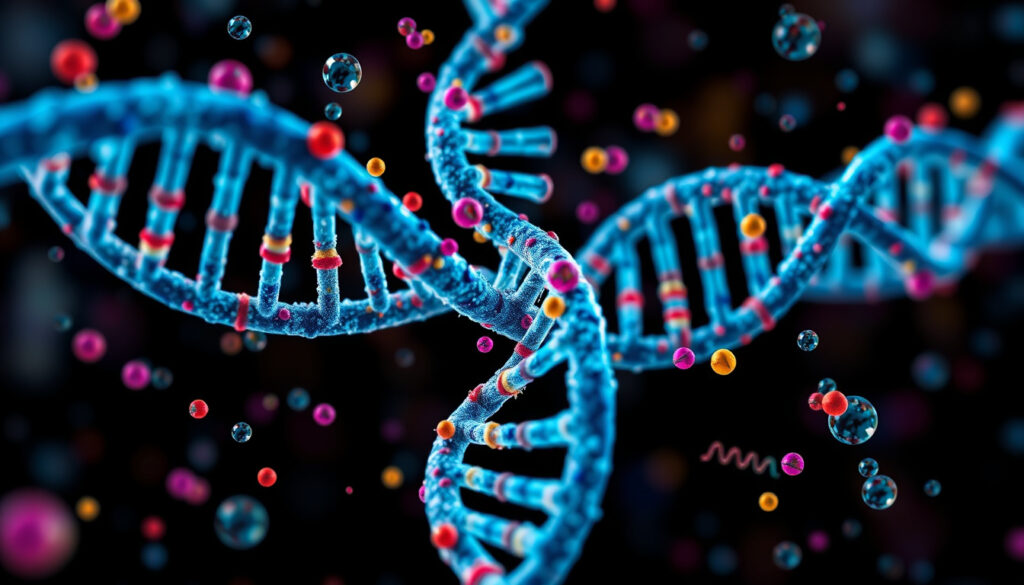
What Is a Gene? Definition, Function, and Types
You probably learned in school that genes are the blueprints for life — little secret instructions that decide your eye color, your height, whether you can roll your tongue. But when scientists started reading the actual human genome, they found something messier and more interesting. The reality is that a gene is not a simple bead on a DNA string; it’s a dynamic, context-dependent sequence that still challenges researchers today.
Number of genes in human genome: ~20,000–25,000 ·
Length of DNA per cell: ~2 meters ·
Base pairs in human genome: ~3 billion ·
Percentage of DNA that codes for proteins: ~1%
Quick snapshot
- Basic unit of heredity (MedlinePlus Genetics (U.S. National Library of Medicine))
- Segment of DNA (NHGRI Genetics Glossary (National Human Genome Research Institute))
- Instructions for proteins (Cleveland Clinic (health system))
- DNA is the full molecule (MedlinePlus Genetics)
- Gene is a specific region (NHS Genomics Education (U.K. National Health Service))
- Non-coding DNA is not genes (NCBI Books (U.S. National Center for Biotechnology Information))
- ~20,000–25,000 protein-coding genes (NHGRI Genetics Glossary)
- Many more non-coding RNA genes (NHGRI Genetics Glossary)
- Smaller than expected (NCBI Books)
- Protein-coding (NCBI Books)
- Non-coding RNA (NCBI Books)
- Regulatory (NCBI Books)
- Pseudogenes (NCBI Books)
Five key facts about genes, one pattern: each source converges on the same core idea — genes are functional units of DNA, but the boundaries and numbers are fuzzier than a textbook suggests.
The table below compiles the core specifications of a gene from authoritative biomedical sources.
| Fact | Value | Source |
|---|---|---|
| Full name | Gene | MedlinePlus Genetics |
| Composition | DNA (deoxyribonucleic acid) | MedlinePlus Genetics |
| Primary function | Carry instructions for making proteins or functional RNA | NHGRI Genetics Glossary |
| Location | Chromosomes in the cell nucleus | NCI Dictionary of Genetics Terms (National Cancer Institute) |
| Human genome size | ~3 billion base pairs | NCBI Books |
| Protein-coding gene count | ~20,000–25,000 | NHGRI Genetics Glossary |
| Non-coding DNA fraction | ~98.5% of genome | NCBI Books |
What is a simple definition of a gene?
The basic unit of heredity
At its simplest, a gene is the basic physical and functional unit of heredity. The MedlinePlus Genetics (U.S. National Library of Medicine) defines a gene as the fundamental unit passed from parents to offspring that carries the information needed to specify traits. The NHGRI Genetics Glossary (National Human Genome Research Institute) echoes this: a gene is the basic unit of inheritance.
Genes are made of DNA
Every gene is a segment of DNA — a long molecule that stores genetic information. According to the NCI Dictionary of Genetics Terms (National Cancer Institute), genes are arranged at specific locations on chromosomes inside the cell nucleus. The Cleveland Clinic (health system) puts it plainly: genes are segments of DNA that give cells instructions for specific traits or body functions.
Genes instruct cells to make proteins
Many genes contain the recipe for making proteins, the workhorses of the cell. The NHS Genomics Education (U.K. National Health Service) explains that genes are stretches of DNA containing instructions to build biological molecules, mostly proteins. But not all genes code for proteins — some produce functional RNA molecules instead.
The fact that only about 1% of the human genome codes for proteins (NCBI Books) means that most of our DNA is not made of classical genes. That non-coding majority was once dismissed as “junk,” but researchers now know it plays critical regulatory roles.
Which best defines a gene?
Mendelian vs molecular gene definitions
There isn’t one “best” definition — it depends on context. The classical Mendelian gene is a unit of inheritance, a theoretical factor that explains why pea plants produce wrinkled or smooth seeds. The molecular gene, defined by NCBI Books (U.S. National Center for Biotechnology Information), is a sequence of nucleotides transcribed into RNA. The NHGRI Genetics Glossary bridges both: a gene contains information to specify traits, and it is made of DNA.
Operational definitions in modern genomics
Today, researchers define genes operationally — by what they do. A 2006 Nature article (peer-reviewed journal) noted that “the idea of genes as beads on a DNA string is fast fading.” Genes can overlap, share regulatory regions, and produce multiple products through alternative splicing. The NHGRI acknowledges RNA genes, which encode functional RNA without coding for proteins.
What is a gene vs DNA?
DNA is the molecule; genes are specific segments of it
Think of DNA as the entire instruction manual, and genes as individual chapters. Medical News Today (health news outlet) distinguishes a gene as a specific segment of DNA, while the genome is all the genetic material in an organism. The NCI Dictionary states that genes are made up of DNA sequences arranged at specific chromosomal locations.
All genes are DNA, but not all DNA is a gene
Only about 1.5% of the human genome consists of coding DNA — the part that directly specifies proteins (NCBI Books). The NHS Genomics Education notes that genes are stretches of DNA, but vast stretches of DNA between genes are not considered genes.
The role of non-coding DNA
Non-coding DNA was once called “junk,” but it contains regulatory elements that control when and where genes are turned on. The NHGRI explains that non-coding DNA includes sequences that regulate gene expression, origins of replication, and other functional elements. So while the genome is mostly non-gene, that non-gene DNA is far from useless.
How many genes do humans have?
Estimated count from the Human Genome Project
When the Human Genome Project completed sequencing in 2003, scientists expected to find around 100,000 genes. Instead, the count landed at roughly 20,000–25,000 protein-coding genes. The NHGRI Genetics Glossary and the NHS Genomics Education both cite this range. The NCBI Books confirms the human genome contains about 3 billion base pairs, with only about 1.5% coding.
Why the number is still uncertain
The exact count of functional non-coding RNA genes remains debated. The NHGRI notes that the definition of a gene is still evolving, and many non-coding RNA genes are still being discovered. The NCBI Books describes three types of RNA genes (type-I, II, III) based on the RNA polymerase that transcribes them, but the total number of these functional RNA genes is not firmly established.
Comparison with other organisms
Humans have about the same number of protein-coding genes as a microscopic worm (C. elegans has ~20,000) and far fewer than some plants (rice has ~40,000). The complexity of human biology comes not from more genes, but from alternative splicing — one gene can produce multiple protein variants. The NCBI Books emphasizes that human complexity is achieved through combinatorial use of gene products.
What are the 4 types of genes?
Protein-coding genes
These are the most familiar: genes that are transcribed into messenger RNA (mRNA) and then translated into protein. The NCBI Books classifies them as type-II genes (transcribed by RNA polymerase II). Most of the ~20,000–25,000 human protein-coding genes fall into this category.
Non-coding RNA genes (e.g., tRNA, rRNA)
These genes produce functional RNA molecules that are never translated into protein. The NCBI Books describes type-I genes (encoding rRNA, transcribed by RNA polymerase I) and type-III genes (encoding tRNA, snRNA, 5S rRNA, transcribed by RNA polymerase III). The NHGRI also recognizes RNA genes, noting they encode RNA molecules that function without directly coding for proteins.
Regulatory genes
Regulatory genes control the expression of other genes. They produce transcription factors, repressors, and other proteins that switch genes on or off. The NCBI Books explains that many regulatory sequences are found in non-coding DNA, but the genes that encode regulatory proteins are themselves protein-coding genes.
Pseudogenes
Pseudogenes are non-functional copies of functional genes. They arise from gene duplication events or retrotransposition, and over time they accumulate mutations that render them inactive. The NCBI Books notes that the human genome contains thousands of pseudogenes, some of which may have regulatory roles.
The more we learn about genes, the harder it becomes to draw clean lines. A pseudogene can sometimes become functional again; a non-coding RNA can regulate dozens of other genes. The “4 types” framework is a useful simplification, but reality is messier.
Confirmed facts vs. what remains unclear
Confirmed facts
- Genes are made of DNA. (MedlinePlus Genetics)
- Genes are the basic units of heredity. (NHGRI Genetics Glossary)
- Humans have approximately 20,000–25,000 protein-coding genes. (NHGRI Genetics Glossary)
What’s unclear
- The exact number of functional non-coding RNA genes is still debated. (NHGRI Genetics Glossary)
- The boundaries of a gene are not always clearly defined due to overlapping transcription and alternative splicing. (Nature (peer-reviewed journal))
Expert perspectives on what a gene is
“A gene is the basic physical and functional unit of heredity. Genes are made up of DNA.”
— MedlinePlus Genetics (U.S. National Library of Medicine)
“Genes are segments of DNA that give cells instructions for specific traits or body functions.”
“The idea of genes as beads on a DNA string is fast fading, and it is becoming clear that the concept of the gene is a moving target.”
Three voices, one message: the gene is both a concrete unit of heredity and an evolving concept. For a student, the simple definition suffices. For a researcher, the gene is a dynamic, context-dependent sequence.
Related reading: What Is a Stoma? · What Is Crohn’s Disease?
byjus.com, en.wikipedia.org, unsw.edu.au, en.wikipedia.org, sciencedirect.com
A simple definition of a gene offers a clear, beginner-friendly introduction to the topic.
Frequently asked questions
What is a gene example?
A classic example is the gene for eye color. The NHGRI explains that the OCA2 gene on chromosome 15 influences melanin production, which determines eye color. Variations in this gene can lead to blue, brown, or green eyes.
What is the shortest known gene?
The shortest known human gene produces a microRNA (miRNA) called miR-21. It is only about 72 base pairs long. The NCBI Books notes that many non-coding RNA genes are very short compared to protein-coding genes, which average around 1,300 base pairs.
Do daughters inherit more from mother or father?
Daughters inherit one copy of each gene from their mother and one from their father. The NCI Dictionary states that genes are passed from parent to child. However, mitochondrial DNA (mtDNA) is inherited exclusively from the mother. So for nuclear genes, it’s a 50/50 split; for mitochondrial genes, it’s 100% maternal.
What is a gene vs allele?
An allele is a variant form of a gene. The NHGRI Genetics Glossary defines an allele as one of two or more versions of a gene. For example, the gene for eye color has blue and brown alleles. The gene is the location; the allele is the specific sequence.
What is a gene in biology?
In biology, a gene is a sequence of nucleotides in DNA that encodes a functional product — usually a protein or an RNA molecule. The NCBI Books describes it as a transcription unit that produces a functional RNA or protein.
What is a gene in simple terms?
In simple terms, a gene is a set of instructions inside your cells that tells your body how to build and operate. The Cleveland Clinic compares it to a recipe: your DNA is the cookbook, and each gene is a recipe for a specific trait or function.
What is a gene A level Biology?
At A-level (or advanced high school) biology, a gene is defined as a sequence of DNA that codes for a polypeptide (protein) or a functional RNA molecule. The NHS Genomics Education provides this definition: genes are stretches of DNA containing instructions to build biological molecules.
For a student studying genetics, the core lesson is clear: the gene is the fundamental unit of heredity, but its definition is richer — and more complex — than what appears in most textbooks.
More related posts
 Auckland Botanic Gardens Tickets: Free Entry Guide
 Black Caps vs England: Live Scores, Schedule & Tickets
 The 48 Laws of Power: Full List, Controversy & Takeaways
 Why Do Dogs Lick You? Vet-Explained Reasons & Meanings
 Sacheu Lip Stain NZ: Where to Buy, Shades & How to Apply
 Funny Pick Up Lines: 111+ Cheesy, Cringe & Flirty Examples
 What Is a Mental Health Crisis Team? Signs, Steps & Help
 Banks Peninsula Heavy Rain: Record Flooding and Road Closures
