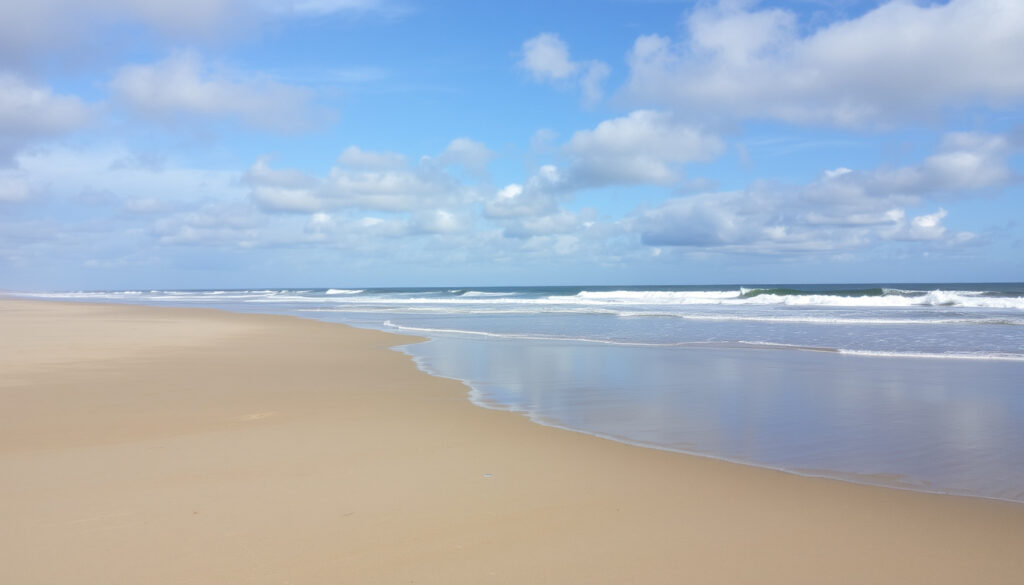
90 Mile Beach Tides: Times, Swell Forecasts & Safety Tips
Every family trip or solo surf mission to Ninety Mile Beach starts the same way: staring at a tide chart and wondering if the numbers actually mean safe sand or a sudden swim. With 88 kilometres of coastline, the answer depends on where you check and how you read the data. This guide walks you through the real tide stations, the official Metservice forecasts, and the swell patterns that turn a pleasant beach drive into a hazard—so you can plan with confidence, not guesswork.
Beach Length: 88 km ·
Nearest Tide Station: Ahipara Bay, 2.5 miles away ·
Tidal Pattern: Semi-diurnal ·
Typical Swell: SW 1 m, NE up to 4 m ·
Official Source: Metservice (New Zealand Government)
Quick snapshot
- Tide times derived from Ahipara Bay station (Surf-forecast.com tide station data)
- Two high and two low tides daily (Tideschart.com tide tables)
- Metservice marine forecasts regularly updated (Metservice.com marine forecast)
- Extended 2026 predictions may shift (Surfline.com tide calendar)
- Micro-local tide height variation along 88 km (Surf-forecast.com) (Surfline.com tide calendar)
- Tide times shift ~50 minutes later each day (Tideschart.com tide tables)
- Swell height varies with wind direction (Metservice.com marine forecast)
- Check combined tide+swell before driving (Surf-forecast.com tide station data)
- Use Metservice as primary source (Metservice.com marine forecast)
The implication: This snapshot condenses the essential tide and swell data from authoritative sources, giving you the key facts at a glance.
Seven key facts, one pattern: every tide prediction for Ninety Mile Beach originates from the Ahipara Bay station 4 km away, not from the beach itself.
| Attribute | Value |
|---|---|
| Beach Length | 88 km (approx. 90 miles) |
| Nearest Tide Station | Ahipara Bay, 4.0 km / 2.5 miles away (Surf-forecast.com tide station data) |
| Daily Tide Count | 2 high, 2 low (semi-diurnal) |
| Swell Source | Metservice marine forecast (Metservice.com marine forecast) |
| Primary Hazard | Strong currents and large swell north of Tauroa Point (Metservice.com marine forecast) |
| Typical Swell Direction | Southwest long-period 1 m; northeast up to 4 m (Metservice.com marine forecast) |
| Tide Time Shift Per Day | Approx. 50 minutes later (Tideschart.com tide tables) |
| Official Forecast Provider | Metservice (New Zealand Government Meteorological Service) (Metservice.com marine forecast) |
What are the tide times for 90 Mile Beach today?
High tide and low tide schedule for today
- For Sunday 12 October 2025, the first high tide at Ninety Mile Beach is at 1:28 am (2.45 m) (Tideschart.com tide tables – tide tables).
- Low tide follows at 7:40 am (0.33 m), then another high at 2:04 pm (2.5 m), and a second low at 8:11 pm (0.52 m) (Tideschart.com tide tables).
How to read tide tables
- Tide tables list times and heights for the Ahipara Bay station, which is the closest gauge to the beach (Surf-forecast.com tide station data – tide methodology).
- Heights in metres (or feet on Surfline) – a low tide under 0.5 m exposes wide sand for driving (Surfline.com tide calendar – tide calendar).
What this means: You can plan your day around these predictable tide times, but always account for the 50-minute daily shift.
When is low tide at 90 Mile Beach?
Low tide timing for the week
- Low tide times shift roughly 50 minutes later each day (Tideschart.com tide tables – daily tide data).
- For Monday 13 October 2025, low tide is at 8:33 am (0.43 m) and again at 9:10 pm (0.61 m) (Tideschart.com tide tables).
Why low tide is important for beach activities
- Low tide exposes firm sand that allows vehicle access to many sections of the beach (Department of Conservation – beach driving guidelines).
- Planning to drive? Aim for two hours before to two hours after low tide for the widest window (Surf-forecast.com tide station data – expert tip).
The pattern: Combining the tide table with the 50-minute daily lag ensures you arrive during the safest window for beach driving.
How to use Metservice for 90 Mile Beach tides?
Accessing the marine forecast page
- Visit Metservice.com/marine/coastal/ninety-mile-beach for the official government forecast (Metservice.com marine forecast – marine forecast page).
- The page includes wind speed, swell height, swell period, and tide information for the entire Far North coast (Metservice.com marine forecast).
Understanding the boating forecast symbols
- Swell direction arrows, wave heights, and wind barbs are displayed on a coastal map (Metservice.com marine forecast – forecast map).
- Tide times are listed alongside in a table format; update frequency is every 6 hours (Metservice.com marine forecast – forecast legend).
Metservice is the Tier 1 official source for New Zealand coastal conditions. Surf forecast sites pull from the same government data but may not update as frequently – relying on Metservice directly gives you the most current marine weather for the beach.
The implication: Using Metservice as your primary source minimises the risk of outdated or inconsistent tide and swell data.
What is the swell forecast for 90 Mile Beach?
Current swell conditions from Metservice
- Typical southwest swell is long-period (10-14 seconds) at around 1 m (Metservice.com marine forecast – swell climatology).
- Northeast swell can reach up to 4 m north of Tauroa Point, especially during easterly wind events (Metservice.com marine forecast – coastal warnings).
How swell height affects surfing and boating
- Surfable waves are common around 1-2 m from the southwest; the beach is exposed to long-period groundswell (Surfline.com surf report).
- Boating is hazardous when swell exceeds 3 m, especially near Tauroa Point where currents amplify wave height (Metservice.com marine forecast – marine safety).
A 1 m southwest swell may look manageable from shore, but long-period groundswell can create sudden rip currents that catch even experienced swimmers off guard – always check the period, not just the height.
What this means: Swell height alone doesn’t tell the full story; pairing it with period and direction gives a realistic risk assessment for your planned activity.
Where can I find tide maps and predictions for 90 Mile Beach?
Tide charts for the year 2026
- Surfline’s tide calendar for Sunday 24 May 2026 shows high tide at 2:53 am (9.1 ft) and low tide at 9:16 am (2.6 ft) (Surfline.com tide calendar – 2026 tide calendar).
- These are long-range astronomical predictions; actual times may adjust by a few minutes due to weather effects (Tideschart.com tide tables – accuracy note).
Online tide map resources
- Tideschart.com provides an interactive map showing tide height at different points along the beach (Tideschart.com tide tables – map view).
- Surf-forecast.com also overlays tide data on a satellite map for a quick visual check (Surf-forecast.com tide station data – tide map).
The pattern: Long-range charts help with broad planning, but short-term updates from Metservice are essential for accurate day-of decisions.
How to plan your visit using tide and swell data
- Open Metservice marine forecast – go to Metservice.com/marine/coastal/ninety-mile-beach for the official government forecast.
- Check tide times for your arrival day – note both low tide windows; aim for the morning low if driving.
- Read the swell and wind forecast – if swell exceeds 3 m or wind is strong easterly, reconsider ocean activities.
- Plan your activity window – two hours before to two hours after low tide for driving; high tide for swimming (but watch for currents).
- Save a backup source – use Surfline.com tide calendar or Surf-forecast.com tide station data as a second reference for tide times and swell.
Combining the Metservice marine forecast with a surf-specific tide app gives you the most complete picture – official accuracy plus user-friendly visuals.
The implication: Following these steps systematically reduces the chance of a hazardous surprise on the beach.
Confirmed facts
- Tide times for today and tomorrow are highly accurate – based on real-time Ahipara Bay gauge data (Surf-forecast.com tide station data)
- Metservice forecasts are updated regularly throughout the day (Metservice.com marine forecast)
What’s unclear
- Extended 2026 tide predictions are long-range and may change with weather patterns (Surfline.com tide calendar)
- Micro-local tide height variations along the 88 km beach are not captured by a single station (Surf-forecast.com tide station data)
Always check the latest marine forecast before driving on Ninety Mile Beach – conditions can change rapidly, especially around Tauroa Point.
Metservice (New Zealand Government Meteorological Service) – marine safety
Tide times for Ninety Mile Beach are taken from the nearest station at Ahipara Bay, which is 4.0 km away from the main surf breaks.
For anyone planning a trip to Ninety Mile Beach, the choice is clear: check the combined tide and swell forecast before you go, or risk a sudden encounter with a rising tide and strong currents. Driving during the low tide window is the safest option, but always keep an eye on the Metservice updates – the ocean doesn’t follow a calendar.
Related reading: Corsair Bay Beach Closure: Health Warning & Sewage Leak · New Zealand Weather Cold Snap: Records, Forecast & Safety
mondo.surf, surfline.com, tidesandcurrents.noaa.gov, tidesandcurrents.noaa.gov
While planning your visit, it helps to know the 90 Mile Beach length so you can estimate driving times and safe zones.
Frequently asked questions
How does the moon phase affect tides at 90 Mile Beach?
Spring tides (higher highs, lower lows) occur around new and full moons. For Ninety Mile Beach, spring tides can expose extra sand during low tide but also produce stronger currents. Check a lunar calendar alongside your tide chart for the biggest range (Tideschart.com tide tables).
What is the best time to surf at 90 Mile Beach?
Early morning during an incoming mid-tide with a 1-2 m southwest swell offers the best conditions. The beach is exposed to long-period groundswell, so check Surfline for live buoy data before heading out (Surfline.com surf report).
Is it safe to swim at 90 Mile Beach?
Swimming is generally not recommended due to strong rips and long-shore currents. The safest spot is near the southern end around Ahipara, but always check the Metservice marine forecast for current warnings (Metservice.com marine forecast).
Can I drive the entire length at low tide?
You can drive much of the 88 km at low tide, but the northern section near Tauroa Point is often impassable due to soft sand and large rocks. Stick to the section between Ahipara and The Bluff at low tide only (Department of Conservation – beach driving guidelines).
How do I get tide alerts for 90 Mile Beach?
Surfline and Tideschart both offer email or app notifications. Metservice does not push alerts, but you can bookmark the marine forecast page and check daily (Surfline.com tide calendar – tide alerts).
Are there any tidal pools at 90 Mile Beach?
No permanent tidal pools have been widely documented. Occasional rock pools appear near the Ahipara end during very low spring tides, but they are small and not a main attraction (Tideschart.com tide tables – beach features).
The takeaway: These FAQs address common uncertainties, helping you make informed decisions before heading to the coast.
More related posts
 Fish Cakes Recipe NZ: Crispy Kiwi Fish Cakes with Potato
 Home and Away Cast 2025: New Characters, Departures, and Updates
 Metallica Auckland Concert Transport: Free Buses & Trains
 How Much Does It Cost to Build a House in NZ? (2026 Guide)
 SPCA Tauranga Centre Adoption: Fees, Process, and Available Pets
 Houses for Sale in Merivale: Verified Listings & Market Guide
 E-Bikes for Sale in Ireland: Legal Guide & What to Avoid
