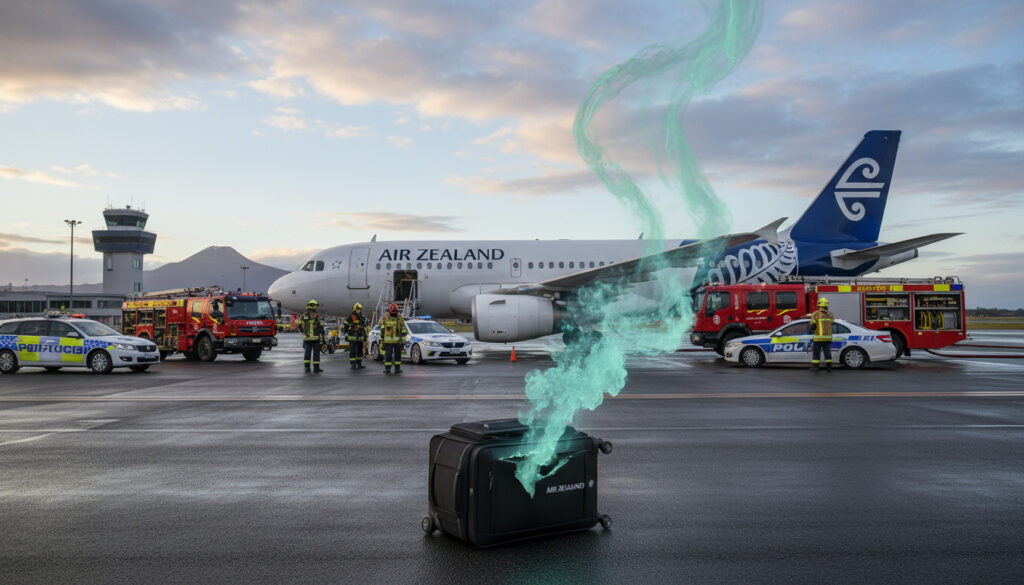
Air NZ Flight Diverted New Plymouth – Fuel Odor in Carry-On Sparks Diversion
Air New Zealand flight NZ5202 bound for Auckland from Blenheim diverted to New Plymouth Airport on Tuesday evening after crew detected a petroleum odor circulating through the cabin. The unscheduled landing, occurring approximately one hour after departure, triggered a full emergency services response and subsequent investigation that revealed the source was not mechanical failure but residual fuel contamination inside a passenger’s carry-on bag.
The incident disrupted travel plans for dozens of passengers, with some missing critical international connections, while highlighting the strict safety protocols governing unexplained odors in commercial aviation. Emergency crews met the De Havilland Canada Dash 8-300 upon its 7 pm arrival at New Plymouth, though no injuries occurred during the precautionary landing.
Why Was the Air NZ Flight Diverted to New Plymouth?
The diversion resulted from what passengers initially described as a strange, overpowering smell resembling aviation fuel permeating the cabin vents mid-flight. Multiple travelers seated forward of witness Cally McKenzie reported the odor to crew members, prompting the pilots to initiate emergency diversion protocols and land at the nearest suitable airport.
Post-landing investigation confirmed the odor originated from an item containing residual fuel within a customer’s carry-on luggage, not from aircraft systems. Aviation A2Z reported that police subsequently spoke with one male passenger regarding the incident, though the airline confirmed no mechanical issues existed with the Dash 8-300 aircraft.
NZ5202 (Blenheim to Auckland)
Fuel odor from carry-on item
New Plymouth Airport (NPL)
Safe landing, flight cancelled
Key Insights
- Unexplained odors trigger immediate diversion protocols regardless of actual threat severity
- The aircraft involved was a 50-seat De Havilland Canada Dash 8-300, registration ZK-NFB
- Post-landing inspections confirmed zero mechanical malfunctions
- Police involvement was limited to interviewing one male passenger about the carry-on item
- Passengers detected the smell circulating through cabin ventilation systems approximately one hour into the scheduled 85-minute flight
- New Plymouth served as the alternate airport despite Wellington being geographically closer to the flight path
| Fact | Details |
|---|---|
| Date/Time | Tuesday, April 8, 2025, ~19:00 NZST |
| Flight Number | NZ5202 |
| Aircraft Type | De Havilland Canada Dash 8-300 |
| Registration | ZK-NFB |
| Origin | Blenheim Woodbourne Airport (BHE) |
| Intended Destination | Auckland Airport (AKL) |
| Diversion Airport | New Plymouth Airport (NPL) |
| Departure Time | 17:59 local time |
| Passenger Capacity | Approximately 50 seats |
| Injuries | None reported |
| Root Cause | Residual fuel in passenger carry-on |
| Current Status | Diverted, cancelled, under investigation |
Timeline of the Air NZ New Plymouth Diversion
Departure and Initial Detection
The aircraft departed Blenheim Woodbourne Airport at 17:59 local time for the scheduled service to Auckland. Approximately midway through the journey, crew and forward passengers detected the distinctive odor of aviation fuel, prompting immediate assessment of potential mechanical leakage or fire risk.
Emergency Landing and Response
Pilots diverted to New Plymouth Airport, landing safely around 19:00. The New Zealand Herald reported that Fire and Emergency New Zealand crews responded according to standard protocols for unexpected arrivals, meeting the aircraft on the tarmac as a precautionary measure.
Investigation Discovery
Ground inspections and passenger interviews revealed the odor source was an item with residual fuel contamination inside carry-on baggage. Police spoke with the owner of the luggage while the airline arranged alternative transport for displaced travelers.
Passenger Impact and Safety from the Diversion
All occupants evacuated the aircraft without injury, though the incident created significant downstream travel complications. Travel and Tour World noted that the diversion prioritized passenger safety under aviation protocols treating unexplained odors as potential fuel leaks or electrical fires until proven otherwise.
International aviation regulations mandate immediate landing at the nearest suitable airport when unexplained odors are detected, as smells can indicate critical system failures including fuel line ruptures or insulation burns that require urgent ground inspection.
Travel Disruptions and Connections
Air New Zealand accommodated stranded passengers on later evening services to Auckland or provided hotel arrangements for those rebooked on Wednesday morning flights. One traveler, identified only as Eric, missed a rare thrice-weekly connection to Hawaii, delaying his departure until Thursday.
Passenger Cally McKenzie described persistent uncertainty about the smell’s origin even after disembarking, underscoring the psychological impact of emergency diversions despite physical safety.
Air NZ Response and Next Steps After Diversion
Hugh Pearce, Air New Zealand’s head of flight operations, issued a statement confirming the cause and thanking passengers for their patience during the disruption. The airline handled rebooking procedures but declined to release specific details regarding accommodation arrangements or potential compensation.
Affected travelers received seats on alternative Auckland services departing Tuesday evening or Wednesday morning, though passengers with tight international connections faced cascading delays extending beyond the initial 24-hour period.
Transporting items contaminated with fuel or other flammable liquids in carry-on luggage violates dangerous goods regulations and can trigger criminal investigation, as demonstrated by police interviewing the passenger associated with the contaminated item.
Broader Context
The incident mirrors previous global aviation events where unusual odors prompted precautionary diversions, often revealing benign sources but maintaining critical safety margins. Air New Zealand has not indicated whether policy changes will follow regarding carry-on screening for chemical contamination.
Inside the Timeline: How the Diversion Unfolded
- 17:59 – Flight NZ5202 departs Blenheim Woodbourne Airport bound for Auckland
- Mid-flight – Crew and passengers detect strange odor resembling aviation fuel circulating through vents
- ~19:00 – Aircraft makes emergency landing at New Plymouth Airport
- 19:00-19:30 – Fire and Emergency New Zealand crews respond to the aircraft on the tarmac
- Post-landing – Police interview male passenger regarding carry-on luggage
- Evening – Air New Zealand confirms residual fuel in passenger item as cause; flight cancelled
- Tuesday night – Some passengers depart on later flights to Auckland
- Wednesday morning – Remaining passengers rebooked on first available services
What Is Confirmed and What Remains Unclear
Established Facts
- Odor originated from residual fuel in carry-on luggage
- Aircraft registration ZK-NFB suffered no mechanical defects
- Landing occurred at approximately 19:00 on April 8, 2025
- Police conducted one passenger interview
- Emergency services followed standard unexpected landing protocols
Unconfirmed Details
- Specific nature of the item containing fuel residue
- Whether criminal charges were laid against the passenger
- Exact passenger count and load factor
- Long-term policy changes regarding dangerous goods screening
- Compensation arrangements for missed international connections
New Plymouth Airport’s Role in Aviation Safety
New Plymouth Airport (NPL) serves as a critical alternate airport for domestic services traversing the North Island, offering sufficient runway length and emergency response capabilities for regional turboprops like the Dash 8-300. The Warehouse Bell Block sits near the airport precinct, illustrating the commercial infrastructure surrounding this Taranaki transport hub.
The facility handles sporadic diversions throughout the year due to weather or technical issues affecting flights between Wellington, Auckland, and smaller regional centers. Jobs in Nelson NZ highlight similar regional airport dependencies across the South Island, where alternate airports play vital roles in network resilience.
While not the closest airport to the flight’s intended route, New Plymouth provided the safest immediate option given meteorological conditions and crew familiarity with the airfield.
Official Statements and Source Verification
“Upon arrival in New Plymouth, it was discovered that the odor was caused by an item found in a customer’s carry-on luggage. We thank customers on board for their patience and understanding as we work to get them to their destination.”
— Hugh Pearce, Air New Zealand Head of Flight Operations
This statement was provided to Aviation A2Z and The New Zealand Herald following the incident. No further updates have been issued regarding the investigation status or potential regulatory review by the Civil Aviation Authority.
Summary of the Diversion Event
Air New Zealand flight NZ5202’s diversion to New Plymouth on April 8, 2025, demonstrates how aviation safety protocols treat unexplained odors with maximum precaution, even when sources prove benign. The incident, caused by residual fuel in a passenger’s carry-on, resulted in safe evacuation and rebooking but significant travel disruptions for those with tight international connections.
Frequently Asked Questions
Is New Plymouth Airport handling more diversions than usual?
Available data does not indicate an increase in diversion rates at New Plymouth Airport. The facility serves as a standard alternate for North Island flights experiencing technical or weather issues, with incidents remaining sporadic and consistent with historical averages.
What was the final destination of the diverted Air NZ flight?
The scheduled destination was Auckland Airport (AKL). Passengers eventually reached Auckland on later Tuesday evening flights or Wednesday morning services, depending on rebooking availability.
What type of aircraft was involved in the diversion?
The aircraft was a De Havilland Canada Dash 8-300, registration ZK-NFB, a turboprop with approximately 50 passenger seats commonly used on New Zealand regional routes.
Did anyone suffer injuries during the emergency landing?
No injuries were reported among passengers or crew. The landing was precautionary rather than emergency-critical, and evacuation was orderly without medical incidents.
How long were passengers delayed?
Delays ranged from several hours for those rebooked on Tuesday evening flights to overnight for passengers departing Wednesday morning. One traveler missed a thrice-weekly Hawaii connection, facing a three-day delay.
Was the aircraft damaged during the incident?
No mechanical issues were detected with the aircraft. Inspections confirmed the odor originated solely from passenger luggage, leaving the airframe and systems undamaged.
More related posts
 Hot Water Cylinder NZ: Sizing, Costs, Lifespan & Replacement
 Turners Cars Christchurch Used Cars: Buying Guide
 What Is a Stoma? Definition, Types, and Living With One
 Best Ready Made Meals NZ: Delivery, Healthiest Options & More
 Sean Wainui Cause of Death: Suicide Investigation and Context
 Time in Thailand Now: Current Time, Weather, and Travel Tips
 n=m/M Chemistry Formula: What It Means and How to Use It
 Latency vs Bandwidth: What’s the Difference
