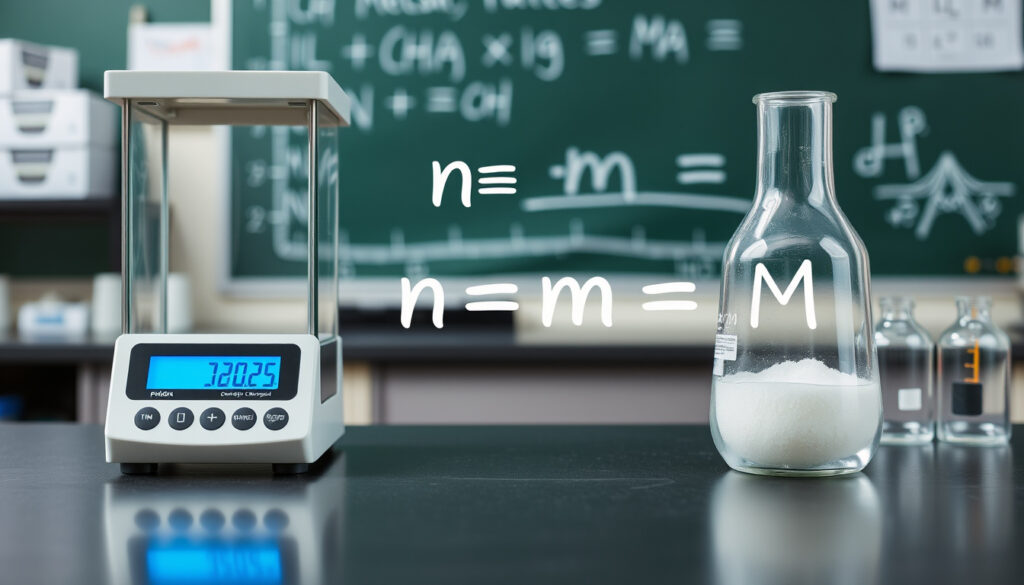
n=m/M Chemistry Formula: What It Means and How to Use It
Few formulas in introductory chemistry cause as much head-scratching as n = m/M — partly because the letters look so similar. It’s the simple division that connects the mass you measure on a lab balance to the number of moles reacting in your flask.
Formula: n = m / M ·
n (moles): Amount of substance (mol) ·
m (mass): Mass in grams (g) ·
M (molar mass): Mass per mole (g/mol) ·
Avogadro’s number: 6.022 × 10²³ particles/mol
Quick snapshot
- n = m/M is the fundamental mass-to-moles relationship in chemistry (OpenStax Chemistry 2e (open-access chemistry textbook))
- Molar mass is the mass of one mole of a substance, expressed in g/mol (Pearson (educational publisher))
- Avogadro’s number is exactly 6.02214076 × 10²³ (OpenStax Chemistry 2e (open-access chemistry textbook)) (OpenStax Chemistry 2e (open-access chemistry textbook))
- Students frequently confuse m (mass) with M (molar mass) — they are not interchangeable (Chemistry LibreTexts (open-access chemistry resource))
- The formula is often mixed up with the dilution equation M1V1 = M2V2, where M stands for molarity, not mass (RevisionDojo (IB chemistry study platform))
- The SI definition of the mole was redefined in 2019, fixing Avogadro’s constant to an exact value (ACS (American Chemical Society))
- Mastering n = m/M unlocks stoichiometry, solution concentration, and gas law calculations (Pearson (educational publisher))
Five key numbers define the n = m/M relationship at a glance — each with a distinct role in the calculation.
| Label | Value |
|---|---|
| Formula | n = m / M |
| Unit of n | mol |
| Unit of m | g |
| Unit of M | g/mol |
| Avogadro’s number | 6.02214076 × 10²³ |
The pattern is clear: every variable carries its own unit, and mixing them up is the fastest route to a wrong answer.
What is n, m, and m in chemistry?
The letters n, m, and M each represent a distinct physical quantity in the n = m/M formula. Knowing which is which is half the battle.
What does n stand for?
- n is the amount of substance, measured in moles (mol). It is the SI base unit for counting particles at the atomic scale (OpenStax Chemistry 2e (open-access chemistry textbook)).
- One mole always contains exactly 6.02214076 × 10²³ elementary entities — atoms, molecules, ions, or whatever is being counted (OpenStax Chemistry 2e (open-access chemistry textbook)).
- The mole is a counting unit, similar to a dozen, but on an enormous scale (Pearson (educational publisher)).
What does m stand for?
- m is the mass of the substance, expressed in grams (g). It is the value you read directly from a laboratory balance (Pearson (educational publisher)).
- Mass must be in grams when using n = m/M — using kilograms without converting will throw the calculation off by a factor of 1000 (RevisionDojo (IB chemistry study platform)).
- In the n = m/M equation, m is lowercase and represents a measured quantity, not a constant.
What does M stand for?
- M is the molar mass, measured in grams per mole (g/mol). It tells you the mass of exactly one mole of a substance (Pearson (educational publisher)).
- Molar mass is numerically equal to the atomic or molecular weight expressed in atomic mass units, but the units are g/mol, not amu (Chemistry LibreTexts (open-access chemistry resource)).
- For a compound like water (H₂O), the molar mass is 18.015 g/mol — the sum of the atomic masses of two hydrogens and one oxygen.
The catch – Chemistry educators note:A student who sees “m” on a lab report and copies it into the denominator as “M” has just divided by mass instead of molar mass — and the answer will be off by orders of magnitude. The difference between lowercase m and uppercase M is the difference between measured mass and a substance-specific constant.
The implication: Confusing m and M is the fastest route to a calculation error.
What is n/m/m used for?
The n = m/M formula is the workhorse of quantitative chemistry. It bridges the macroscopic world of grams and balances with the atomic world of particles and moles.
How is the formula applied?
- Given mass and molar mass, calculate moles: n = m / M (RevisionDojo (IB chemistry study platform)).
- Rearranged to find mass: m = n × M (Pearson (educational publisher)).
- Rearranged to find molar mass: M = m / n (Chemistry LibreTexts (open-access chemistry resource)).
- The formula works for elements, compounds, and any substance with a known chemical formula — including gases at any temperature and pressure (OpenStax Chemistry 2e (open-access chemistry textbook)).
Real-world calculation examples
Step-by-step examples make the formula concrete. Here is a typical classroom problem:
- Find moles from mass: You have 25 g of sodium chloride (NaCl). The molar mass of NaCl is 58.5 g/mol. Moles = 25 g / 58.5 g/mol = 0.427 mol (RevisionDojo (IB chemistry study platform)).
- Find mass from moles: You need 0.5 mol of carbon dioxide (CO₂, molar mass 44.01 g/mol). Mass = 0.5 mol × 44.01 g/mol = 22.005 g.
- Find molar mass from experimental data: A 3.2 g sample of an unknown gas contains 0.05 mol. M = 3.2 g / 0.05 mol = 64 g/mol.
What to watch – Reddit r/chemhelp users caution:A common mistake, according to discussions on Reddit r/chemhelp (student forum), is using atomic mass in amu without converting to molar mass in g/mol. The numeric values look the same, but the units are different — and exam graders will penalize the missing conversion.
The pattern: Each variable has a distinct unit, and mixing them leads to incorrect results.
What is the n/m/m formula called?
The n = m/M relationship goes by several names, and knowing what instructors call it helps when searching for practice problems.
Common names for the formula
- Most textbooks call it the mole formula or the mass-mole relationship (Pearson (educational publisher)).
- Some curricula refer to it as the n=m/M equation or simply the mole equation (RevisionDojo (IB chemistry study platform)).
- It is sometimes called the gram formula mass formula in older textbooks, especially when focusing on molar mass calculation.
Why is it called the mole formula?
- The mole is the central concept that the formula serves. Molar mass (M) is defined as the mass per mole, so the formula directly connects the number of moles (n) to the measured mass (m) (OpenStax Chemistry 2e (open-access chemistry textbook)).
- Historically, the mole was defined as the amount of substance containing as many entities as atoms in 12 g of carbon-12 (Florida State University (chemistry department)). The n = m/M formula is the direct arithmetic expression of that definition.
- In 2019, the SI redefined the mole so that the Avogadro constant has a fixed exact value of 6.02214076 × 10²³ per mole, making the formula even more fundamental (ACS (American Chemical Society)).
The implication: The formula is not just a classroom trick. It reflects the official SI definition of the mole itself. Get comfortable with it, and you are using the same definition that governs international measurement standards.
What does m stand for in m1v1?
This is one of the most common confusion points in general chemistry. The “m” in n = m/M means mass. The “M” in M1V1 means something entirely different.
Difference between m in n=m/M and m in M1V1
- In n = m/M, m is lowercase and stands for mass in grams (Pearson (educational publisher)).
- In M1V1 = M2V2, M is uppercase and stands for molarity (concentration in mol/L), not mass (Chemistry LibreTexts (open-access chemistry resource)).
- The capitalization is crucial: lowercase m = mass, uppercase M = molar mass or molarity depending on context.
How to use M1V1 = M2V2
- The dilution equation M1V1 = M2V2 relates the concentration and volume of a solution before and after dilution (Pearson (educational publisher)).
- M1 and M2 are molarities (mol/L), V1 and V2 are volumes (usually in L or mL as long as units match).
- This formula does not involve mass at all — it is about changing the concentration of a solution by adding solvent.
- The only thing n = m/M and M1V1 = M2V2 share is that both involve the mole concept, but they solve different problems.
The trade-off – Chemistry instructors explain:Treating M as interchangeable between these two formulas will produce a meaningless number. One formula gives you moles from a solid sample; the other gives you the volume of solvent needed to dilute a solution. Keep the context separate, and both become straightforward.
The catch: M in dilution and m in mass are different; context is key.
How do you say 602214076000000000000000?
That long string of digits is Avogadro’s number written out in full — but chemists never actually say it that way. The standard form is what matters.
What is Avogadro’s number?
- Avogadro’s number is 6.02214076 × 10²³, the exact fixed value adopted in the 2019 SI redefinition (OpenStax Chemistry 2e (open-access chemistry textbook)).
- It represents the number of elementary entities (atoms, molecules, ions, electrons, or specified groups) in exactly one mole of a substance (Chemistry LibreTexts (open-access chemistry resource)).
- Prior to 2019, the value was experimentally determined; now it is an SI defining constant with zero uncertainty (ACS (American Chemical Society)).
How to pronounce Avogadro’s number
- The standard spoken form is “six point zero two two times ten to the twenty-third”.
- The full integer — 602,214,076,000,000,000,000,000 — is almost never read aloud. Scientific notation is the universal shorthand.
- The name “Avogadro’s number” honors Amedeo Avogadro, the Italian scientist who proposed that equal volumes of gases contain equal numbers of particles.
Relation to the mole
- The mole and Avogadro’s number are directly linked: one mole = 6.02214076 × 10²³ entities (OpenStax Chemistry 2e (open-access chemistry textbook)).
- When you calculate n = m/M, the resulting number of moles can be multiplied by Avogadro’s number to find the actual particle count.
- For example, 0.427 mol of NaCl contains 0.427 × 6.02214076 × 10²³ = 2.57 × 10²³ formula units of NaCl.
- The mole is the bridge, and Avogadro’s number is the conversion factor between macroscopic mass and microscopic count (Pearson (educational publisher)).
Step-by-step guide to using n = m/M
Following a consistent sequence prevents the common errors that trip up students. Here is the workflow used in most chemistry classrooms:
- Identify the substance — its chemical formula determines the molar mass. You cannot calculate moles without knowing what you are working with (Chemistry LibreTexts).
- Find the molar mass (M) — add the atomic masses of all atoms in the formula, taken from the periodic table. Express the result in g/mol (Pearson (educational publisher)).
- Measure or note the mass (m) in grams — confirm that the mass is in grams, not kilograms or milligrams. Convert if necessary (RevisionDojo (IB chemistry study platform)).
- Divide mass by molar mass — n = m / M. Check that the units cancel: grams divided by grams per mole leaves moles (OpenStax Chemistry 2e (open-access chemistry textbook)).
- Round to the correct significant figures — match the smallest number of significant figures in your inputs.
- Verify with dimensional analysis — write out the units at each step to confirm the answer is in moles.
For a student studying under the NCEA system in New Zealand, getting the mole calculation right is a prerequisite for passing Level 2 and Level 3 chemistry standards (NCEA Guide: Levels, Credits, and Reforms (New Zealand qualification framework)).
The implication: The steps are simple, but each one is a potential trap. Skipping unit conversion or using the wrong molar mass will cascade into a wrong answer — and in an exam, partial credit rarely recovers the lost marks.
onlinelibrary.wiley.com, en.wikipedia.org, openstax.org, pasco.com, en.wikipedia.org, youtube.com
For students studying this formula in the New Zealand curriculum, the NCEA Level 3 Chemistry guide provides a comprehensive overview of the relevant standards and requirements.
Frequently asked questions
How do you calculate molar mass of a compound?
Add the atomic masses of every atom in the chemical formula, using values from the periodic table in g/mol. For water (H₂O): 2 × 1.008 g/mol (hydrogen) + 15.999 g/mol (oxygen) = 18.015 g/mol. The result is the mass of one mole of that compound (Pearson (educational publisher)).
What is the difference between n and M?
n is the number of moles (amount of substance, unit = mol). M is the molar mass (mass per mole, unit = g/mol). They are different physical quantities connected by the formula n = m/M. Confusing them is one of the most common mistakes in introductory chemistry (Chemistry LibreTexts (open-access chemistry resource)).
Can n=m/M be used for gases at any temperature?
Yes — n = m/M applies to any substance in any phase, including gases, because it relates mass to molar mass independent of temperature and pressure. For gas-specific calculations involving volume, use the ideal gas law PV = nRT instead (OpenStax Chemistry 2e (open-access chemistry textbook)).
What is the formula for moles when given volume and concentration?
When you have the volume and concentration (molarity) of a solution, use n = c × V, where c is concentration in mol/L and V is volume in L. This is a separate formula from n = m/M, which deals with solid masses rather than solutions (Pearson (educational publisher)).
Why is the mole concept important in chemistry?
The mole allows chemists to convert between macroscopic mass measurements and the actual number of atoms, molecules, or ions involved in a reaction. Without the mole, balancing equations would be a counting problem with no measurement tool (Pearson (educational publisher)).
How to remember the formula triangle for n=m/M?
Draw a triangle divided into three sections. Place M (molar mass) at the top, m (mass) at the bottom left, and n (moles) at the bottom right. Cover the variable you want to solve for. If the other two are side by side, multiply; if one is above the other, divide. The same logic applies to converting between units using a conversion factor (Convert NZD to USD: Live Exchange Rate & Guide 2024 (formula-based calculation analogy)).
What are the units of molar mass?
The SI unit of molar mass is grams per mole (g/mol). It is numerically equal to the atomic or molecular weight expressed in atomic mass units (amu), but the units are different — g/mol is macroscopic, amu is per particle (OpenStax Chemistry 2e (open-access chemistry textbook)).
More related posts
 What Is a BSB Number? Compare IBAN, SWIFT, Sort Code
 Edit PDF Online Free: Compare the Top 5 Free PDF Editors
 Dollar Rate in India: USD to INR Live & Cost of Living Guide
 Baradene College of the Sacred Heart: Fees, Ranking & Type
 Nilavuku En Mel Ennadi Kobam OTT Release on Prime Video
 Unclaimed Money NZ List: How to Search and Claim Your Funds
 Happy Birthday in German: Phrases, Cards & the Birthday Song
 Sacheu Lip Stain NZ: Where to Buy, Shades & How to Apply
