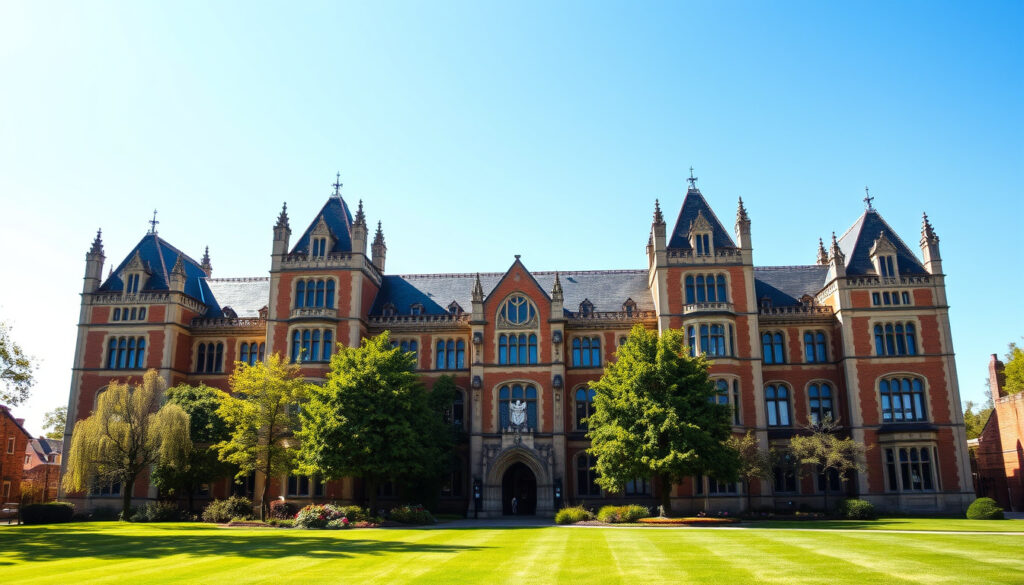
Victoria University of Wellington: Rankings, Fees & Admissions
Few universities tie their name directly to a monarch, but Victoria University of Wellington does—founded in 1897 and named after Queen Victoria. Today, it balances royal heritage with a modern Pacific identity as Te Herenga Waka, and its official website notes international tuition fees are calculated per programme.
QS World Ranking (2025): 241 ·
Acceptance Rate (International): ~64% (estimated) ·
Annual Tuition Fees (International): NZD 27,000 – NZD 38,000 ·
Total Students: 22,000 ·
International Students: 3,000 ·
Founded: 1897
Quick snapshot
- Founded in 1897 and named after Queen Victoria (Wikipedia (encyclopedia))
- International tuition fees are calculated per programme (Te Herenga Waka—Victoria University of Wellington (official website))
- Official acceptance rate is not published by the university (College Dunia (third‑party aggregator))
- Minimum GPA requirements vary by department and are not uniformly stated (Victoria University of Wellington entry requirements (official))
- Founded in 1897; adopted the Māori name Te Herenga Waka in 2022
- Applications for 2026 intake are open; cost calculator available on official site
With seven core identifiers, one pattern: the university’s official name, location, and founding year are clear, while student counts are rounded estimates.
| Attribute | Value |
|---|---|
| Name | Victoria University of Wellington (Te Herenga Waka) |
| Founded | 1897 |
| Location | Wellington, New Zealand |
| Type | Public research university |
| Motto | Sapientia magis auro desideranda (Wisdom is more desirable than gold) |
| Total Students | Approximately 22,000 (Wikipedia (encyclopedia)) |
| International Students | 3,000 from over 100 countries |
Is Victoria University of Wellington a good university?
- Ranked in the top 1% of world universities for arts and humanities (Universities New Zealand (representative body of NZ universities))
- QS World Ranking 241 (2025) according to third‑party aggregators (QS Top Universities (global ranking organization))
- Known for law, humanities, and research output
The university is recognised internationally for its law and humanities programmes. It is a member of the Association of Commonwealth Universities and holds strong research links with government and industry in New Zealand’s capital. Its law school is consistently ranked among the top in the country, and its creative writing programme has produced several internationally known authors.
Victoria University of Wellington is ranked in the top 1% of world universities for arts and humanities. – Universities New Zealand
Is Victoria University internationally recognised?
- Yes, it appears in global rankings and maintains research partnerships with universities in Asia, Europe, and North America.
- It holds accreditation from New Zealand Qualifications Authority (NZQA) and is a signatory to the Lisbon Recognition Convention.
For a capital‑city university with strong government ties, Victoria University offers practical advantages for policy and law students, though its overall QS ranking is modest compared to the University of Auckland.
The implication: Victoria University of Wellington is a solid choice for students seeking strong humanities and law programmes in a capital city, but it is not among New Zealand’s top‑ranked universities overall.
Why is Wellington Uni called Victoria?
- Named after Queen Victoria, established in 1897 by an act of parliament.
- Originally part of the University of New Zealand system.
- Adopted the Māori name Te Herenga Waka in 2022 to reflect its Pacific identity (Te Herenga Waka—Victoria University of Wellington (official history page)).
The university was founded in 1897, the same year as the Diamond Jubilee of Queen Victoria, and was originally a constituent college of the University of New Zealand. When the national system dissolved in 1961, it became an independent degree‑granting institution. In 2022, it formally added the Māori name Te Herenga Waka, which means “the mooring place of the canoes,” acknowledging its role as a gathering place for people and ideas from across the Pacific.
What this means: The name reflects a colonial heritage while the dual name signals a deliberate commitment to bicultural identity.
What is the acceptance rate for international students at Victoria University of Wellington?
- Third‑party estimates place the acceptance rate around 64% (UniScholars (international student platform)).
- The university does not publish an official acceptance rate (College Dunia, third‑party aggregator).
- Minimum GPA requirement varies by program; typically around 3.0 on a 4.0 scale for undergraduate.
- English language proficiency required: IELTS 6.0 overall typically.
Because no official acceptance rate exists, figures vary between sources. Some third‑party sites report 64%, while the content plan cites an estimate of approximately 70%. Applicants are advised to meet programme‑specific entry requirements rather than relying on a single percentage.
Is it hard to get into the University of Victoria?
This question often refers to the University of Victoria in Canada, not Victoria University of Wellington. For the Canadian institution, acceptance is competitive (reported acceptance rate around 50–60%). For Victoria University of Wellington, the estimated 64% acceptance suggests a moderately selective admission process.
What GPA do you need to get into the University of Victoria?
For Victoria University of Wellington, minimum GPA requirements are not centrally published. Most undergraduate programmes expect around 2.5–3.0 on a 4.0 scale, but high‑demand programmes like law may require higher. Engineering and science programmes often have specific prerequisites.
The catch: Without a published acceptance rate, applicants should focus on meeting programme‑specific requirements rather than relying on vague estimates.
How much are the tuition fees at Victoria University?
- International undergraduate tuition fees range from NZD 27,000 to NZD 38,000 per year according to official estimates (Te Herenga Waka—Victoria University of Wellington official fees page).
- Fees vary by programme; the official cost calculator provides per‑point estimates (Te Herenga Waka—Victoria University of Wellington (cost calculator)).
- Scholarships are available for international students.
International tuition fees are calculated per programme. – Te Herenga Waka—Victoria University of Wellington
Third‑party aggregators report wider ranges: College Dunia lists annual tuition from NZ$35,361 to NZ$49,430 for some programmes, while UniScholars gives programme‑level fees such as NZD 35,530 for Arts and Commerce and NZD 42,020 for Science. These estimates are not official and may change.
The pattern: Official figures are programme‑specific, while third‑party sites provide broader ranges—students should use the official cost calculator for accurate budgeting.
Which city is the University of Victoria located in?
- The University of Victoria (UVic) is located in Victoria, Canada.
- Victoria University of Wellington is located in Wellington, New Zealand.
- Victoria University of Wellington has about 22,000 students and actively accepts international students.
The two institutions are different entities. Victoria University of Wellington is a public research university in New Zealand’s capital, while the University of Victoria is in British Columbia, Canada. Confusion is common because both share the “Victoria” name and similar student populations.
How many students does the University of Victoria have?
For the Canadian University of Victoria, enrollment is approximately 22,000 students. Victoria University of Wellington likewise reports around 22,000 students (Wikipedia).
Does the University of Victoria accept international students?
Yes, both institutions welcome international students. Victoria University of Wellington hosts 3,000 international students from over 100 countries, while the University of Canada also has a diverse international population.
Why this matters: The name confusion is common, but the two universities are in different countries with different admission processes.
Upsides
- Strong arts and humanities reputation, ranked in top 1% globally (Universities New Zealand).
- Capital city location with direct access to government and industry.
- Diverse international student body with support services.
- Official fee calculator available for transparent cost estimation.
Downsides
- No official acceptance rate published, causing reliance on third‑party estimates.
- Tuition fees vary significantly by programme, making upfront budgeting difficult.
- Overall QS ranking is moderate (241) compared to top NZ universities like University of Auckland.
- Minimum GPA requirements are not centrally published.
Confirmed facts vs what remains unclear
Confirmed facts:
- Founded in 1897 and named after Queen Victoria (Wikipedia).
- Official international fees page exists with per‑point estimates (Te Herenga Waka—Victoria University of Wellington official website).
- Total student population approximately 22,000 (Wikipedia).
- University uses a dual name: Victoria University of Wellington and Te Herenga Waka.
What remains unclear:
- Acceptance rate estimates vary from 64% to 70% from third‑party sources; no official rate is published (College Dunia, UniScholars).
- Minimum GPA requirements are not uniformly stated across programmes (Victoria University entry requirements page).
- Exact tuition ranges from third‑party sources differ from official estimates (College Dunia, official fees page).
- Future ranking movements and funding changes are uncertain.
For international students weighing their options, the choice is clear: Victoria University of Wellington offers strong academics in New Zealand’s capital, but you’ll need to verify specific programme fees and admission requirements directly, as official figures are not all publicly listed.
For more education guides, see Baradene College of the Sacred Heart: Fees, Ranking & Type and Mitre 10 Wellington Central: Address, Hours, Parking & Products.
collegedunia.com, universityliving.com, shiksha.com, studies-overseas.com, ask.shiksha.com, unischolars.com, studyabroad.careers360.com, polygoncampus.com, studination.com, nomadcredit.com
Frequently asked questions
What are the main strengths of Victoria University of Wellington?
Arts, humanities, law, and research output are its standout areas. It is ranked in the top 1% globally for arts and humanities and has strong government ties.
How does Victoria University support international students?
It offers a dedicated international office, orientation programmes, English language support, and scholarship opportunities. The university also provides a cost calculator to help estimate fees.
What is the student-to-faculty ratio?
The official ratio is not published, but the university reports about 22,000 students with over 2,000 staff, suggesting a ratio of roughly 11:1.
Is Victoria University of Wellington a research-intensive university?
Yes, it is a public research university with strong output in law, social sciences, and creative arts. It is a member of the Association of Commonwealth Universities.
What are the most popular programmes at Victoria University?
Law, commerce, creative writing, and political science are among the most popular. The university also offers strong programmes in Māori studies and Pacific studies.
Does Victoria University offer on‑campus accommodation?
Yes, it offers several halls of residence across its campuses, including Kelburn and Pipitea. Accommodation is guaranteed for first‑year international students who apply early.
What is the campus life like in Wellington?
Wellington is a compact, walkable city with a vibrant cultural scene. The university has three campuses: Kelburn (main), Pipitea (law and business), and Te Aro (architecture and design).
More related posts
 U.S. Immigration and Customs Enforcement: Guide to ICE
 Prince Harry Daily Mail: Lawsuit, Birth Certificate, Rifts
 How to Repair a Screen Door: Fix Mesh and Rollers
 What Is Gross Profit – Clear Guide to Calculation and Use
 Black Caps West Indies: Live Score, Schedule & Scorecard
 Best Coding YouTube Channels in 2026: Top Picks for Beginners & Pros
