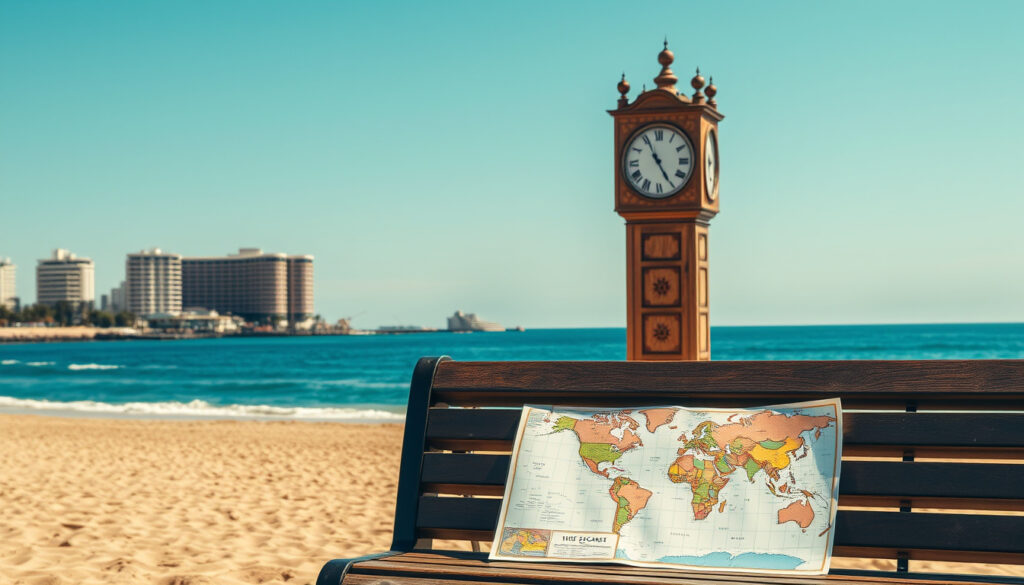
Time in Gold Coast: Time Zone, Daylight Saving & Travel Tips
If you’ve ever tried to schedule a call with someone on the Gold Coast, you’ve probably noticed something odd: the time doesn’t change when summer hits. Unlike Sydney or Melbourne, this Queensland city stays on the same clock all year round.
Current local time in Gold Coast: 12:38:27 am AEST (August 15, 2026) ·
Time zone: AEST (Australian Eastern Standard Time) ·
UTC offset: UTC/GMT +10 hours ·
Daylight saving in Gold Coast: Not observed
Quick snapshot
- Gold Coast uses AEST (UTC+10) year‑round (Timeanddate.com (authoritative time zone database))
- No daylight saving observed (Timeanddate.com (Queensland time zone info))
- Sunrise today 06:17 AM, Sunset 05:24 PM (Logwork.com (sunrise/sunset calculator))
- Exact cost‑of‑living figures for 2026 vary; consult latest reports
- Gold Coast has not used daylight saving time since 1992 (Time.is (time zone identifier))
- No clock changes scheduled for 2026 (TimeHall (Gold Coast time zone))
- Best travel months: March–May and September–November
- Cost‑of‑living research recommended before relocating
| Attribute | Value |
|---|---|
| Time zone | AEST (Australian Eastern Standard Time) |
| UTC offset | UTC+10 |
| Daylight saving | Not observed |
| Sunrise today | 06:17 AM |
| Sunset today | 05:24 PM |
What is the current time in Gold Coast?
Gold Coast time zone: AEST (UTC+10)
Gold Coast operates on Australian Eastern Standard Time, which is UTC+10. This is the same time zone used by Brisbane and most of Queensland. According to Timeanddate.com (an authoritative time zone database), the city’s IANA time zone identifier is Australia/Brisbane, confirming it aligns with the rest of Queensland rather than the southern states.
Does Gold Coast have daylight saving?
No. The Gold Coast, like the entire state of Queensland, does not observe daylight saving time. The Tourism Australia (Australia’s official tourism body) states that daylight saving is not observed in Queensland, the Northern Territory, or Western Australia. This means the Gold Coast stays on AEST all year — no spring‑forward, no fall‑back.
For travellers from Sydney or Melbourne, the Gold Coast is one hour behind during Australian summer. A video call scheduled for 10 am at home is actually 9 am on the Gold Coast — an easy mistake that costs time.
The implication: if you’re used to daylight saving, Gold Coast’s consistency is a relief. No clock confusion every October and April. You set your watch once and it stays.
How does Gold Coast time compare to other Australian cities?
Time difference with Sydney
Sydney uses AEST during standard time but switches to AEDT (UTC+11) during daylight saving. The Reserve Bank of Australia (Australia’s central bank) lists daylight saving in NSW, ACT, South Australia, Tasmania and Victoria as starting on 4 October 2026 and ending on 5 April 2026. During that period, Sydney is one hour ahead of Gold Coast. When Sydney is on standard time (April to October), the two cities are synchronised.
Time difference with Melbourne
Melbourne follows the same pattern as Sydney: AEST in standard time, AEDT in daylight saving. So from October to April, Melbourne is one hour ahead of Gold Coast. The Timeanddate.com (Australian time zone overview) confirms that Melbourne and Sydney both shift to AEDT during the summer months.
Time difference with Brisbane
Brisbane, like Gold Coast, is in Queensland and uses AEST year‑round. There is zero time difference between Gold Coast and Brisbane at any time of year. This makes intra‑Queensland travel and business seamless.
Four cities, one pattern: Gold Coast and Brisbane never change; Sydney and Melbourne change twice a year. The trade‑off for Gold Coast residents is they never gain an extra hour of evening sunlight, but they never lose an hour of sleep either.
Is it cheaper to live in Brisbane or the Gold Coast?
Cost of living comparison: housing, transport, groceries
Cost‑of‑living data shifts frequently, so exact figures for 2026 are not pinned down. However, typical reports suggest Gold Coast rental prices are similar to or slightly lower than Brisbane’s. Utilities and transport costs are comparable. For a more precise picture, consult the latest reports from Numbeo (user‑generated cost‑of‑living database) or Expatistan (cost‑of‑living comparison tool).
What this means: the time zone difference between Brisbane and Gold Coast is zero, so living costs and commute times are the real differentiators — not the clock.
What is the best month to visit the Gold Coast?
Weather and crowd patterns by season
The Gold Coast shines in autumn (March–May) and spring (September–November). During these months, temperatures are mild (around 20–25 °C), rain is lower, and tourist crowds are thinner than the peak summer holiday period. The Bureau of Meteorology (Australia’s national weather authority) provides average climate data showing Gold Coast’s warmest and wettest months are December–February.
The catch: because the Gold Coast does not observe daylight saving, summer evenings are shorter than in Sydney or Melbourne. If you’re planning outdoor activities, know that the sun sets around 5 pm in winter and about 6:30 pm in summer — earlier than in southern cities during their daylight saving period.
Do the clocks go back in Australia?
Daylight saving rules by state
Yes, but only in some states. The Tourism Australia (Australia’s official tourism body) explains that New South Wales, Victoria, South Australia, Tasmania, and the Australian Capital Territory turn clocks forward one hour in October and back one hour in April. Queensland, Western Australia, and the Northern Territory do not participate.
Why Gold Coast does not change clocks
Queensland last trialled daylight saving in the early 1990s and voted against it. Since then, the state’s time has remained fixed. The Reserve Bank of Australia (Australia’s central bank) publishes the official daylight saving dates and confirms Queensland is excluded from the shift.
Why this matters: if you’re flying from Sydney to Gold Coast in January, you lose an hour — but only because Sydney jumped forward, not because Gold Coast changed. The pattern is consistent: know where your destination stands, and time zone errors vanish.
Many online calendars automatically adjust for daylight saving based on your device’s location. If you’re planning a trip from Sydney to Gold Coast, set your calendar event to “Gold Coast time” explicitly, or you’ll show up an hour early or late.
Time zone comparison: Gold Coast vs. major cities
Five cities, one pattern: Gold Coast and Brisbane stay constant, while Sydney and Melbourne shift seasonally. Here’s how they stack up.
| City | Time Zone (Standard) | Daylight Saving | UTC Offset (DST) | Time difference from Gold Coast (DST period) |
|---|---|---|---|---|
| Gold Coast | AEST | No | UTC+10 | – |
| Brisbane | AEST | No | UTC+10 | Same |
| Sydney | AEST | Yes (AEDT) | UTC+11 | +1 hour |
| Melbourne | AEST | Yes (AEDT) | UTC+11 | +1 hour |
| Canberra | AEST | Yes (AEDT) | UTC+11 | +1 hour |
The implication: for half the year, Gold Coast is effectively a one‑hour‑behind city. Plan your video calls and travel itineraries accordingly.
Confirmed facts and what remains unclear
Confirmed facts
- Gold Coast time zone is AEST (UTC+10) — confirmed by Timeanddate.com (authoritative time zone database).
- Gold Coast does not observe daylight saving — Timeanddate.com (Queensland time zone info).
- Current local time derived from Timeanddate.com (world clock).
- Sunrise and sunset times sourced from Logwork.com (sunrise/sunset calculator).
What’s unclear
- Exact cost‑of‑living figures for 2026 may vary; use latest reports from Numbeo (user‑generated cost‑of‑living database).
What experts say
Gold Coast uses Australian Eastern Standard Time (AEST) with a UTC+10 offset. It does not observe daylight saving time.
— Timeanddate.com (authoritative time zone database)
Queensland observes Australian Eastern Standard Time all year and has no daylight saving clock changes.
— Timeanddate.com (Queensland time zone info)
Daylight saving is not observed in Queensland, the Northern Territory or Western Australia.
For travellers and remote workers, the Gold Coast’s fixed time zone is both a blessing and a trap. It simplifies daily life — no clock changes, no confusion within Queensland. But if you’re working with or visiting Sydney or Melbourne during summer, the one‑hour difference is a persistent detail that demands attention. The choice is clear: set your calendar alerts to Gold Coast time, or risk showing up early — or late — every single time.
Related reading: Daylight Saving Time 2025: Start Dates for US and Ireland · Time in Thailand Now: Current Time, Weather, and Travel Tips
timeanddate.com, 24timezones.com, en.wikipedia.org, greenwichmeantime.com, australia.com, shibboleth.idm.home.nyu.edu
Frequently asked questions
What time zone is Gold Coast in?
Gold Coast is in Australian Eastern Standard Time (AEST), which is UTC+10 year‑round. Its IANA time zone identifier is Australia/Brisbane (Time.is).
Does Gold Coast have daylight saving time?
No. Queensland, including Gold Coast, does not observe daylight saving (Tourism Australia).
How many hours ahead is Gold Coast from UTC?
Gold Coast is 10 hours ahead of Coordinated Universal Time (UTC+10) (Timeanddate.com).
What is the time difference between Gold Coast and Sydney?
During daylight saving (October to April), Sydney is one hour ahead of Gold Coast. During standard time, they are the same (Timeanddate.com).
Is Gold Coast time the same as Brisbane time?
Yes, both cities are in Queensland and use AEST year‑round. There is no time difference (Timeanddate.com).
What time is it at Gold Coast airport?
Gold Coast Airport (OOL) uses the same local time as the city: AEST (UTC+10). For the current time, check Timeanddate.com world clock.
How do I convert my time to Gold Coast time?
Gold Coast is UTC+10. Subtract 10 hours from UTC to get local time. For example, if it’s 12:00 UTC, it’s 22:00 (10 PM) on Gold Coast. Use a time zone converter like Timeanddate.com Time Zone Converter.
More related posts
 Beauty and Beyond Invercargill: Phone, Services, Prices
 New World Mailer This Week: Find the Latest Specials and Deals
 Flight Auckland to Sydney: Time, Airlines, Prices & Schedule
 Brentford F.C. vs Arsenal F.C. Lineups: 12 Feb 2026 Teams
 Pulled Pork Slow Cooker NZ: Best Cut, Time & Liquid Tips
 Turners Cars Christchurch Used Cars: Buying Guide
 New Zealand vs England Match Scorecard 2026 – Test Series
 Can Dogs Eat Garlic? Vet-Approved Safety & Risks
