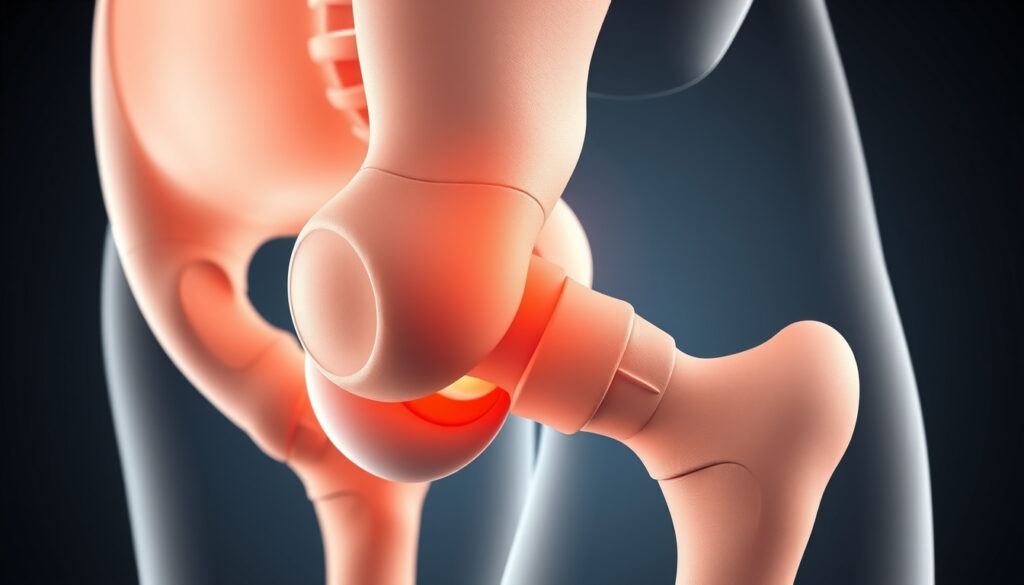
Ball and Socket Joint: Anatomy, Examples & Function
Ball-and-socket joints are the most mobile joint type in the human body, but this remarkable flexibility comes with a trade-off in stability. Found only in the hip and shoulder, these synovial structures let you rotate your arm in a full circle, kick sideways, and perform movements that hinge joints simply cannot match. This guide breaks down how they work, where they’re located, and what happens when they wear out.
Primary locations in human body: Hip and shoulder · Joint type: Synovial · Movement range: Multi-directional (flexion, extension, abduction, adduction, rotation) · Replacement possible: Yes, via joint replacement surgery
Quick snapshot
- The hip and shoulder are the only ball-and-socket joints in the human body (Lumen Learning)
- Ball-and-socket joints are multiaxial, allowing movement in all three planes (Kenhub)
- Synovial membrane lines the joint, secreting lubricating fluid (Johns Hopkins Medicine)
- Whether minor anatomical variations create additional ball-and-socket structures in some individuals
- The exact threshold where “normal” anatomical variation becomes a distinct third ball-and-socket joint
- Kenhub’s ball-and-socket joint article was last reviewed on October 30, 2023 (Kenhub)
- Cleveland Clinic updated its shoulder joint page on September 19, 2025 (Cleveland Clinic)
- Both hip and shoulder joints can be replaced surgically when damaged beyond repair
- Understanding the mobility-stability trade-off helps patients make informed decisions about treatment
Ball-and-socket joint characteristics are well-established in anatomical literature, with the key parameters summarised in the table below.
| Attribute | Value |
|---|---|
| Joint Type | Synovial (spheroid) |
| Primary Human Locations | Hip, shoulder |
| Degrees of Freedom | 3 or more planes |
| Ligament Support | Capsule and ligaments |
| Shoulder Socket Name | Glenoid cavity |
| Hip Socket Name | Acetabulum |
| Joint Classification | Multiaxial / Polyaxial |
| Shoulder Ball Component | Humerus head |
| Hip Ball Component | Femur head |
What is a ball and socket joint?
A ball-and-socket joint is a type of synovial joint where the rounded head of one bone fits into a cup-like depression of another bone. According to Lumen Learning (educational resource), this ball-and-socket structure enables the widest range of motion of any joint type in the body. The synovial membrane lines the joint cavity and secretes synovial fluid, which reduces friction during movement Johns Hopkins Medicine.
Anatomy basics
The “ball” component is the rounded end of one bone, and the “socket” is the concave surface it fits into. In the human body, the Innerbody Research describes how the humerus head sits in the glenoid cavity of the scapula at the shoulder, while the femur head fits into the acetabulum of the os coxa at the hip.
Ligaments surround the joint for support and help limit excessive movement Johns Hopkins Medicine. The shoulder joint specifically features a glenoid labrum—a ring of cartilage that deepens the socket for added stability Innerbody Research.
Key features
According to Kenhub (expert-reviewed anatomy resource), ball-and-socket joints are classified as polyaxial, meaning they allow movement around all three axes of rotation. The Better Health Channel confirms that this structure permits movement in all directions.
Ball-and-socket joints offer maximum mobility, but this comes at a cost: less inherent stability. The shoulder prioritizes range of motion, while the hip prioritizes weight-bearing stability.
The implication is that no ball-and-socket joint is superior in isolation—design is always a compromise between how far the joint can move and how securely it holds its position.
What is an example of a ball and socket joint?
The human body contains exactly two ball-and-socket joints—both major joints involved in everyday movement. According to Lumen Learning, the hip and the shoulder (glenohumeral joint) are the only ball-and-socket joints in the human body.
Hip joint
The hip joint connects the femur head to the acetabulum of the pelvic bone. According to Innerbody Research, the femur head fits tightly into this deep bony socket, making the hip joint highly congruent and stable. The hip is built for weight-bearing and stability rather than extreme mobility.
The Vaia (textbook resource) explains that hip support comes from the pelvic girdle and muscles including gluteals, quadriceps, hamstrings, and iliopsoas. According to Lumen Learning, the hip joint’s acetabulum is a deep socket with strong ligaments that prioritizes stability and weight-bearing.
Shoulder joint
The shoulder joint (glenohumeral joint) connects the humerus head to the glenoid cavity of the scapula. Cleveland Clinic notes that the shoulder has the greatest range of motion of all joints in the body. According to Vaia, the shoulder is supported by the clavicle, scapula, deltoid, and rotator cuff muscles.
The shoulder joint’s glenoid cavity is notably shallow. Lumen Learning reports that this shallow structure enables extensive range of motion but provides less stability. The humerus articular surface is about four times larger than the glenoid cavity area, according to research published in the KJMS Archives (anatomical study).
Other examples
While the hip and shoulder are the primary examples in human anatomy, ball-and-socket structures also appear in mechanical applications such as vehicle suspension systems. These engineered joints serve similar functions in allowing multi-directional rotation and movement.
Patients researching joint replacement should understand that “ball and socket” describes a mechanical structure found in both medicine and engineering—context determines whether the discussion involves human anatomy or mechanical components.
What this means for readers is that searching for “ball joint replacement” online will pull up both medical and automotive results, so clarifying the anatomical context is essential before proceeding.
What are the 4 examples of ball and socket joints?
The phrase “4 examples” often refers to the two human ball-and-socket joints counted twice (hip × 2, shoulder × 2) or references mechanical applications alongside the anatomical ones.
Human body examples
For the human body, there are two ball-and-socket joints total: the hip joints (one on each side) and the shoulder joints (one on each side). This gives a total of four joint structures when counting bilaterally, though anatomically they represent just two joint types.
Mechanical applications
Beyond human anatomy, ball-and-socket joints appear in various mechanical systems. Vehicle suspension systems commonly use ball joints to allow steering movement while supporting the vehicle’s weight. These mechanical counterparts serve a similar purpose: enabling rotation while bearing load.
Patients researching joint replacement should understand that “ball and socket” describes a mechanical structure found in both medicine and engineering—context determines whether the discussion involves human anatomy or mechanical components.
The catch is that mixing up anatomical and mechanical references can lead to confusion in patient-provider discussions and search results—clarity on context prevents misunderstandings about treatment options.
Does a ball and socket joint work?
Ball-and-socket joints function by allowing the ball end of one bone to rotate within the socket of another bone. According to Brookbush Institute (rehabilitation resource), ball-and-socket joints allow motion in all three planes: sagittal, frontal, and transverse.
Movement types
According to Kenhub, ball-and-socket joints permit several types of movement:
- Flexion and extension
- Abduction and adduction
- Medial (internal) and lateral (external) rotation
The Vaia notes that both hip and shoulder have outer powerful mover muscles and inner fine tuner muscles like the rotator cuff. This combination allows both gross movements and precise positioning.
How it functions
The joint capsule plays a crucial role. According to Big Picture Anatomy (YouTube educational channel), the hip joint capsule is taut, providing stability, while the shoulder capsule is lax—especially inferiorly—allowing greater mobility.
Hip ligaments are strong and limit movement, while shoulder ligaments are relatively weaker, according to the same source. This structural difference explains why the shoulder can rotate more freely but is more prone to dislocation.
Ball-and-socket joints are the most mobile of all joints in the human body. — Danijel Tosovic, PhD, Author, Kenhub
The implication is that every ball-and-socket joint carries an inherent instability risk proportional to its mobility—the more freely it moves, the more it depends on surrounding soft tissue for protection.
Can a ball and socket joint be replaced?
Yes, both hip and shoulder ball-and-socket joints can be surgically replaced when damaged by arthritis, injury, or wear. Hip replacement surgery (total hip arthroplasty) and shoulder replacement surgery (total shoulder arthroplasty) are established procedures with good long-term outcomes.
Wear and symptoms
Ball-and-socket joints can wear out over time, primarily through osteoarthritis, where cartilage breaks down and causes pain and stiffness. Symptoms typically include joint pain during movement, limited range of motion, and morning stiffness that improves with activity.
The shoulder is particularly susceptible to soft tissue injuries due to its relative instability. According to Stumpff Chiropractic, shoulder injuries often involve the rotator cuff, which compensates for the shallower socket structure.
Replacement options
Hip replacement surgery involves removing the damaged femur head and acetabulum and replacing them with artificial components. Shoulder replacement similarly replaces the humerus head and glenoid socket with prosthetic parts.
According to Cleveland Clinic, the shoulder is supported by rotator cuff muscles and tendons, so a successful replacement depends partly on the condition of these supporting structures.
Shoulder dislocations are more common than hip dislocations because the shoulder has less bony support. Athletes and individuals with shoulder instability should seek evaluation to prevent chronic joint damage.
What this means for anyone facing joint replacement is that the condition of surrounding muscles and tendons—particularly the rotator cuff for the shoulder—directly influences surgical outcomes and recovery expectations.
Understanding what’s confirmed and what remains unclear
Confirmed facts
- Hip and shoulder are ball-and-socket joints (verified by multiple sources)
- Ball-and-socket joints allow multi-directional movement
- Shoulder has greater range of motion; hip provides greater stability
- Synovial fluid lubricates these joints
What’s unclear
- Whether anatomical variations might create additional ball-and-socket structures in some individuals beyond the standard hip and shoulder
- Exact quantitative thresholds for when variation constitutes a distinct joint type
What experts say
The joint with the greatest range of motion is the ball-and-socket joint. — Lumen Learning (Educational Resource)
Shoulder like a golf ball sitting on a golf tee and the hip as a true ball in socket. — Stumpff Chiropractic
The comparison between shoulder and hip structures reveals a fundamental trade-off in joint design: mobility versus stability. The shoulder’s shallow glenoid cavity sacrifices bony support for exceptional range of motion, while the hip’s deep acetabulum prioritizes weight-bearing stability over extreme flexibility.
Related reading: BMI guide · Te Aroha Hot Pools
Omega-3 supplements like Seven Seas Joint Care, with decades of expertise, can help maintain ball and socket joint function amid early wear signs.
Frequently asked questions
What causes a ball and socket joint to wear out?
Ball-and-socket joints wear out primarily through osteoarthritis, where protective cartilage gradually breaks down. Other causes include rheumatoid arthritis, traumatic injury, repetitive overuse, and age-related degeneration. The synovial fluid may also decrease over time, reducing natural lubrication.
How is a bad ball joint diagnosed?
Diagnosis typically involves physical examination assessing range of motion and pain points, followed by imaging such as X-rays or MRI to evaluate cartilage and bone structure. In some cases, CT scans provide detailed views of bony architecture.
What is the difference between ball and socket and hinge joints?
Ball-and-socket joints allow movement in multiple planes and rotation, while hinge joints (like the elbow or knee) permit movement primarily in one plane—bending and straightening. Ball-and-socket joints offer greater mobility but less inherent stability than hinge joints.
Are there ball and socket joints in animals?
Yes, many animals have ball-and-socket joints in their hips and shoulders. The basic structure of rounded bone ends fitting into socket depressions is conserved across many vertebrate species, though the specific anatomy varies by species and their locomotion needs.
How does synovial fluid help ball and socket joints?
Synovial fluid, secreted by the synovial membrane, lubricates the joint surfaces and reduces friction during movement. It also nourishes the articular cartilage and acts as a shock absorber. In ball-and-socket joints, this fluid is particularly important given the extensive range of motion these joints permit.
What exercises strengthen ball and socket joints?
Strengthening exercises for ball-and-socket joints include resistance training for surrounding muscles, gentle stretching to maintain flexibility, and low-impact activities like swimming or cycling. For the shoulder, rotator cuff exercises are particularly beneficial. For the hip, exercises targeting gluteals and quadriceps provide crucial support.
Is ball joint replacement outpatient?
Hip and shoulder replacement surgeries vary from outpatient to multi-day hospital stays depending on the patient’s overall health, the surgical approach used, and whether there is adequate home support for recovery. Minimally invasive techniques have made some replacements same-day procedures.
More related posts
 Catch of the Day NZ: Vape Wholesale Guide & AU Closure Facts
 Franz Josef Glacier Walk: Time, Distance & Tips
 Kids Shoe Size Chart: UK EU US by Age & cm Guide
 Convert PNG to JPG: Free Online, Mac, iPhone Guide
 St Albans Medical Centre: Appointments, Prescriptions & Sick Notes
 Op Shops Near Me: Complete Thrifting Guide for Ireland
 Confessions of a Shopaholic – Plot Summary, Series Order, Movie Guide
 New World Mailer This Week: Find the Latest Specials and Deals
