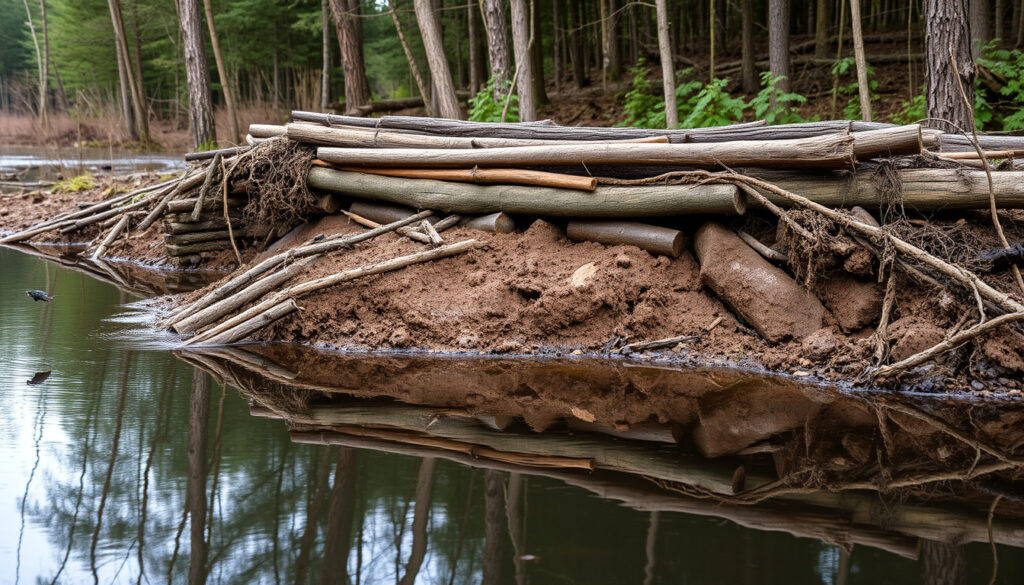
Why Do Beavers Build Dams? Instinct, Purpose & Ecological Impact
There’s something almost comical about a beaver scrambling to patch a leaky dam with mud and sticks, but behind that frantic activity lies a survival instinct that reshapes entire landscapes. Beavers build dams not by conscious plan but because the sound of running water triggers an automatic reflex that has kept their species safe for millions of years (Britannica (encyclopedia of natural history)).
Beaver dams can exceed 1,500 feet in length: World’s largest in Wood Buffalo National Park stretches 2,790 feet · Beavers build dams primarily for safety: Creates deep ponds that protect against predators like bears and wolves · Dam construction time varies: A small dam can be built in a single night; large dams take weeks to months · Beaver lifespan in the wild: 10–12 years on average, up to 24 years in captivity
Quick snapshot
- Beavers build dams to create deep ponds that protect against predators (Britannica)
- Dam building is an instinctive response to the sound of running water (BBC Science Focus Magazine)
- Beavers do not live in the dam itself—they live in the pond behind it (BBC Science Focus Magazine)
- Whether beavers consciously understand the purpose of dam building
- Exact number of beavers in largest colonies
- Long-term effects of repeated dam removal on beaver population health
- Beavers build dams as needed, not on a fixed schedule; construction can begin within hours of hearing running water (Beaver Solutions (wildlife management consultancy))
- As beaver populations rebound in many regions, conflicts with humans may increase, requiring careful management strategies
Six key facts, one pattern: beavers are masters of adaptation through construction.
| Attribute | Value |
|---|---|
| Dam length record | 2,790 feet (Wood Buffalo National Park) |
| Typical construction time | One night to several months, depending on size |
| Average beaver lifespan | 10–12 years (wild), up to 24 (captivity) |
| Beaver group name | Colony or family |
| Maximum dam height | Up to 10 feet |
| Number of beaver species | Two: North American and Eurasian |
Why do beavers build dams?
What triggers the instinct to build dams?
- Beavers are hardwired to respond to the sound of running water (BBC Science Focus Magazine (popular science publication))
- The reflex is so strong that beavers will build dams even in captivity if they hear water (Britannica (encyclopedia of natural history))
The primary driver is predator protection. By building a dam, beavers raise the water level around their lodge, creating a deep moat that predators like bears, wolves, and coyotes cannot easily cross (Britannica). The pond also allows beavers to store branches and bark underwater for winter food, and to access their lodge through submerged tunnels that serve as hidden escape routes (Britannica). Beavers are slow and vulnerable on land, so staying close to water is essential for survival (Beaver Solutions (wildlife management consultancy)).
Beavers don’t choose to build—they simply hear rushing water and start moving mud. Their entire survival strategy depends on this automatic behavior, not on conscious planning.
Are beavers aware of the purpose behind dam building?
- Science suggests the behavior is entirely instinctual, not intentional (BBC Science Focus Magazine)
- No evidence indicates beavers form a mental plan before building; they react to sensory cues
According to Richard Brazier, a beaver expert quoted by BBC Science Focus, beavers in the UK face far fewer predators than their North American cousins because large predators like bears and wolves have been largely killed off there (BBC Science Focus Magazine). Nevertheless, British beavers still build dams—proof that the instinct persists even when the original threat is absent. This reinforces the idea that beavers are not consciously calculating the benefit; they are following a deep-seated reflex.
The pattern: What looks like engineering is actually automatic behavior. The beaver’s brain is wired to turn the sound of flowing water into a construction command, regardless of whether a dam is actually needed.
Do beavers know why they build dams?
- Current research indicates beavers lack the cognitive awareness to understand the consequences of dam building (Britannica)
- The behavior is triggered by a simple auditory cue, not by a conscious goal to create a pond
In other words, a beaver does not think, “I need to raise the water level to hide from wolves.” Instead, it hears water trickling and begins to pile sticks and mud until the sound stops. The result—a deep pond—is beneficial, but the beaver never planned for it. This distinction matters because it shapes how we interpret beaver behavior and how wildlife managers design interventions. Treating dam building as a reflex, not a choice, changes the approach to coexistence.
The implication: If beavers don’t know what they’re doing, then removing a dam won’t “teach” them a lesson—they’ll simply rebuild as soon as they hear water again.
Where is the biggest beaver dam in the world?
How large is the world’s largest beaver dam?
- Located in Wood Buffalo National Park, Alberta, Canada
- Length approximately 2,790 feet (850 meters) (Britannica)
- Visible on satellite imagery but not from the ISS naked eye
This massive structure was discovered on satellite photos and later confirmed by researchers on the ground. It is so large that it has created a wetland ecosystem visible from space, though it cannot be distinguished by the unaided eye from the International Space Station. For comparison, the average beaver dam is 30–50 feet long (Beaver Solutions). The Wood Buffalo dam is an extreme case, built over many years by successive generations of beavers.
Can beaver dams be seen from space?
- Yes, on satellite imagery, the dam and its pond are clearly visible
- But they are too small to be seen with the naked eye from orbit
The United States Geological Survey has used satellite data to map beaver dams across North America, revealing tens of thousands of these structures. The largest dam in Wood Buffalo National Park is a standout even among thousands, but it is still far below the resolution of human eyesight from the ISS. The catch: While beaver dams are impressive ecosystem modifiers, they are not space-scale landmarks.
For researchers, the ability to spot beaver dams from orbit has revolutionized population tracking. For the public, it’s a reminder that even small animals can leave planetary-scale footprints.
Why destroy beaver dams?
What damage do beaver dams cause?
- Dams can flood roads, agricultural fields, and timber (Britannica)
- Flooding can block drainage systems and damage infrastructure
When beavers build in human-dominated landscapes, their dams often cause costly problems. Roads may become impassable, crops drown, and septic systems fail. In extreme cases, dam‑induced flooding can wash out driveways or weaken building foundations (Beaver Solutions).
How do authorities manage problematic dams?
- Removal methods include trapping, water flow devices, and manual dismantling
- Permits often required before removal (BBC Science Focus Magazine)
Wildlife agencies typically recommend non‑lethal solutions first—such as flow devices that let water pass while preventing beavers from building up the dam. Manual removal is done only with a permit, and only when the dam poses an immediate risk. The trade-off: Removing a dam without replacement controls can trigger downstream erosion and flooding, while leaving it in place may damage private property.
The consequence: Landowners must weigh the short‑term relief of dam removal against the long‑term liability of altered hydrology. In many jurisdictions, the safest legal route is to install a pond leveler or fence the area—both of which respect the beaver’s instinct while protecting human assets.
Do beaver dams harm the environment?
Positive ecological effects of beaver dams
- Create wetland habitat for fish, birds, amphibians (Britannica)
- Improve water quality by trapping sediment and pollutants
- Increase biodiversity in streams and rivers
Beaver ponds are among the most productive wetland habitats in temperate forests. They provide spawning grounds for fish, stop‑over sites for migratory waterfowl, and nurseries for amphibians. The organic matter captured in the pond also supports insects and aquatic plants, which in turn feed higher predators. In many regions, beaver dams are deliberately reintroduced to restore degraded streams.
Negative impacts on fish migration and water quality
- Can block fish migration, especially for salmon and trout (BBC Science Focus Magazine)
- May alter stream temperature and dissolved oxygen levels
Not all effects are beneficial. Dams can raise water temperature in summer, lower oxygen levels, and physically block fish from reaching upstream spawning grounds. In streams where cold‑water fish like trout are present, beaver dams can reduce habitat quality. However, many fish species adapt by using side channels or by timing migration around dam breaches.
The balance: Whether a beaver dam helps or harms depends on the specific stream, the fish species present, and the density of beavers in the watershed. In most cases, the net effect is positive for overall biodiversity, but the trade‑off for certain fish populations can be significant.
“Beavers only build dams when necessary; in wide rivers they use burrows instead.”
– Wild Trout Trust (beaver conservation group)
“It’s like a reflex—when you touch something hot, you pull away without thinking. Beavers hear running water and start building.”
– Reddit ELI5 contributor (online community explanation)
“Dam removal requires careful planning and permits. Unauthorized removal can cause flooding and erosion downstream.”
– Wisconsin DNR (state waterway protection agency)
For landowners in regions with expanding beaver populations, the choice is clear: invest in non‑lethal flow management devices, or risk recurring flood damage and regulatory fines. The beaver’s reflex to build is not going away—and neither are the consequences of ignoring it.
Related reading: Endangered Animals in NZ: Top 10, Stats & Threats · Ball and Socket Joint: Anatomy, Examples & Function
To understand these engineering instincts, it helps to know what beavers eat and how their diet influences their dam-building behavior.
Frequently asked questions
Do beavers live in their dams?
No. Beavers live in lodges built in the pond behind the dam. The dam itself is just a water‑control structure (BBC Science Focus Magazine).
What do beavers eat?
Beavers are herbivores that eat bark, leaves, twigs, and aquatic plants. They especially favor aspen, willow, and birch (Britannica).
Are beavers aggressive toward pets?
Beavers generally avoid conflict but may defend their territory if approached. They can inflict serious bites with their sharp incisors (Beaver Solutions).
How does a beaver dam affect fish populations?
Dams create pond habitat that benefits some species (e.g., bass, pike) but can block migration for trout and salmon. Overall impact is context‑dependent (BBC Science Focus Magazine).
Can beaver dams cause flooding?
Yes, especially in agricultural or developed areas. Dams can raise water levels enough to flood roads, fields, and buildings (Britannica).
How deep is the water behind a beaver dam?
Typically 2–6 feet deep, but can reach 10 feet behind large dams (Beaver Solutions).
Do beavers build dams in lakes?
In lakes, beavers usually build lodges without dams because the water is already deep enough for protection. They may construct small dams at lake outlets to regulate water levels (BBC Science Focus Magazine).
What happens to a beaver dam when beavers leave?
Without maintenance, the dam gradually deteriorates. Storms and high water can breach it, releasing the pond and causing downstream erosion. Eventually, the stream returns to its original course (Britannica).
More related posts
 Wet and Forget Christchurch: Buy, Recall, and Usage Guide
 New Zealand vs England Match Scorecard 2026 – Test Series
 Taranaki Daily News Today: Breaking News, History & Ownership
 Best Hair Dryer NZ: Expert Picks & Comparisons
 Top 10 Best Chicken Slow Cooker Recipes
 North Island Map NZ: Driving Times & Towns
 Q Card Mastercard Application: How to Apply Online in NZ
 Get in Touch with Voices of Conservation Blog: Contact Guide
