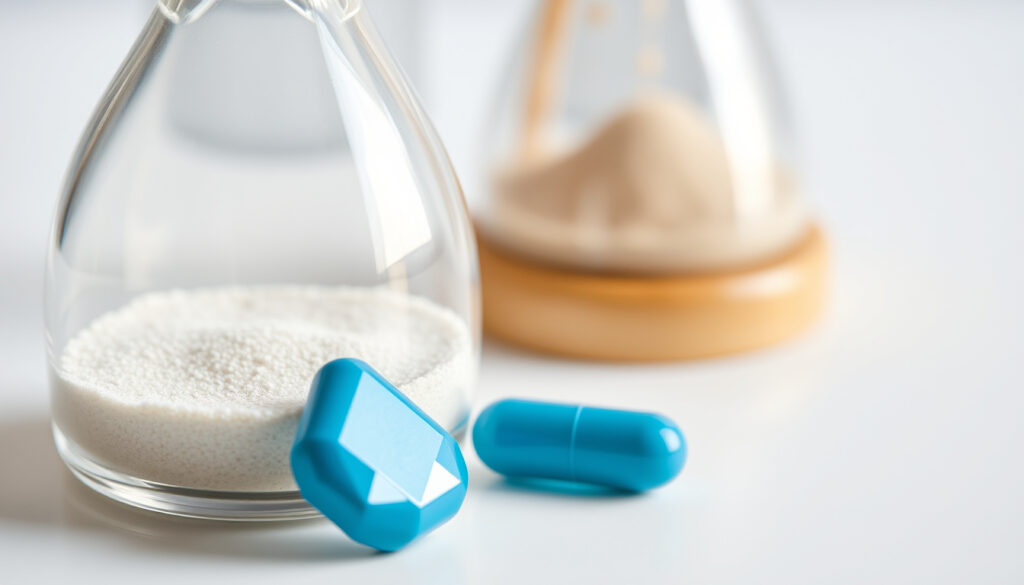
How Long Does Viagra Last? Duration & Key Facts
If you’ve ever looked at a little blue pill and wondered just how long it will keep working, you’re not alone. Viagra (sildenafil) is one of the most prescribed medications for erectile dysfunction, but its duration depends on dosage, what you ate, and your own metabolism.
Average Duration: 4-6 hours ·
Onset Time: 30-60 minutes ·
Half-life: 4 hours ·
Maximum Dose: 100 mg
Quick snapshot
- Viagra lasts 4-6 hours (Mayo Clinic (trusted medical institution))
- Effects may persist up to 12 hours in some individuals (UCSF Health (academic medical center))
- Takes 30-60 minutes (Mayo Clinic)
- High-fat meals delay absorption (Mayo Clinic)
- Available in 25mg, 50mg, 100mg (NCBI Bookshelf / StatPearls (clinical reference))
- 100mg is maximum (StatPearls) (NCBI Bookshelf / StatPearls (clinical reference))
- Do not combine with nitrates (DailyMed (FDA drug labeling database))
- Common side effects: headache, flushing (DailyMed) (DailyMed (FDA drug labeling database))
Here are the key facts at a glance:
| Average Duration | 4-6 hours |
|---|---|
| Half-life | 4 hours |
| Onset | 30-60 minutes |
| Peak Effect | 1 hour |
| Maximum Dose | 100mg |
How long does Viagra last?
Viagra’s effects are commonly described as lasting about 4 to 5 hours, according to the Mayo Clinic. Clinical guidance at UCSF Health says it works best between 30 minutes and 4 hours after taking the pill. For most men, the functional window is about 4-6 hours, though some may feel residual effects for up to 12 hours as the drug is gradually eliminated.
Within 8 to 12 hours, Viagra is almost completely cleared from the body, per UCSF Health. The half-life — the time it takes for half the drug to leave your system — is approximately 4 hours, as stated in the FDA prescribing information (via DailyMed).
A 100mg dose extends the window slightly, but not dramatically — and comes with a sharper side-effect profile. Most men get the best risk-benefit balance at 50mg.
The implication: Most men find 50mg gives the best balance of effectiveness and tolerability, not the highest dose.
How long does 100mg Viagra last?
The 100mg dose, the maximum recommended, still operates within the same 4-6 hour window. Doses greater than 100mg have not shown increased efficacy but have increased side effects, according to StatPearls. The main difference is the intensity and reliability of the erection, not a longer duration.
Users on forums like Reddit often claim 100mg lasts longer, but clinical data does not support a proportional duration increase beyond 4-6 hours. What does change is the risk of side effects such as headache, flushing, and dyspepsia.
How long does 50mg Viagra last?
The standard starting dose, 50mg, also provides a 4-6 hour window. The FDA labeling confirms that 50mg is the recommended starting dose, with adjustment to 25mg or 100mg based on response, per Drugs.com (drug information resource). The onset and elimination timeline are similar across all doses; only the intensity of response and side effects differ.
How long does Viagra take to work?
Viagra is typically taken about 1 hour before sexual activity. Most men feel the effect within 30 to 60 minutes, but the key variable is what you ate. Mayo Clinic warns that a high-fat meal can significantly slow absorption, delaying onset by up to an hour. Taking it on an empty stomach gives the fastest and most predictable result.
What factors affect onset time?
- Food: High-fat meals delay absorption. Stick to light or no food for best results.
- Alcohol: Heavy drinking can reduce effectiveness and delay onset — moderate use is advised.
- Age and metabolism: Older men or those with liver issues may process the drug more slowly, slightly extending onset time.
- Other medications: Certain alpha-blockers or antifungal drugs can alter absorption.
If you want the fastest possible onset, take Viagra on an empty stomach at least 1 hour before, and avoid heavy meals and excessive alcohol.
The pattern: The single most controllable factor is food – empty stomach consistently delivers the shortest onset.
Does Viagra last 24 hours?
No — this is one of the most common myths. Viagra’s effect window is 4-6 hours, not 24. The confusion comes from comparisons with Cialis (tadalafil), which is often called the “weekend pill” because it can last up to 36 hours per Mayo Clinic. Viagra is designed for occasional use within a narrow window, not continuous coverage.
Does Viagra last longer than Cialis?
Quite the opposite. Cialis lasts significantly longer. Here’s how they compare:
Two oral ED drugs, one clear pattern: Viagra works fast and fades fast; Cialis lasts all weekend but takes longer to kick in.
| Feature | Viagra (sildenafil) | Cialis (tadalafil) |
|---|---|---|
| Duration | 4-6 hours | Up to 36 hours |
| Onset | 30-60 minutes | 1-2 hours |
| Food sensitivity | High-fat meals slow it down | Can be taken with or without food |
| Dosing options | As needed (25-100mg) | As needed (5-20mg) or daily (2.5-5mg) |
| Common side effects | Headache, flushing, vision changes | Headache, dyspepsia, back pain |
The catch: Cialis’s long half-life means side effects like back pain can linger for 24-48 hours, per American Family Physician (family medicine journal). Viagra’s shorter window makes it easier to avoid prolonged side effects.
Is Viagra 100mg strong?
100mg is the maximum recommended single dose. It is considered the “strongest” available, but that strength comes with a higher risk of side effects. The FDA labeling for sildenafil lists common adverse reactions including headache, flushing, dyspepsia, abnormal vision, nasal congestion, and back pain, as detailed in DailyMed. Doses above 100mg are not recommended.
What is the maximum Viagra dose?
100mg is the ceiling. Here’s the dosing breakdown:
Three dose levels, one warning: start low and only go up if needed.
| Dose | Typical Use | Strength vs. Side Effects |
|---|---|---|
| 25 mg | For men sensitive to the drug or with liver/kidney issues | Lower efficacy, minimal side effects |
| 50 mg | Standard starting dose | Good balance of efficacy and tolerability |
| 100 mg | Maximum dose for those who tolerate 50 mg well | Highest efficacy but increased side effect risk |
StatPearls notes that doses greater than 100 mg have not demonstrated added benefit — only a higher side-effect burden.
A 100mg tablet may feel like more power, but for many men, 50mg provides all the effectiveness without the headache. More is not better.
The pattern: Start low, go slow – 50mg is the sweet spot for most men.
Can Viagra make you go multiple rounds?
Viagra helps you achieve an erection when sexually stimulated, but it does not shorten the refractory period — the time after ejaculation before you can get another erection. Some men may indeed have multiple erections within the 4-6 hour window, but it is not a guaranteed effect. The drug does not change the underlying neurological recovery time.
How does Viagra affect refractory period?
Studies have not shown a significant reduction in refractory time. However, because Viagra maintains higher blood flow to the penis for hours, some men report being able to regain an erection faster after stimulation. This is anecdotal and varies widely.
Upsides
- May allow multiple erections within the same window
- Does not require constant redosing
- Short half-life means side effects resolve quickly
Downsides
- Does not shorten refractory period
- Effect on libido is indirect — desire must be present
- Higher doses raise side-effect risk without guaranteeing multiple rounds
The pattern: Viagra is a reliable single-round aid for most men, with the possibility of a second round if your biology cooperates. Expect one solid performance rather than a marathon.
Confirmed facts vs. What’s unclear
Confirmed facts
- Viagra lasts 4-6 hours (Mayo Clinic)
- Viagra onset 30-60 minutes (Mayo Clinic)
- Viagra half-life 4 hours (DailyMed)
- 100 mg is the maximum dose (StatPearls)
What’s unclear
- Exact individual duration — varies with metabolism, age, and health
- Effect of alcohol on duration — moderate intake is safe but heavy drinking may reduce effect
- Long-term effects of regular use — most studies focus on short-term outcomes
Expert perspectives
“The half-life of sildenafil is approximately 4 hours.”
“Viagra works best when taken on an empty stomach, and a high-fat meal can slow absorption.”
Mayo Clinic (trusted medical institution)
“Cialis (tadalafil) is commonly described as lasting up to 36 hours.”
Mayo Clinic
“Doses greater than 100 mg of sildenafil have not shown increased efficacy but have increased side effects.”
NCBI Bookshelf / StatPearls (clinical reference)
The consequence for anyone choosing between Viagra and Cialis is clear: if you want a predictable, short-duration option that lets you plan ahead, Viagra works — but do not expect it to last 24 hours. For men who prefer spontaneity or prolonged coverage, Cialis is the smarter pick. Start at 50mg, take it on an empty stomach, and never exceed 100mg. For the average patient, the choice between 4 hours and 36 hours defines the entire ED medication strategy.
accessdata.fda.gov, goodrx.com, accessdata.fda.gov, accessdata.fda.gov, onlinedoctor.superdrug.com, gaurology.com
For a more detailed duration guide, detailed duration guide breaks down how dosage and food intake can shift the timeline.
Frequently asked questions
How to tell if a man is taking Viagra?
There is no simple diagnostic test. Some physical signs may include a flushing of the face, slight nasal congestion, or, rarely, visual changes. However, these symptoms are not specific and can occur for other reasons.
What is 10 times better than Viagra?
No medication is universally “10 times better.” Some men respond better to Cialis due to its longer duration; others prefer Levitra for its faster onset. Individual response varies widely. Always consult a doctor.
Is it hard to come when taking Viagra?
Viagra improves erectile function but does not directly affect ejaculation. Some men report a slight delay in ejaculation, while others notice no difference. If you experience difficulty reaching orgasm, speak with your physician.
What pill is safer than Viagra?
“Safer” depends on your medical history. For men with heart conditions or those taking nitrates, any PDE5 inhibitor carries risks. Daily low-dose Cialis may have a different safety profile. All ED medications require a prescription and medical evaluation.
Why can’t my husband get hard even with Viagra?
Viagra is not always effective. Common reasons include: incorrect dose, recent heavy meal, alcohol intake, psychological factors, or underlying medical issues such as untreated diabetes or low testosterone. A urologist can diagnose the root cause.
More related posts
 How Old Is the Sun? Age, Composition, and Future of Our Star
 Mitre 10 Wellington Central: Address, Hours, Parking & Products
 ANZ Term Deposit Rates: 12-Month Rate, Big Four Comparison
 Catch of the Day NZ: Vape Wholesale Guide & AU Closure Facts
 Best Broadband Deals NZ: Unlimited Data & Cheap Fibre 2026
 All Blacks Team to Play France – What We Know So Far
 Haircut for Thin Hair to Look Thicker – Best Styles for Men and Women
 Best 55-Inch TV in NZ: Buyers Guide & Prices 2025
