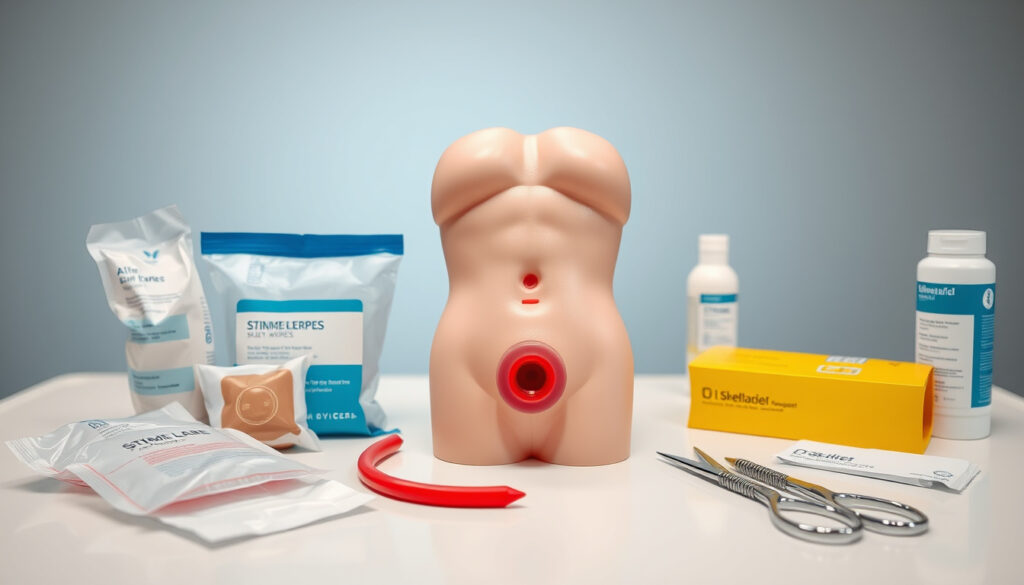
What Is a Stoma? Definition, Types, and Living With One
If you or someone close to you has been told a stoma is needed, the first reaction is often confusion: what exactly is it, and how will it change everyday life? A stoma is a surgically created opening on the abdomen that reroutes waste when the usual pathway is damaged or blocked.
People living with a stoma in the US: over 725,000 ·
Annual ostomy surgeries in the US: about 100,000 ·
Common reasons: bowel cancer, Crohn’s disease, ulcerative colitis, bladder cancer ·
Colostomies as share of all stomas: roughly 50% ·
Stoma lifespan with proper care: decades or a lifetime
Quick snapshot
- A stoma is a surgically created opening in the abdominal wall to divert waste (Mayo Clinic (leading US hospital))
- Types include colostomy, ileostomy, and urostomy (American College of Surgeons (US surgical authority))
- Modern stoma bags are odor-proof when properly sealed (StatPearls (clinical database))
- Exact lifespan variation per individual condition is not fully predictable (Mayo Clinic)
- Chance of reversal for temporary stomas depends on healing and underlying disease (American College of Surgeons)
- Long-term dietary needs may vary per individual (clinical observation)
- Pre-surgery: diagnostic imaging and planning, often weeks ahead (MyHealth Alberta (Canadian health authority))
- Surgery day: stoma created, bag attached (MyHealth Alberta (Canadian health authority))
- First 2–6 weeks: healing, learning care with a stoma nurse (MyHealth Alberta (Canadian health authority))
- Resume normal activities with proper bag fit and maintenance (Canadian Cancer Society (national cancer charity))
- Regular bag changes 3–6 times daily, diet adjustments (Canadian Cancer Society (national cancer charity))
Five key facts, one pattern: stoma creation is a controlled surgical solution, not a complication. Here’s a quick reference.
| Label | Value |
|---|---|
| Medical name | Ostomy |
| Purpose | Divert waste when natural pathway is blocked or damaged |
| Common surgeries | Colostomy, ileostomy, urostomy |
| Lifespan | Decades with proper care |
| Odor | Sealable bags prevent odor |
| Bag change frequency | Every 2–4 days |
| Emptying frequency | 3–6 times daily |
What is a stoma?
Simply put, a stoma is a surgically created opening in the abdominal wall that allows body waste to exit through the abdomen instead of the usual route. The term “stoma” comes from Greek, meaning “mouth” or “opening.” As Mayo Clinic (leading US hospital) explains, it’s the protruding end of the intestine brought through the abdominal wall. The American College of Surgeons (US surgical authority) calls it the opening through which stool or urine leaves the body into a collection bag.
Medical definition of a stoma
- A stoma is the visible part of an ostomy — the surgical rerouting of the bowel or bladder.
- It has no nerve endings, so it is not painful to touch.
- It is pink or red, moist, and resembles the lining of the mouth (MyHealth Alberta (Canadian health portal)).
Common types of stoma
The three main types form the basis for most ostomy surgeries, each diverting waste from a different part of the digestive or urinary tract.
- Colostomy — connects the colon (large intestine) to the abdominal wall. Stool is formed or semi-formed (Canadian Cancer Society).
- Ileostomy — connects the ileum (small intestine) to the abdominal wall. Stool is liquid because the colon is bypassed (StatPearls (clinical reference)).
- Urostomy — diverts urine when the bladder is removed or damaged.
The type of stoma directly determines the consistency of output and the type of bag needed. A patient with an ileostomy will empty liquid stool more frequently than someone with a colostomy.
The implication: knowing which type you have is the first step in picking the right pouching system and diet.
Why do people get a stoma?
The reasons span serious chronic diseases and acute surgical emergencies. According to Mayo Clinic, common conditions include Crohn’s disease, ulcerative colitis, familial adenomatous polyposis, colon or rectal cancer, and bowel injury. Cancer Care (Canadian Cancer Society) notes that colostomies are often used in colorectal cancer surgery when part of the intestine is removed.
Medical conditions requiring a stoma
- Bowel cancer (colorectal cancer) — the most common indication for a colostomy (Canadian Cancer Society).
- Inflammatory bowel diseases — Crohn’s and ulcerative colitis (Mayo Clinic).
- Bladder cancer — leads to urostomy when the bladder is removed.
- Trauma or injury to the bowel or bladder.
- Birth defects such as bladder exstrophy.
Emergency vs planned stoma surgery
Some stomas are created in a planned surgery after a cancer diagnosis or as part of a treatment plan. Others are created in an emergency when the bowel perforates or becomes obstructed. The American Society of Colon and Rectal Surgeons notes that emergency stomas are more often temporary, though reversal depends on healing and the underlying condition.
What this means: the reason for a stoma strongly affects whether it will be temporary or permanent. A planned stoma for cancer may become permanent if the rectum or anus is removed.
A stoma is often life-saving when inflammation, cancer, or injury blocks the natural pathway. Without it, waste buildup can cause sepsis or organ damage.
What does a stoma look like on a person?
Many people worry about appearance before surgery. A stoma is usually bright pink or red, moist, and somewhere between the size of a dime and a quarter. healthdirect Australia (government health service) describes it as “like the inside of your mouth.” It may protrude slightly from the skin or be flush with it.
Appearance and color
- Healthy stoma color: pink or red (like mucous membrane).
- It has no nerve endings, so it’s not painful to touch.
- Bleeding a little when cleaning is normal — the tissue is delicate.
Common stoma locations on the abdomen
- Ileostomy: usually on the right lower abdomen (American Cancer Society (US cancer authority)).
- Colostomy: typically on the left lower abdomen (UC Davis Health (academic medical center)).
- Urostomy: often on the lower right side.
The trade-off: the stoma’s location is chosen to maximize secure bag adhesion and avoid skin folds. A stoma nurse will mark the best spot before surgery.
Do you still go to the toilet with a stoma?
This is one of the most common questions, and the answer is straightforward: waste passes into a collection bag attached to the stoma, not through the anus. MyHealth Alberta (Canadian health authority) confirms that people with an ostomy no longer pass waste through the rectum.
How waste is collected
- The pouching system (often called a “bag”) sticks to the skin around the stoma.
- Stool or urine collects inside the bag.
- The bag is emptied into the toilet 3–6 times a day and changed every 2–4 days (varies by type and output).
Toilet routine for stoma users
The routine is simple: empty the bag into the toilet, rinse it, and re‑seal it. Crohn’s & Colitis UK (patient charity) notes that most people get comfortable with the process within a few weeks.
The pattern: the toilet routine shifts from voluntary control to scheduled bag maintenance. Diet and hydration affect output volume and frequency.
How long can a person live with a stoma?
Having a stoma does not shorten life expectancy. Mayo Clinic states that people can live for decades with proper care. The stoma itself is a stable surgical outcome, not a progressive condition.
Lifespan with a stoma
- Decades or a lifetime — many people have lived 40+ years with a stoma.
- Complications such as hernias or skin irritation are manageable with professional help.
Factors affecting quality of life
Cancer Research UK (UK cancer research charity) emphasizes that patients can lead full, active lives — working, traveling, exercising, and having intimate relationships.
The pattern: With proper care, a stoma does not reduce life expectancy.
Does a stoma bag smell?
Odor is a top fear, but modern pouches are designed to be odor-proof. Colostomy UK (patient support charity) states that properly sealed bags contain all odor. Healthdirect Australia adds that diet and hygiene can further minimize any smell.
Odor management
- Bags have charcoal filters that vent gas without smell.
- Seal integrity is key — a leak causes odor.
- Foods like asparagus, onions, and beans may increase gas but not necessarily odor.
Modern bag features
- Odor-proof film (multi‑layer plastic).
- Adhesive wafer that conforms to skin.
- Closure options: drainable (for frequent emptying) or closed (throw‑away after single use).
The catch: if you smell something, it usually means the bag isn’t sealed properly or needs changing. A quick check solves it.
Is a stoma permanent?
Not all stomas are permanent. Mayo Clinic confirms that some are temporary — created to allow the intestine to heal — and can be reversed later. Others are permanent, especially when the rectum or anus is removed permanently.
Temporary vs permanent stomas
- Temporary stomas: commonly used after bowel surgery for diverticulitis or to protect a new surgical connection.
- Reversal surgery is typically done 3–6 months later, depending on healing (Macmillan Cancer Support (UK cancer charity)).
- Permanent stomas: when the anus or rectum is removed, or when the remaining bowel is too short to reconnect.
Reversal surgery
Reversal involves reconnecting the bowel and closing the stoma. It’s a separate operation. American College of Surgeons notes that reversal is only possible if enough healthy bowel remains.
What this means: if you’re having a temporary stoma, talk to your surgeon about the planned reversal timeline and the likelihood based on your specific condition.
Comparison: Colostomy vs Ileostomy vs Urostomy
Three main types, one key difference: which part of the digestive or urinary tract is bypassed. Here’s how they compare.
Three stoma types, one contrast: the further along the bowel the output starts, the more liquid the waste.
| Feature | Colostomy | Ileostomy | Urostomy |
|---|---|---|---|
| Origin | Colon (large intestine) | Ileum (small intestine) | Urinary tract (often ileal conduit) |
| Output consistency | Formed or semi-formed | Liquid to pasty | Liquid urine |
| Location on abdomen | Left side (typically) | Right side (typically) | Right lower quadrant |
| Bag type | Closed or drainable | Drainable (frequent emptying) | Drainable with anti-reflux valve |
| Common reason | Colorectal cancer, diverticulitis | Crohn’s, ulcerative colitis | Bladder cancer, injury |
The trade-off: colostomy output is easier to manage for many, but ileostomies allow the colon to rest. Urostomies require a different bag but no stool management.
Steps for stoma care (daily routine)
Proper care keeps the skin healthy and the bag secure. MyHealth Alberta and StatPearls outline the core routine.
- Gather supplies: pouch, flange, adhesive remover, skin barrier wipe, water, scissors.
- Remove the old pouch gently using adhesive remover — never pull or tug.
- Clean the skin around the stoma with warm water (no soap residue). Dab dry — don’t scrub.
- Apply skin barrier powder if the skin is irritated (as recommended by your stoma nurse).
- Measure the stoma and cut the flange to fit snugly (no gap larger than 1/8 inch).
- Attach the flange to the skin, press for 30 seconds for adhesion, then snap on the pouch.
- Empty the pouch when it’s one-third to half full: sit on the toilet, open the drain, empty into the bowl, wipe the end, re-seal.
The implication: after a few weeks, the whole process takes under 10 minutes. A stoma nurse provides initial training.
“With modern pouching systems, most patients return to full activity — swimming, travel, even contact sports — as long as the bag is secure.”
“The stoma itself has no feeling, so cleaning it is not painful. The skin around it is the part that needs careful protection.”
Crohn’s & Colitis UK (patient charity)
For someone facing ostomy surgery, the decision is clear: the stoma is a trade‑off — a permanent change in bowel function for the chance to live without pain, obstruction, or cancer. With the right support and modern pouching systems, the quality of life after an ostomy is high.
healthline.com, blog.wcei.net, cancer.ca, member.wocn.org, crspecialists.com
For a detailed look at different stoma types and how to manage them, you can read this stoma types and care guide which covers everything from ileostomy to colostomy.
Frequently asked questions
Can you get a stoma for colon cancer?
Yes, colorectal cancer is one of the most common reasons for a colostomy. The surgeon may create a stoma after removing the cancerous part of the colon or rectum (Canadian Cancer Society).
How is a stoma created in surgery?
The surgeon makes a small incision in the abdominal wall, brings a loop of intestine through it, opens it, and stitches the edges to the skin. The procedure takes 1–2 hours under general anesthesia (American College of Surgeons).
Can you swim or shower with a stoma bag?
Absolutely. The bag is waterproof. You can shower without covering it, and many people swim with a stoma bag — just empty it beforehand and use a waterproof tape around the edges if needed.
Do stoma bags need to be changed daily?
Not necessarily. Most people change the entire pouching system every 2–4 days. The bag itself may be emptied 3–6 times a day without removing it (StatPearls).
What foods should I avoid after getting a stoma?
There’s no one‑size‑fits‑all list, but common culprits include foods that cause gas (beans, onions, carbonated drinks) or blockage (nuts, seeds, popcorn). Introduce new foods one at a time. Dietitians recommend chewing thoroughly.
Is a stoma reversible?
Temporary stomas can be reversed with another surgery, typically 3–6 months after the first one. A permanent stoma cannot be reversed because the anus or rectum has been removed (Macmillan Cancer Support).
Can you still have a sex life with a stoma?
Yes. Many people maintain active sex lives. Emptying the bag beforehand, choosing a discreet pouch cover, and communicating with your partner help. Stoma surgery may affect nerve function, but professional support can address specific concerns.
What is the difference between a colostomy and an ileostomy?
A colostomy uses the large intestine, producing semi‑solid stool; an ileostomy uses the small intestine, producing liquid stool. Ileostomies require more frequent emptying. Urostomies divert urine.
More related posts
 Trade Me Jobs Rotorua: Find Part-Time, Urgent & Full-Time Work
 Number One Shoes Albany: Hours, Location & Deals (2025)
 I Know What You Did Last Summer: Complete Franchise Guide
 Happy Mother’s Day Quotes: Warm, Funny & Short (2026)
 Shipping Containers for Sale in Ireland: Prices
 VTNZ Pre-Purchase Inspection: Cost, Coverage & Booking
 Daylight Saving Time 2025: Start Dates for US and Ireland
 Pulled Pork Slow Cooker NZ: Best Cut, Time & Liquid Tips
